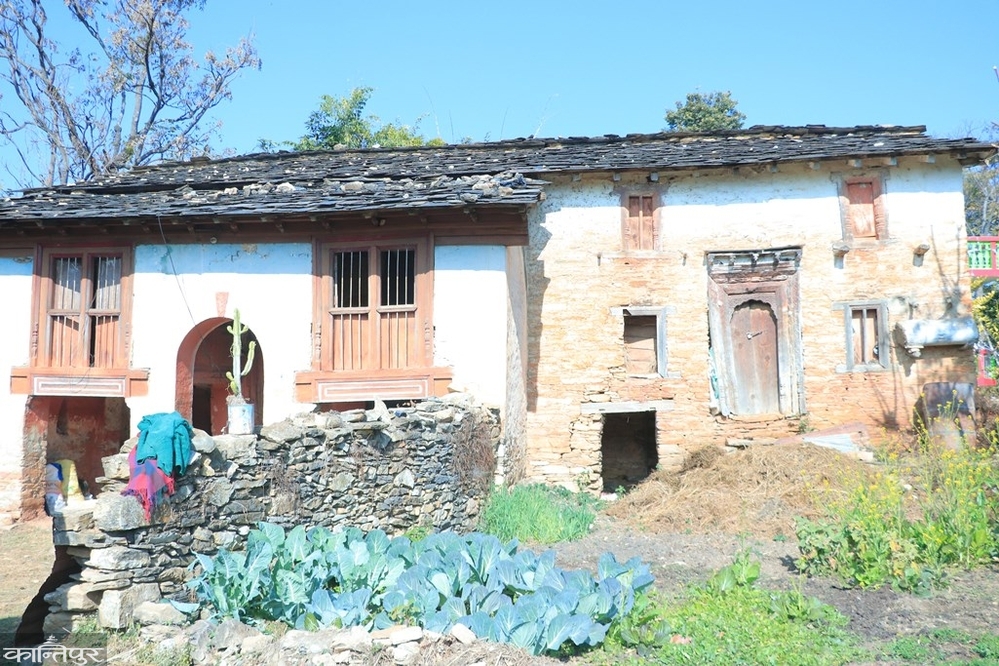
The presence of youth in the villages of Baitadi has been decreasing due to the terror of monkeys and wild boars, the search for quality education and health facilities, and the lack of employment, which has led to the settlement becoming deserted.
We use Google Cloud Translation Services. Google requires we provide the following disclaimer relating to use of this service:
This service may contain translations powered by Google. Google disclaims all warranties related to the translations, expressed or implied, including any warranties of accuracy, reliability, and any implied warranties of merchantability, fitness for a particular purpose, and noninfringement.
Baitadi is a hilly district of Sudurpaschim Province, covering an area of 1,519 square kilometers. It shares its border with India. There are 10 local levels, including 4 municipalities and 6 rural municipalities. Dasharathchand Municipality and Shivnath and Pancheshwar rural municipalities share the border with India.
Residents of local levels connected to India travel across the border to India for daily necessities and medical treatment. This district is also known as Devbhumi as there are many temples dedicated to gods and goddesses. It is also the birthplace of martyr Dasharathchand. The first female minister, Dwarikadevi Thakurani, represented the political scene from this district in 2015. Lokendra Bahadur Chand, who has been a politician from this district, has been the Prime Minister four times during the Panchayat and multi-party periods.
The Pancheshwar Multi-Purpose Project, which could not be constructed, is also located in this district. The border between India and Baitadi is separated by the Mahakali River. The main occupation of the residents here is agriculture and labor. After federalization, roads have reached all 10 local level centers of Baitadi, but transportation facilities are not available in all wards. Although electricity has not been expanded to all wards, electricity service has also reached all local level centers.
The number of people migrating in the district is high. There seem to be two main reasons for migration, one is the lack of quality education and health and the threat of wild animals in agriculture. The population of the district has decreased by 8,741 in 2078 compared to the national census 2068. The current population of the district is 242,157 people. Baitadi's population density is 165 people per square kilometer.
According to the data of the National Identity Card and Registration Department, the number of people migrating to Baitadi has increased by 9 times compared to the number of people migrating to the country. According to the data of the National Identity Card and Registration Department from 2080 Baisakh to 2082 Kartik, the number of people migrating to the country is 401. The number of people migrating to the country is 3,642.
Among the 10 local levels, the highest number of people migrating to the country is from Dogadakedar, 544, and from Dasharathchand Municipality, 721. Dasharathchand is the municipality where Sadrumkam is located in the district. Pancheshwor Rural Municipality Registration Branch Chief Priya Chand said that this number could be even higher as most people migrate without carrying documents. ‘Only a few people register in the places where they have settled,’ he said, ‘Although the rate of settlement is rapid, it is seen as low because most of them do not have documents.’
Most of the houses in the villages have become empty due to migration. A few years ago, there were no rooms available for rent in the district headquarters and neighboring villages. Now, houses that cannot be found are becoming barren. There are no young people in the villages. Only the elderly are found. There is a race to migrate to the Terai. After monkeys started destroying the crops and fruits planted, the locals have stopped farming. After stopping planting crops in the fields, many families have left the villages and migrated because the monkeys started eating the food stored inside.
After the locals stopped farming, the monkeys broke the windows and doors to get food kept inside the houses, said Ghanshyam Bhatta, a local of Dasharathchand Municipality-5. ‘They break the closed doors after not getting any food in the fields,’ he said, ‘More than 60 families in our village have migrated to the Terai due to the fear of monkeys.’
In Dasharathchand Municipality, the monkeys are more dangerous than the wild boars. There is a wild boar threat in other local levels of the district. Jantara Bhatta of Melauli-5 said that she has to stay awake all night to protect her crops from the wild boars when they are ripe. She said that she has stopped farming now because the wild boars have started destroying the crops she has worked hard to grow throughout the year. She said that since she stopped farming, she has to rely on the rations brought from the Terai for food, and more than half of the families in the village have migrated to the Terai.
A few years ago, 66 families lived in Matela village of Pancheshwor-2 in the district. There was a lot of activity in the village. During the work season and festivals, everyone who had gone to work in the village and went out for other work would return to the village, so there was a lot of fun. Recalling those days, local 76-year-old Karbir Chand says, ‘Now there is no one in the village, the village is deserted. The houses are empty, we are the only old people in the village.’ The migrants come only once a year for worship. He said that no one comes during the fairs and work season.
In Matela village, which is home to 66 families, only 32 families have migrated in the last three or four years. The paddy fields have become barren. In this village, most of the children have migrated to the Terai (Kailali, Kanchanpur) to study in private schools. Chand said that the rest of the families in the village also live in the Terai by renting rooms to educate their daughters-in-law and grandchildren.
Setu Chand, a 63-year-old local single woman, said that she is now the only one in a family with two sons, two daughters-in-law and grandchildren. ‘Both sons work in India, my daughter-in-law went to Mahendranagar (Kanchanpur) to educate her grandchildren,’ she said, ‘I am alone at home and cannot do farming. I have been living like this.’
Since there are no people in the village, the farms have become barren as there is no one to look after the farms. The Bharkoti Basic School in the village, which provides education up to grade five, has been reduced to grade three. The school's principal, Jhupur Singh Mangola, said that the school is on the verge of closing down because there are no students studying up to grade 3. 'Since last year, there have been no admissions in the child development class,' he said. 'When there are no admissions in child development, where will students come from in the upper grades?' He said that all private schools go to the Terai to teach.
This is not only the situation of Bherkoti Basic School, but also the situation of the entire district's community schools is similar. The number of students in grades 11/12 and campuses is also low. There are 538 community and 24 institutional schools and 13 campuses in the district. After students did not come to the campus, all the teachers of the campuses went to the villages to look for students in the new academic session, said Surendra Bam, head of the Jagnath Multiple Campus in the district headquarters. Despite all this, he said that no students were found.
Parents' attraction towards private schools and trust in community schools have decreased, and due to high migration, the number of students in Baitadi's community schools and campuses has decreased, said Narendra Awasthi, head of the Education Coordination Unit, Baitadi. He said that to prevent students from leaving, the quality of community schools in the district should be improved and plans should be introduced to reduce migration.
Even though a well-equipped hospital building has been constructed in the district, doctors are not available as per the quota, but they are going to neighboring districts Dadeldhura, Dhangadhi in the Terai and India for health treatment. Harish Pant, Information Officer of District Hospital Baitadi, informed that although there are 13 permanent doctors in District Hospital Baitadi, there are only 5 doctors.
He said that due to the arrival and departure of doctors on scholarship contracts, patients do not always get all types of services regularly, which has reduced the trust of service recipients in the district hospital. ‘If there is no doctor, patients have to be referred,’ he said, ‘rather than going there and referring them, they don’t come here because it will cost less.’
Most of the youth in the district are going to India and other Gulf countries for employment. As soon as winter begins, most of the men here go to India in search of work. Although the main occupation here is agriculture, the attraction towards this profession has been decreasing recently as farmers are not getting a fair price for the vegetables and grains they produce. Ram Singh Mangola, a local farmer from Pancheshwor, said that they sold the soybeans and millet they produced to traders across the border in India because they did not get the market price.
Similarly, Hemraj Pant, a local farmer from Patan-8, said that they sold the vegetables they produced to traders in Dhangadhi in the Terai because they did not find a market price and a buyer in Baitadi. Although vegetables are produced in the district, farmers have not been able to store them due to the lack of cold stores. As a result, they are forced to sell them at a lower price during the season. This is causing a decrease in the attractiveness of agriculture, unemployment and financial shortages.
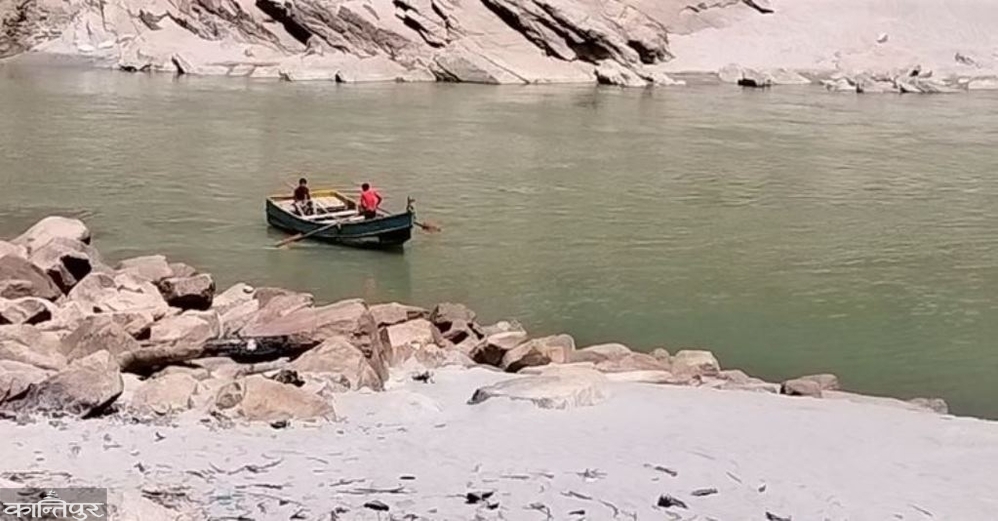
Dasharathchand Municipality, Shivnath and Pancheshwar Rural Municipality in the district share a border with India. The residents here go to Indian markets for everything from medical treatment to shopping for daily necessities. There is a dilapidated suspension bridge built by the British over the Mahakali River in Julaghat of Dasharathchand Municipality, while the residents of Shivnath and Pancheshwar take a risky journey and cross the Mahakali River by boat.
Although the main roads in the district have been constructed, they have not been upgraded and blacktopped. The work on the Satbanjh-Shribhavar Hat Darchula Road Project under the State Pride Plan has been underway since 2075.76. Dhirendra Bhatta, head of the Infrastructure Office, Baitadi, informed that the work has not been completed yet as the budget is coming in little by little. Other news related to
Chitwan's election issues: parks, river erosion and infrastructure
Palpa's agriculture and tourism sector overshadowed by lack of infrastructure
Obstacles to Achham's development: incomplete infrastructure, unemployment and migration
Development in Kavre, connected to the capital, is limited to the city
Bajura residents await a change in the identity of the 'poor'
Sunsari's two faces: developed cities, backward villages
Population declining in Ramechhap, development infrastructure incomplete
Bajhang: A district trapped by problems in a mine of potential
Lack of employment and infrastructure Gorkha villages are emptying
Dhankuta is becoming a bridge connecting Madhesh and Himalayas
The same scourge is always in Mahottari of Madhesh - floods and drought
Migration will decrease, potential for herbs and tourism in Dolpa
Dry port and Mahakali corridor show promise in Kanchanpur
Monkeys hinder farming in Baglung preparing to export meat to China
Province capital Surkhet is facing a lack of infrastructure
Monkey terror and lack of infrastructure are emptying villages in Syangja
Development infrastructure is increasing, youth are struggling to survive in Makawanpur
Development is insufficient in Dang, the capital of Lumbini
Roads, employment, drinking water and electricity problems are the same in Jajarkot, reconstruction agenda added after the earthquake
Hopes that infrastructure expansion will reduce migration in Dadeldhura
The face of Lamjung is changing with hydropower and tourism
Kapilvastu, which has abundant tourism infrastructure, is always desertedTanahun: A confluence of natural, historical and rural tourism
Kailali at the crossroads of opportunities and challenges

