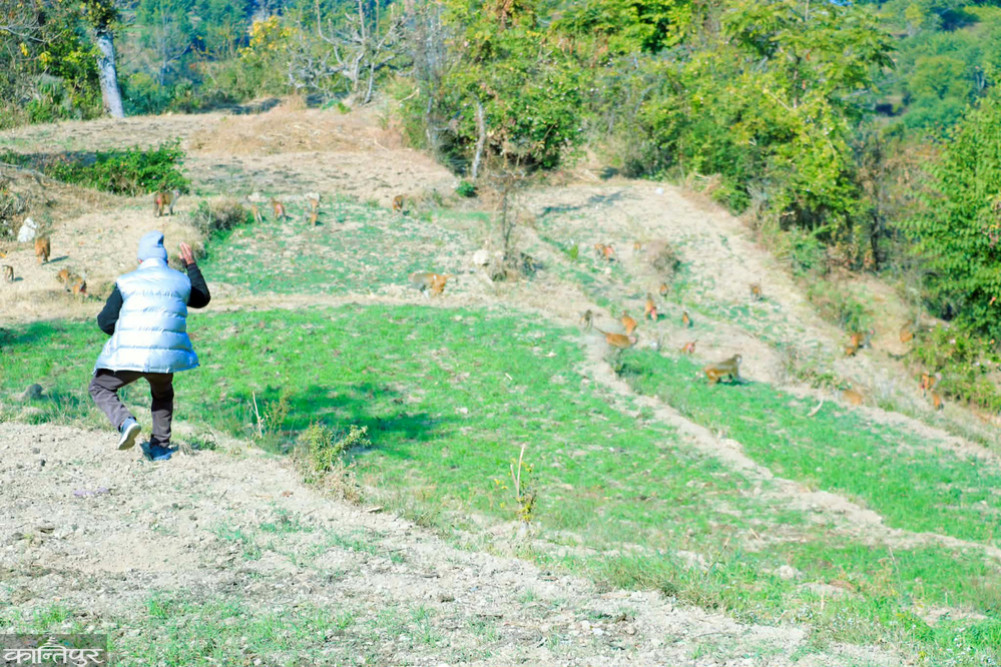
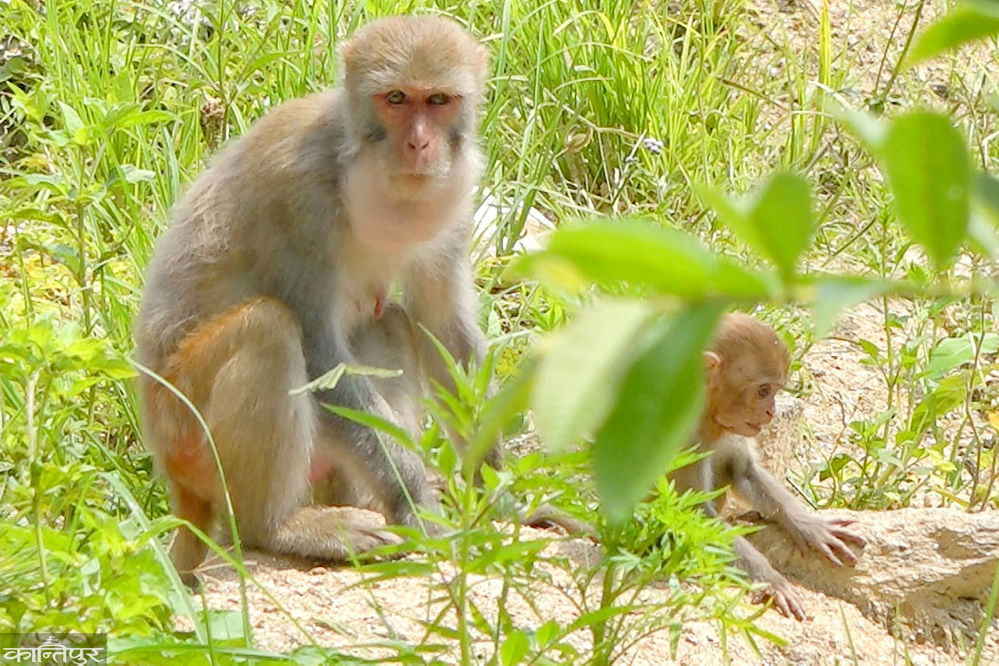
Nepal's hill settlements are under a double threat of monkey terror - on the one hand, the fear of crops being destroyed, and on the other, the fear of them entering homes and attacking! People are being forced to flee their homes.
We use Google Cloud Translation Services. Google requires we provide the following disclaimer relating to use of this service:
This service may contain translations powered by Google. Google disclaims all warranties related to the translations, expressed or implied, including any warranties of accuracy, reliability, and any implied warranties of merchantability, fitness for a particular purpose, and noninfringement.
In the last House of Representatives election, the biggest 'election agenda' of the candidates from the Mid-Hill District was monkey control. The first demand of the voters, who have been suffering from monkeys for years, was their control. In line with their promise to the voters, the MPs from those districts have now started raising the issue of monkey control in the House. However, there are differences of opinion on the control method - some MPs are in favor of stopping the terror even by killing the monkeys, while others are expressing strong objections to the 'killing' issue, saying it is inhumane.
The reason why the monkey terror has spread in the Mid-Hill District is that it has not only destroyed crops, but has also devastated settlements that have been inhabited for generations. Unable to bear the harassment of the monkeys, more than two dozen villages have been completely deserted. From Taplejung in the eastern hills to Baitadi in the far west, there is a fear of monkeys, which is driving people away from their homes.
000
The house of Leela Ram Puri of Kartike, Phungling-3, Taplejung is now deserted. Four of his five sons migrated to Jhapa and Morang in the Terai, and one son went to Canem in the village. Leela Ram's brother Tula Ram is in a similar situation. Six of Tula Ram's seven children have also left their birthplace. After the monkeys could not settle in the village, 10 families of two brothers left their homes for generations.
According to Netra Prasad Bhattarai, a neighbor of Leela Ram and Tula Ram, the main reason for this exodus is the constant terror of red monkeys and skunks. ‘When there were many people in the family, they would gather in the rain and go chasing monkeys,’ says Bhattarai. ‘As the families with many members left, another dozen families gradually left, and the settlement became empty.’
And, after the settlement became empty, farming has stopped in Kartike. Now, there are monkeys, deer, deer and deer in the settlement. The houses are becoming ruins, the lush settlement is turning into a forest.
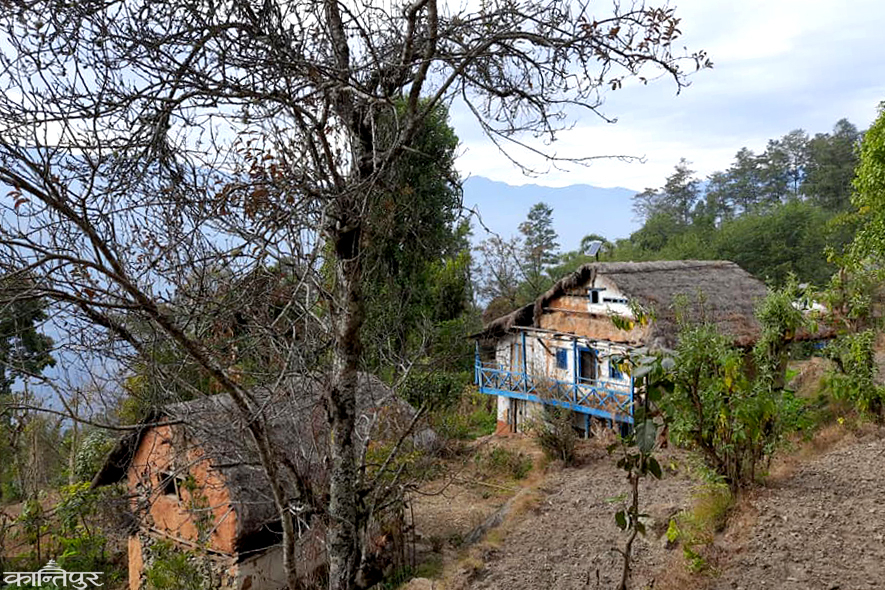
As the forest area starts to increase and food is no longer available in the forest, monkeys are entering the crops and settlements. Residents of Phungling Municipality and Pathibhara Yangwarak Rural Municipality from Tamor River to Upper Saptel, Bhedabari, Guhenli, Aagedim, Bhate, Lyangwa, Khodambu, Bejambu to Nafelyang are troubled by the ‘snarls’ of monkeys. Regarding the suffering caused by the monkeys, Chetraj Ghimire, a local from Agedim, says, ‘This is the reason why many people have migrated. We have tried to stay here and do something. But now there is no option but to move. No matter what crops we plant, we are not happy.’
Ward No. 4 of Chaubise Rural Municipality is at the forefront of the villages that have migrated from Dhankuta. 276 people have migrated from 90 houses in this ward. In the large village, which had 35 houses until a few years ago, only one house remains – Tanka Dewan’s. Earlier, locals used to leave the village in search of infrastructure like education, health, roads, and electricity. However, even though development has gradually reached the village, now people are migrating because they cannot stop the spread of the monkeys. ‘The main problem now is monkeys,’ says Lokendra Magar, ward chairman of ward number 4, ‘the population of the plains has increased due to monkeys.’
Ward chairman Lokendra Magar says that places like Bajthala, Bansapani, Thulagaun, Gairigaun, Khani Gaun, Katwal Gaun, Manedanda and others are becoming empty due to migration. Those who have migrated from here have piled up in Jhapa, Morang and Sunsari. The sparse settlements of Swara, Surungi, Bistagaun and Bhainsetar are also being emptied due to monkey terror. And, the locals are in a migration mindset.
Marse, Furkesalla and Titribote villages of ward number 6 of Dhankuta’s former Teliya VDC had a settlement of 70 families. Now, only 13 houses remain in those villages. In this sparsely populated area of Bhanjyang Danda, Ramite, Marse, Khamdanda, and Ratmate, surrounded by community forests, farmers are unable to farm due to the monkey menace. Many farmers in the area say that they are migrating because they cannot bear the monkey menace – Ward Chairman of Chhathar Jorpati-4 Tek Bahadur Ghising. ‘Most of the migrants say that they left their homes because they could not bear the monkey menace,’ says Ghising. ‘Now the monkey menace has increased and has spread to Khamdanda, Marse, Phandire, Karkle, Piple, and Pathibhara.’
Not only in the eastern hilly districts – in the central, midwestern, and remote hilly districts as monkeys have started destroying crops, villagers are leaving their birthplaces to embrace alternative arrangements and professions. People affected by monkeys in Sindhuli, Ramechhap, Dolakha, Syangja, Parbat, Baglung, Arghakhanchi, Gulmi, Dailekh and Baitadi are leaving their villages in droves. Due to this, the villages are now emptying.
Chakra Bahadur Mangarati of Tapli Rural Municipality-5 Bhadaure, a remote hilly area of Udayapur, had to leave the farmland he had worked hard to till all his life and the ancestral home where he was born. He became helpless after the monkeys started destroying the paddy, maize, millet, fruits and vegetables he had planted with hard work every year. After adopting various tricks and measures to drive away the monkeys, Chakra Bahadur has migrated to Kirtipur in Kathmandu with no other option.
Yesterday, Mangrati, the owner of his own farm, is now running his family by working as a daily wage laborer in the streets of Kirtipur. The monkey terror displaced him from his birthplace, and even turned a farmer into a laborer. ‘Farming was our life, but the monkeys did not allow us to bring in our produce,’ says Mangrati, ‘After months of suffering were wiped out by the monkeys in an instant, we had no option but to leave the village.’
The locals of Bhimeshwor-8, Dolakha, have been migrating since 2074 BS after the monkey terror could not be tolerated. After entering their homes and attacking family members, 15 families from Bahrakoch had to leave the settlement and migrate to a safer place.
Farmers have complained that monkeys are harassing them in Khyaha, Deurali, Kusumkhola, Thimur of Ribdikot Rural Municipality in Palpa, Chappani, Darlamdanda, Yamgha, Khanigaun of Baganaskali Rural Municipality, and Chidipani of Gadakot Mathagadhi of Rampur Municipality. Monkeys have also harassed villages such as Dharampani, Telgha, Baughapokhrathok, Boghagumma of Tansen Municipality in Palpa, Bhuwanpokhari, Siddeshwor, Somadi, Satyawati of Rainadevi Chhahara.
More than 300 families from Palchaudali, Aula, Kumali, Baskot, Richpala, Silali, Markandgaun, Kotila, Karpat, Simali Simatala, Nauhat, Damarkholi, Aitabhattagaun, and Sellauti settlements in Baitadi's Dasharathchand Municipality-5 have left their farmlands and homes and migrated to the Terai due to monkeys, says Ward Chairman Keshav Raj Lekhak.
180 families from Jajala, Saikhetgaun, Khaligada, Chauda, and Basali in Dogadakedar Rural Municipality-4 in the district have been displaced due to monkeys, says Surendra Bhatta, former chairman of Dogadakedar. They say, ‘After the locals stopped farming and did not get food, the monkeys started entering the houses and many families were displaced.’
000
Not only are the crops being destroyed, the seeds are being sown and the crops are being destroyed, but the entire settlement has been terrorized by the monkey attacks. Panchamaya Rai of Dharan shares her unpleasant experience of seeing a swarm of monkeys enter the house and when she tries to chase them away, they attack her instead. The public is terrified by the monkeys that enter the house and spoil the food, tear and break the furniture.
‘The public is terrified by the swarm of monkeys seen in the streets, markets, houses and schools,’ says Rai, ‘It is difficult to keep food dried on the roof safe. If you dry something on the roof, the monkeys will eat it. When you chase them away, they attack her instead. You yourself are also in danger, you have to live in fear. Panchamaya narrated the sad story of how monkeys would tear, wear and dirty even the clothes she had dried. She said, “They ate the food, now they don’t even leave any clothes to spoil.”
Local Manisha Dewan says that monkeys not only steal food but sometimes attack. According to her, about 6 months ago, she and her 8-year-old daughter were sitting on the balcony when a pack of monkeys suddenly attacked her. “When I tried to chase them away, they attacked my daughter,” says Manisha. “I had to get a rabies vaccine.”
Dharan residents formed a ‘Monkey Victims’ Struggle Committee’ in 2070 BS and drew the attention of all three levels of government. Shanta Rai of Dharan-12 says that the local, provincial and federal governments have not shown seriousness in this matter. ‘Despite drawing attention to it repeatedly, the monkey terror has not been resolved,’ says Shanta, ‘Everyone has thought it was a joke. We can’t sit still.’ Now, when we look at it on social media, it seems like fun, only those who experience it know the pain.’
Similarly, Jamuna Poudel of Devisthan, Falebas Municipality-6, Parbat, also complained that it is difficult to save her life due to the monkey terror. ‘I am an old person, and the monkeys enter the house when no one is home,’ said Jamuna. ‘They carry rice pots, and if you try to drive them away, they come and tear them to pieces.’
000
The number of people who are leaving their homes due to the monkey terror is increasing, while those who live in the village and do farming have to suffer equally. The monkeys destroy everything they plant in their fields, so farmers are now in a state of mind to leave their villages.
Chaitanya Ghimire of Bhedabari, Phungling-8, is also a monkey-afflicted farmer. He planted everything from corn and rice to fruits, vegetables and tree seedlings. However, he could neither save any of the crops nor find a reliable way to prevent them. After the monkeys destroyed all the crops, he planted a langur tree as an alternative. He could not save that either. Ghimire says, ‘The monkey climbs the plants and plays with the soil. It breaks the top of the tree. Once the top is broken, the tree will not grow tall. Once the top is broken, it will become crooked from there. No solution was found. Besides, the bamboo shoots were also broken and new shoots could not grow. In the next five to seven years, the bamboo will be completely extinct. We are sitting here thinking that we should do something. If the monkey terror is not stopped, we will have no choice but to leave.'
The daily life of Yogendra Prasad Ghimire of Marse Tol in Teliya, Chhatharjorpati Rural Municipality of Dhankuta is - from the time the sun sets in the morning until the evening, the monkeys become a colony that creates trouble in the fields. If there is no shepherd from morning to evening, the monkeys destroy the grains, vegetables and fruits planted in the fields in a moment. The Ghimire couple, who are both 63 years old, are the only ones at home. There are neither other family members nor neighbors who can drive away the monkeys that enter the fields. ‘Monkeys don’t leave anything behind,’ says Ghimire, ‘earlier, monkeys wouldn’t touch garlic, onions, and raw bananas, now they don’t.’ He is in a situation where he can’t save fruits and grains. But, there is no solution.
Even Meghraj Khatiwada, who was killed, has been left in a state of tears by the monkeys. He says, ‘There is no way to plant crops in the field. Due to the terror of the monkeys, he doesn’t even have time to eat rice or breathe.’ He complains that after the surrounding settlements were built, the monkeys have also been harassing the remaining settlements. He says, ‘You can’t eat anything after growing or cooking it, everything is for the monkeys.’
To what extent have the monkeys troubled the farmers? The experience of Uddhav Khatri of Gurans, Katari Municipality-2 is enough to understand that. He is very worried after monkeys destroyed mango trees on the tree last Falgun. He is sad that all his hard work is going to waste as the monkeys start attacking the tree from the moment the flowers start blooming. He says, ‘Monkeys start disturbing us from the moment the flowers bloom. They don’t leave anything until they ripen. They eat not only fruits, but also planted corn or other crops.’
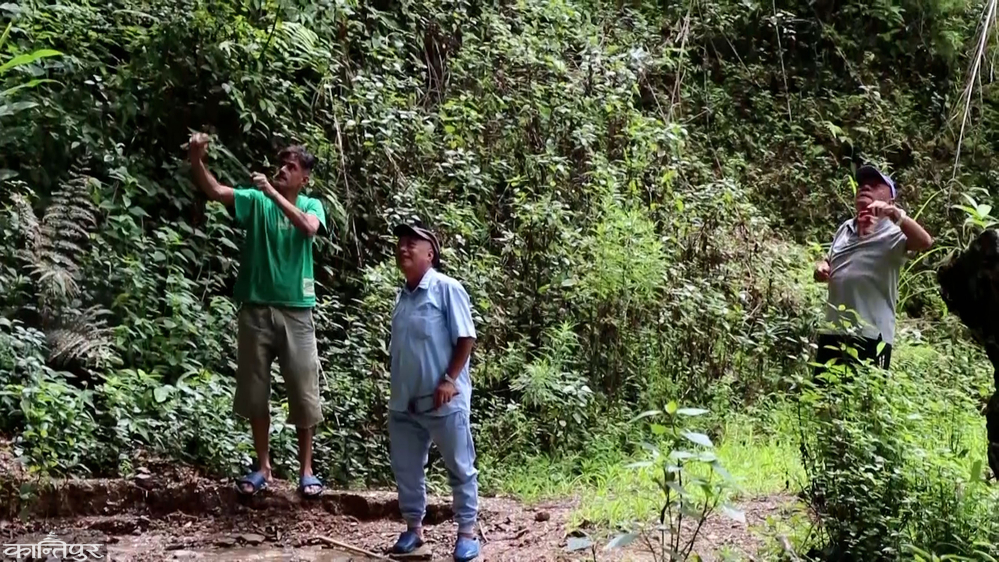
According to locals, as the forests are being destroyed and there is not enough food in the forest, monkeys have started entering the settlements. Katak Bahadur Magar, a monkey victim of Dhunge, Udayapurgadhi Rural Municipality-4, says, ‘We have to keep watch all day. Sometimes, the monkeys come and destroy everything.’
Locals say that monkeys have started destroying not only vegetables and fruits in the garden but also the things kept in the house’s garden. The daily life of the locals of Fasku, Shailung Rural Municipality-7, Dolakha is also spent waiting for monkeys at the edge of the fields.
‘Monkeys destroy the crops that have been planted with hard work throughout the year,’ says Goma Bik, ‘When and where do the monkeys enter the fields? You never know.’ Farmers who earn their livelihood every year have started leaving their fields barren due to the monkey terror. ‘Earlier, the monkeys used to cause trouble only during the day,’ she said, ‘Now they come even at night. Sometimes they spend the night at the edge of the fields to protect the grain.’ She says that people are becoming unsafe due to the monkeys.
According to Khim Bahadur Thapa of Resunga-12, Gulmi, the main problem of farmers is the monkey and wild boar terror. ‘Farming is not allowed,’ says Khim Bahadur, ‘migration is increasing due to monkeys and wild boars. Farming is the only way to earn income. Because of monkeys, farming has not been allowed, so how can we survive?’
Farmers in Palpa have also been suffering from monkeys for 10 years. They say that the monkeys that come in droves can destroy the year-round farming in an instant. Krishna Nepal of Ribdikot-3 complains that farmers have been suffering more because policies and programs for wildlife control were introduced in the past years, but no budget allocation has been made.
Farmers complain that now monkeys are ruling the village after people from the village moved to the city. The monkeys have not only uprooted the grains stored at home, but also the corn, wheat, mustard and vegetables planted in the fields. Krishna Prasad Bhusal, a farmer from Baganaskali Rural Municipality-9, Chappani, says that they are troubled by the problem of not allowing the ripe crops to be brought in, eating them and uprooting them.
The Division Forest Office, Palpa, has recommended planting amriso, timur, and tejpat to reduce human-wildlife conflict. According to Khil Bahadur Tamang, Information Officer of the Division Forest Office, farmers are being advised to go for alternative farming.
In Baitadi too, fertile land used for farming is barren due to the harassment of monkeys. Sunit Bhatta of Dasharathchand Municipality-5 says, ‘After the locals stopped farming, the monkeys used to break windows and doors to eat the food kept inside the houses.’ According to Ganesh Bogati of Dasharathchand-4, it has been more than seven years since the locals stopped farming, due to which the farmland has now become a bush. They say, ‘Many villagers left their fields for cultivation, some left them barren.’ And, those lands have now become forests.’
000
Various municipalities have allocated budgets and run various programs to end the increasing suffering of monkeys. Municipalities have allocated budgets ranging from Rs 5 to 1 million. Some have spent money on monitoring, some on purchasing guns (to scare away monkeys), and some on catching monkeys. However, locals say that although the municipality’s efforts to control monkeys have been effective for some time, they have not been long-term.
Laligurans Municipality in Tehrathum declared a public holiday on Jestha 1 to chase away monkeys. After shutting down essential services, employees and public representatives working in the municipality were running up and down the hill to chase away monkeys along with farmers. Arjun Babu Mabuhang, the mayor of Laligurans Municipality, says, “We are running a campaign by giving a public holiday to draw the state’s attention to the monkeys’ destruction of the village’s crops.”
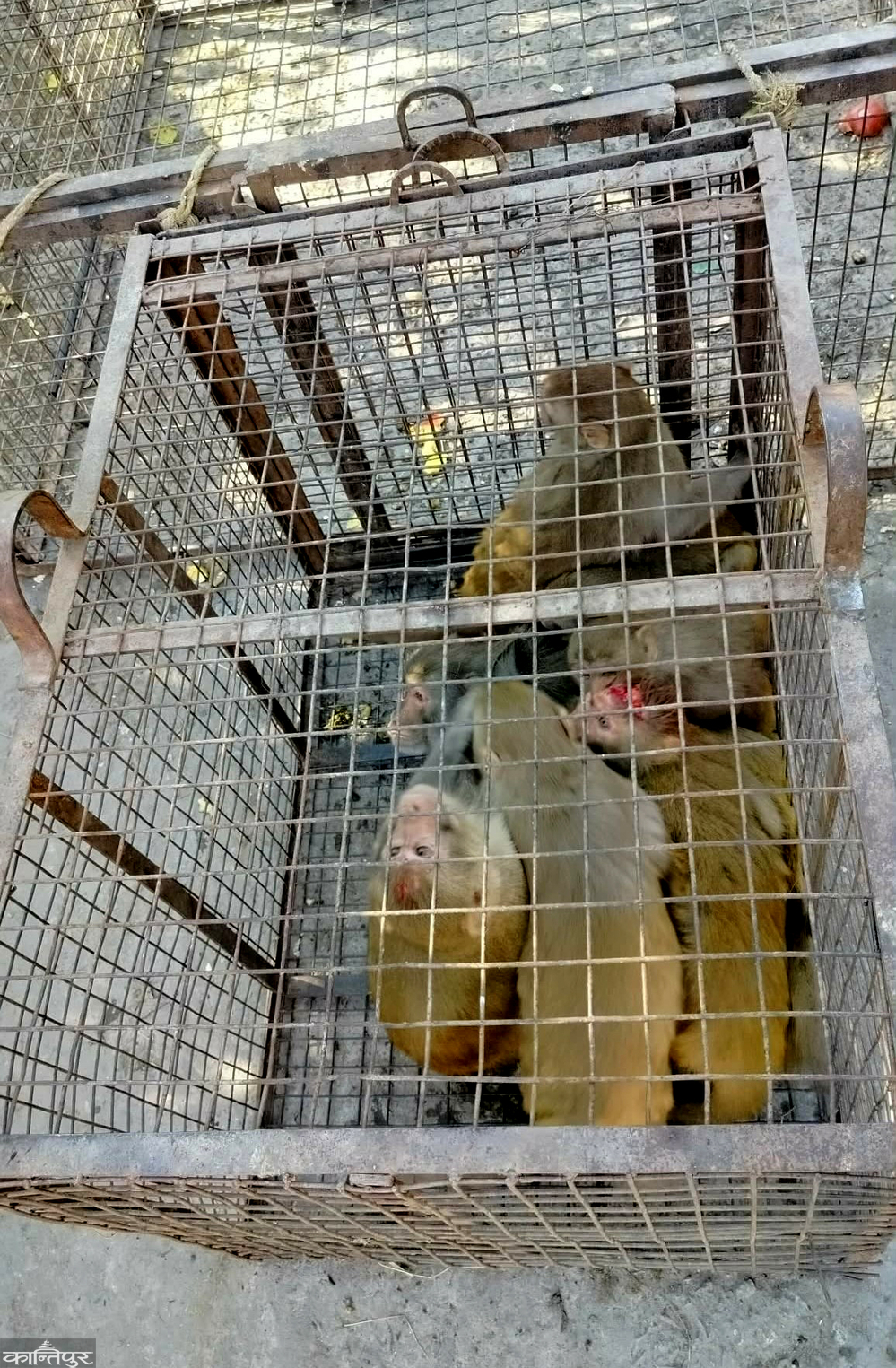
Dhankuta Municipality had allocated a budget of 1 million to start the campaign by bringing skilled manpower to catch the monkeys, but locals say that the effort has proven futile. Although it is said that 600 monkeys have been relocated from Dhankuta, locals complain that the terror has persisted lately.
Sahidbhumi Rural Municipality has started a campaign to plant fruit trees in forests and vacant land. Municipality Chairman Manoj Rai says that they have started planting fruit trees and saplings in the forests to control monkeys under the title of ‘Forest Environment, Climate Adaptation’.
National Orange Breed Research Program Paripatle has been allocated 500,000 for monkey monitoring. 30 metric tons of oranges are produced there annually. It is said that the annual expenditure for monkeys is Rs. 3.5 million for garden cultivation and other necessary work.
After the monkeys started damaging the crops, the Pakhribas have appointed and mobilized two watchmen on daily wages to control the monkeys. Last year, Paiyun Rural Municipality of Parbat had appointed 35 people and Ribdikot Rural Municipality-1, Khyha of Palpa had appointed 9 watchmen for the entire ward. The municipality plans to keep watchmen this year as well.
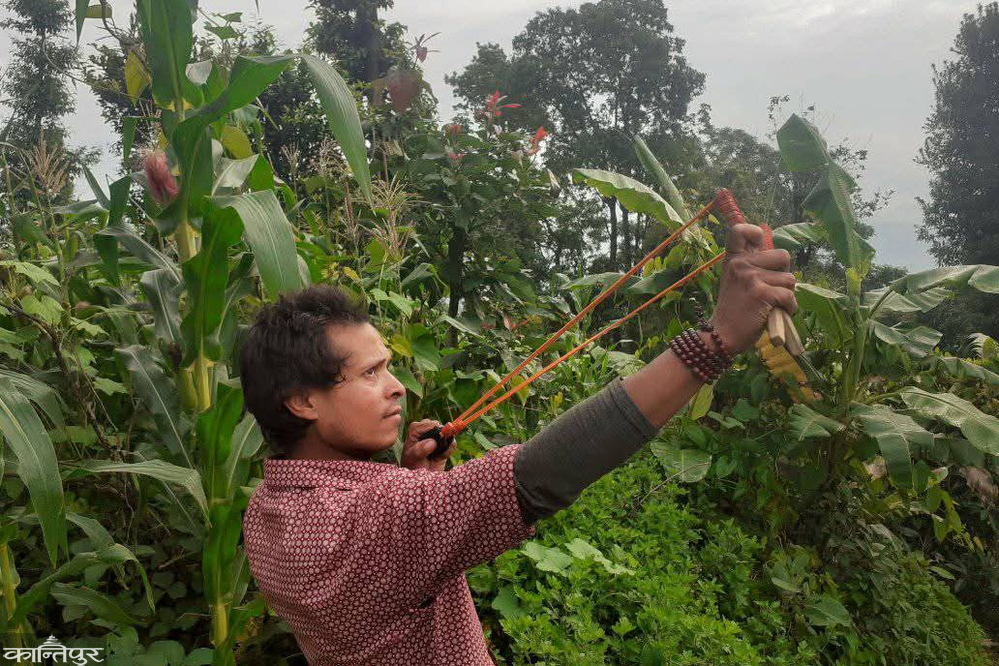
Udayapur Tapli Rural Municipality had purchased monkey-repelling guns by allocating Rs. 800,000 in the fiscal year 2081/82. Guns were also distributed to 42 tole development organizations at the rate of one police station each. According to Rural Municipality Chairman Dhungraj Bishwakarma, the monkeys used to run away at the sound of the gun in the beginning. ‘Earlier, they would run away as soon as they heard a sound,’ says Chairman Bishwakarma, ‘now, they have stopped caring even when a gun goes off. Since they cannot be killed legally, other control measures have not been effective.’
The local level of Dolakha has introduced various programs, from shooting to killing monkeys. However, none of the efforts have been fruitful. Kalinchowk Rural Municipality even came up with a plan to raise ‘one house, one monkey’, but it could not be implemented due to the law.
000
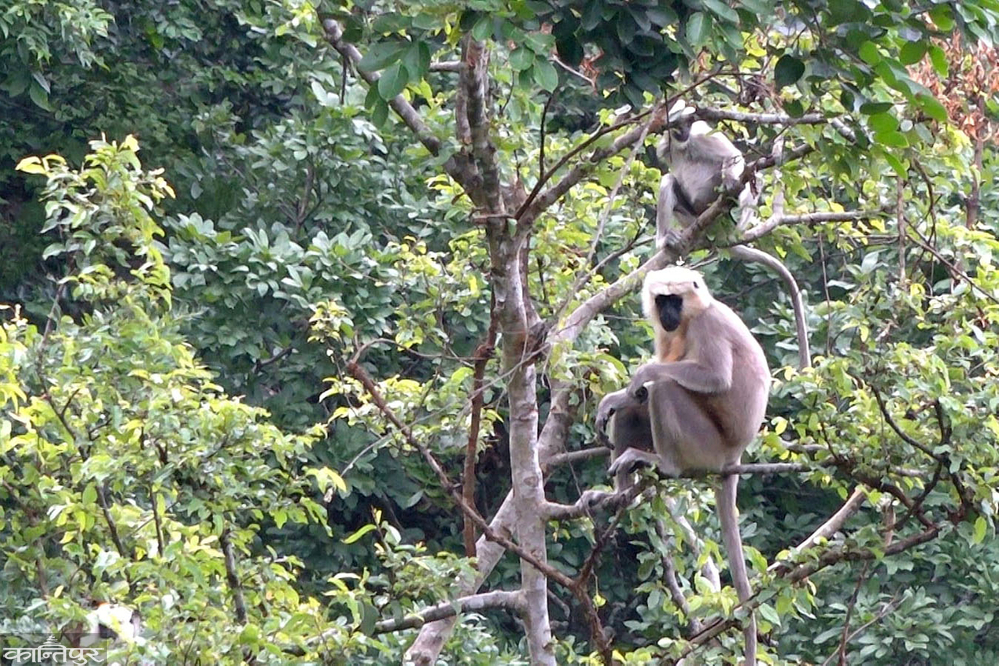
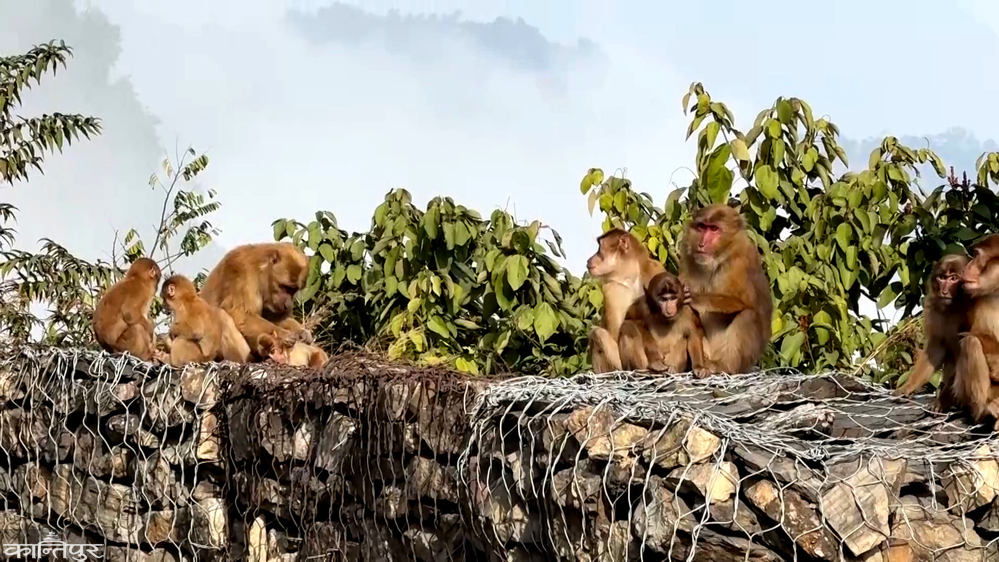
Mukesh Chalise, who holds a PhD in monkeys, says that there are three species of monkeys in Nepal: red, pahare and dhendu, and among them, the red monkey causes the most trouble. He said that the monkeys killed in the recent incident in Panchthar are pahare, which is one of the protected animals in Nepal.
‘The incident in Panchthar shows that negative feelings towards all types of monkeys have increased because monkeys have caused trouble,’ says Chalise. ‘What are monkeys? Which monkeys need to be chased or caught?’ The local level should make the community aware of these issues,’ suggests Chalise.
He suggests finding a long-term and effective solution to control the troublesome red monkeys. He understands that monkeys come out when there are no fruits, seeds and leaves to eat in the forest. ‘We should plant crops in the village that monkeys do not damage and grow plants that are suitable for monkeys in the forest. It is not enough to have big trees in the Sal forest,’ says Chalise. ‘The provincial government should open a research institute in every province, make vaccines and medicines and test them on monkeys.’ It is impossible to control the number of monkeys by sterilizing them.'
Retired professor Karan Shah, who is involved in wildlife conservation campaigns, says that monkeys are the main food of leopards. 'Nowadays, incidents of both monkeys and leopards causing trouble come from everywhere,' says Shah, 'How did the problem really come about? We need to see that. Management should be effective in the long term. Monkeys should be controlled in a way that does not conflict with national and international laws.'