Bhimsen Thapa is one such person and reference in history, which exposes the conspiracy and use of assassination to reach the center of power and authority in Nepal. However, this was neither the first incident, nor the last. In the 219 years since Thapa came to the center of power, 43 people have become Prime Minister/Mukhtiar. However, the hard or soft conspiracy to become Prime Minister is continuous.
We use Google Cloud Translation Services. Google requires we provide the following disclaimer relating to use of this service:
This service may contain translations powered by Google. Google disclaims all warranties related to the translations, expressed or implied, including any warranties of accuracy, reliability, and any implied warranties of merchantability, fitness for a particular purpose, and noninfringement.
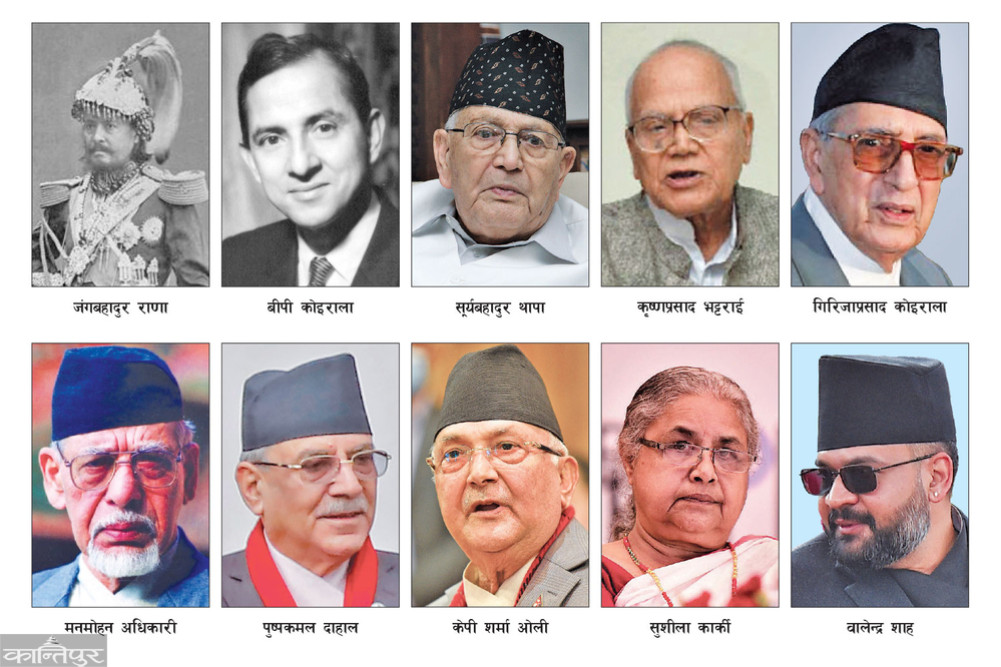
इतिहासकै शक्तिशाली जनमतसहित वालेन्द्र शाह प्रधानमन्त्री बनेको तीन साता पुगेको छ । प्रधानमन्त्रीका रूपमा उनको भूमिका कस्तो रहनेछ ? उनलाई इतिहासले कसरी सम्झिन्छ ? अहिल्यै आकलन गर्नु हतारो हुनेछ । नेपालको राजनीतिक इतिहासमा ४० जना प्रधानमन्त्री भइसकेका छन् । तीमध्ये कतिपयलाई निरन्तर सम्झना गरिन्छ । कतिपय भने गुमनाम जस्तै छन्, औपचारिक सन्दर्भभन्दा बाहेक चर्चा गरिँदैनन् । ‘कोसेली’ ले केही प्रधानमन्त्रीको कार्यकाल सम्झना गरेको छ । ‘कान्तिपुर’ को सम्पादकीय समूहले पदमा रहँदा निर्वाह गरेको भूमिका र सार्वजनिक विमर्शमा नाम आइरहने १२ पात्र छनोट गरेको छ । उनीहरूको पदावधिको चर्चा गर्दा नेपालको मूलभूत शासकीय प्रवृत्ति उजागर हुनेछ भन्ने हाम्रो विश्वास छ ।
15 Baisakh 1863. The royal assembly was sitting at the house of Qazi Tribhuvan Pradhan. The purpose was to find out the names of those involved in the loss of the government treasury. Rana Bahadur Shah, who had entrusted the royal duties to his son Girwanyudh Bikram, who was then the Mukhtiyar or royal representative, led the assembly. When there was a dispute, his half-brother Chautara Sher Bahadur Shahi stabbed Rana Bahadur with a sword and killed him. Then Sardar Bal Narsingh Kunwar beheaded Shahi on the spot. His bodyguards were also beheaded.
Interestingly, during that period, Qazi Bhimsen Thapa, who was using the indirect power of the state power by promoting Rana Bahadur Shah, left the assembly as it was starting. He was still eating food even while the dispute was going on. He came to the scene only after some were cut and some were injured. The powerful Thapa then manipulated the situation to his advantage.
With the help of the army, Thapa initially imprisoned his opponents. Then he launched a purge campaign. Chautara Bidur Shahi, Qazi Tribhuvan Pradhan, Qazi Narsingh Gurung, Palpali Raja Prithvipal Sen and his brother Chautara Ran Bahadur Sen were also cut. Some of their sons and grandsons were also cut. Rana Bahadur Shah's queen Rajarajeshwori, who was kept in Helambu, was not allowed to come to Kathmandu and was forced to commit sati in the Shali River in Sankhu.
Whose crime is it? The opponents were cut indiscriminately without any confirmation. Baburam Acharya has written – ‘In this massacre that continued for about two weeks, 16 helpless women who were burnt as Sati, as well as about 77 other male citizens, were forced to lose their lives unnecessarily.’ (Baburam Acharya/Let this never happen again). The
The story begins two weeks before the massacre. At the age of 23, King Rana Bahadur Shah had entrusted the royal duties to Girwanyudh Vikram, a boy of about one and a half years, in Falgun 1855. After his attempt to return to royal duties failed, he went to Banaras in Baisakh 1857. Thapa also went with him at that time. And, after Thapa’s strategy was successful, Rana Bahadur Shah’s team returned to Nepal in Falgun 1860. Rana Bahadur had arrived with the purpose of royal duties despite Girwanyudh being the king. Bhimsen Thapa, who came like this, had eliminated Kazi Damodar Pande, Sardar Prabal Rana, former minister Bhim Khawas and his sons, Subba Shankhadhar Khawas and others within a few days. He had reduced the Pandeys around the ruling power to almost zero. The two-week extermination campaign of Baisakh 1863 was the highlight.
After killing almost all his opponents at once, Kazi Bhimsen Thapa became unopposed and powerful. After that, he received the post of 'Mukhtiyar' or royal representative from the child king Girwanyuddha Bikram Shah.
The list of former prime ministers of Nepal in the 'Office of the Prime Minister and Council of Ministers' begins with the same Mukhtiyar Bhimsen Thapa, who remained at the center of the government for 31 years (however, there is a dispute whether he should be considered only as Mukhtiyar or also as Prime Minister). He was able to rule for such a long time under the guise of a weak king and a favorable Rajmata (the king's protector).
Even before becoming the Mukhtiar, Rana Bahadur Shah's words are enough to understand the extent of Bhimsen Thapa's influence or dependence on him in the exercise of power and power. He had said - 'If I die, the country will not sink, if Bhimsen dies, the country will sink.' It is easy to understand that the dependence on him has increased even more after becoming the Mukhtiar.
Bhimsen Thapa is one such person and reference in history, who exposes the conspiracy and use of assassination to reach the center of power and authority in Nepal. However, this was neither the first incident nor the last.
In the 219 years since Thapa came to the center of power, 43 people have become Prime Minister/Mukhtiar. But the hard or soft conspiracy to become the Prime Minister is continuous.
40 years after the rise of Bhimsen Thapa and 9 years after his fall, another major scandal occurred – the Kot Parva. At that time, the state administration and military structure were divided into two factions: King Rajendra Bikram and Queen Rajya Lakshmi. While one side was trying to overtake the other and reach the center of state power, General Jung Bahadur Kunwar used the situation to his advantage. Meanwhile, a meeting of bardars called at the Kot in the Hanumandhoka Durbar complex to find the killer of Rajya Lakshmi's close 'Dada' Gagan Singh, which was believed to be according to Jung Bahadur's plan, became a golden opportunity for him. He had deceived the deranged Queen and eliminated the opponents with the help of his brothers. In that incident on 2 Asoj 1903, influential bardars were mass murdered.
That midnight, the number of brothers who were killed by swords or bullets in one place in Patangini of Kot had reached more than 31. It is estimated that about 40 people, including other minor soldiers, died that night. (Gyanmani Nepal/Mahabharata of Nepal)
On the eve of the Kot festival, when all the opposition was eliminated, Jung Bahadur obtained the office of Prime Minister. After that, the kings became only powerless heirs. Instead, the powerful Rana rule began, which lasted for 104 years. During that period, 10 prime ministers became prime ministers. Even during the rule of the Ranas, there was no decrease in conspiracy, murder and cunning to reach the post.
After the revolution against the Rana regime was successful and the Rana regime ended in Falgun 2007, some definite methods were established for the process of becoming a prime minister. The first government after the revolution was formed in Delhi under the leadership of the then Prime Minister Mohan Shumsher Jabra with the participation of the Rana and the Congress. However, the government lasted only a year.
Since then, the selection process of the Prime Minister has been carried out under the auspices of the Constitution. However, there are many contradictions in it. In some cases, the Prime Minister has been selected according to the method directly directed by the Constitution and clarified by various articles. Governments are formed within the scope of the Constitution according to the elections held for the Representative/Constituent Assembly and the number of seats determined by it. When the Representative/Constituent Assembly worked naturally, the process of one government falling and another being formed also occurred within the constitutional framework. According to the mandate given by the House of Representatives election held on 21 Falgun, Balendra Shah, who was appointed Prime Minister on 13 Chaitra, is the latest example, which is the government envisioned by the Constitution of Nepal promulgated in 2072.
On the other hand, in Nepal, the Prime Minister has been appointed and removed by violating the constitutional system or by narrowing/broadening the meaning. The kings were especially fond of this practice. After the 2007 revolution, King Tribhuvan and King Mahendra, contrary to the spirit of the ‘Nepal Interim Government Act, 2007’, sometimes formed governments under their own leadership, sometimes formed consultative governments, and sometimes formed governments under the leadership of incompatible characters through personal selection.
In 2015, he himself carried out a ‘coup’ against the government of BP Koirala, who became Prime Minister by winning two-thirds of the seats in the elections held in accordance with the constitution given by King Mahendra. And, in 2019, by promulgating a new constitution, he started the practice of forming governments under his own chairmanship or under the leadership of the person he wanted. Whereas, the right to elect the Prime Minister belongs to the people. During the Panchayat period, no clear criteria were established for the Prime Minister selection process. The articles of the constitution were cited during every appointment, but a unified method was not established. At that time, the king's interest was more important than the constitution.
On 18 Asoj 2059, the then King Gyanendra had created a similar distortion in the selection of the prime minister after dismissing Prime Minister Sher Bahadur Deuba. By setting aside the main article of the 2047 constitution to appoint the prime minister, he misused Article 127, which had the power to remove obstacles. Gyanendra had linked the article, which was included to make it easier to remove obstacles in implementing the constitution, to a process like selecting the prime minister. On 19 Magh 2061, he himself assumed the power of governance. Whereas, the main essence of the constitution was to run the government under the leadership of parties elected by the people.
Even when there are repeated upheavals in Nepal and they lead to the birth of an interim government, constitutional continuity or the continuity of constitutional provisions has been disrupted. For example, the 2046 People's Movement gave a rest to the 2019 Constitution. The 2062/63 People's Movement gave a rest to the 2047 Constitution. After 2046, when the government was formed under the leadership of Krishna Prasad Bhattarai, the articles of the Constitution were not explained. It was only said 'in accordance with the Constitution of Nepal'. Even after Girija Prasad Koirala became Prime Minister after the 2062/63 People's Movement, it was said 'in accordance with the Constitution of the Kingdom of Nepal, 2047'. After the promulgation of the Interim Constitution, 2063, Koirala became Prime Minister again accordingly.
Two contexts where awkward situations occasionally arise despite constitutional continuity are the two elected governments led by Chief Justice Khilraj Regmi and former Chief Justice Sushila Karki.
After the dissolution of the first Constituent Assembly, the parties appointed the incumbent Chief Justice Khilraj Regmi as the Chairman of the Council of Ministers to hold elections for the second Constituent Assembly under the leadership of a common person. At that time, 25 obstacles were removed to make him the Prime Minister. This allowed the constitution to continue, but it was also disrupted.
After the promulgation of the constitution in 2072, although it was seen that the post of Prime Minister was being rotated among a limited number of people due to the government's complexity and bureaucracy, the constitutional provisions were not violated during the formation of the government. However, the Gen-G movement of 23 and 24 Bhadra created a strange situation. After the resignation of the then Prime Minister KP Sharma Oli on 24 Bhadra, confusion arose regarding the formation of the government. At that time, the agitating Gen-G had demanded the formation of a civilian government. The name of former Chief Justice Sushila Karki was put forward saying that the vote was held on the social network 'Discord', which is popular among the youth.
However, according to the provisions of the constitution, a non-MP could not become the Prime Minister. On top of that, there was also a voice for the dissolution of the then House of Representatives. Meanwhile, on 27 Bhadra, former Chief Justice Karki was appointed Prime Minister. On the same day, the House of Representatives was also dissolved on her recommendation.
The provision regarding the formation of the government is in Article 76 of the 2072 Constitution. However, when President Ram Chandra Poudel appointed Karki as Prime Minister, this article was not touched. At that time, a statement issued by the Office of the President stated that Karki was appointed Prime Minister ‘in accordance with the wishes and aspirations expressed by the young generation, addressing the unusual and extraordinary situation that has arisen in the country, exercising the inherent constitutional powers of the President in accordance with the Constitution of Nepal, and in consultation with political parties and stakeholders, as required to uphold and protect the Constitution of Nepal and promote the national unity of Nepal, in accordance with the constitutional restrictive provisions entrusted to the President in the capacity of the Head of State, on the recommendation and consent of the Prime Minister’.
The situation where the one who can cut the most opponents gets the opportunity to become the Prime Minister is not relevant in the present time . Infighting within and outside the party is considered natural in politics, but the constitution should recognize it . Due to repeated political upheavals in Nepal and the constitution being made a new one, the definite constitutional method of selecting the Prime Minister has not been able to become strong . Which itself has been proving to be a continuation of instability and confusion .
On the other hand, since the constitutional exercise began, no Prime Minister has been able to complete the prescribed term . In the elections held on 21 Falgun, the Rashtriya Swayamsevak Sangh (RSS) has won almost two-thirds of the seats in the House of Representatives and Balendra Shah has become the Prime Minister . He has the responsibility to fulfill the aspirations of the people, as well as the challenge of running the government for five years . That will also help establish a strong tradition .
All related news