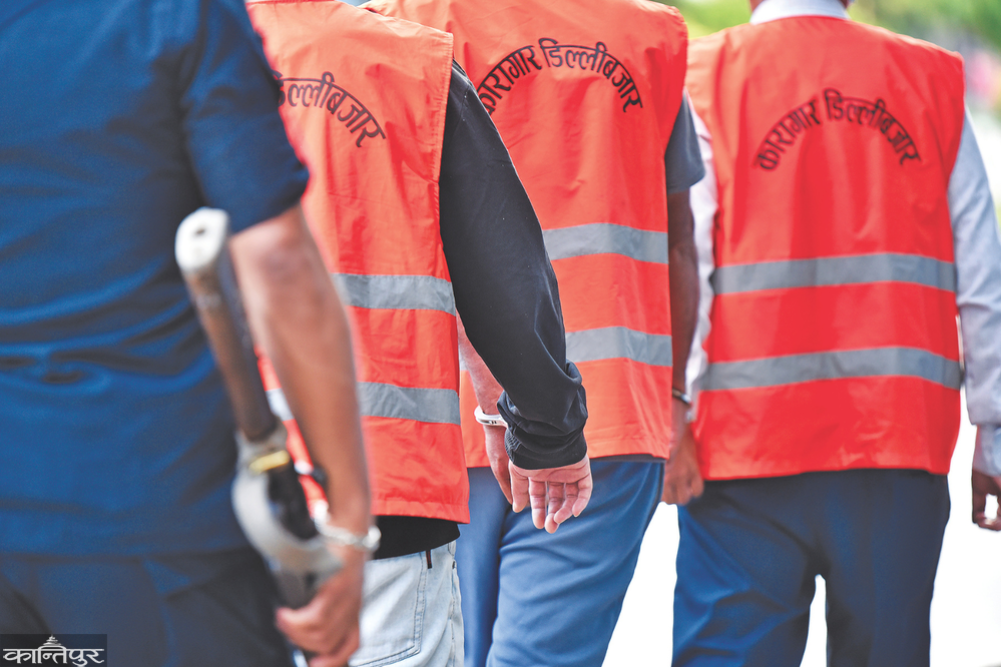
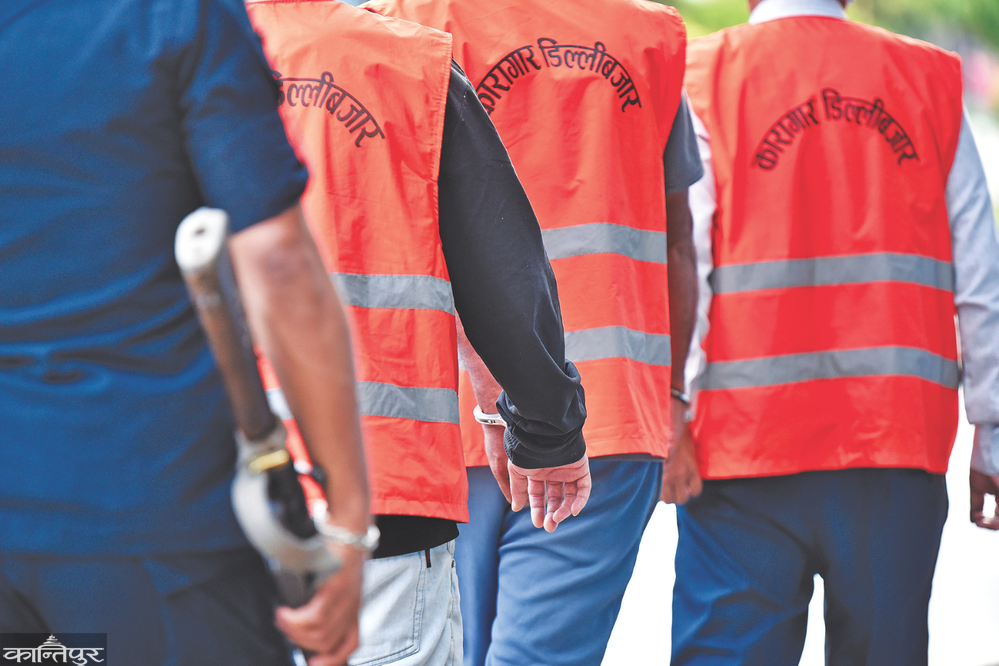
The Nepal Police's tendency to make arrests first and investigate crimes later is raising concerns from the courts to civil society.
We use Google Cloud Translation Services. Google requires we provide the following disclaimer relating to use of this service:
This service may contain translations powered by Google. Google disclaims all warranties related to the translations, expressed or implied, including any warranties of accuracy, reliability, and any implied warranties of merchantability, fitness for a particular purpose, and noninfringement.
The basic principle of the criminal justice system is to hear first and then arrest. Its core sentiment is that the guilty should go free but not a single innocent person should be caught. However, in recent times, there has been a trend of Nepal Police first taking some people into custody and only then starting to investigate the crime.
The latest example of this is the incident where the Vice President's Office Secretary Krishnahari Pushkar was taken into custody from his home by a team of the Office for Investigating Heinous Crimes in the Valley on Thursday. He was taken into custody for allegedly sending a message to the Prime Minister and violating the 'chain of command'. After being brought to the office, the police finally concluded that there was no sufficient basis to file a case. Finally, after four hours of interrogation, the Valley Crime Investigation Office handed Pushkar over to Mrs. Abha Shrestha. Even when he was taken to the police office in Teku, it was not known for what offense Pushkar had been arrested. 'Have I been brought in for a matter related to the Ministry of Labor or the Ministry of Commerce or the Ministry of Finance?' he had asked the investigating officers. The officers said, 'You will know' and did not say anything for a long time, but were even preparing the arrest warrant necessary to keep him in custody. The order to leave again came at night. On Saturday, the Prime Minister's sarcastic status came, 'I also want to become an ambassador, if you have the Prime Minister's number, please give it to me.'
Some of the actions taken by this unit of the police in the past have not reached the point of registering a case. The office raided 95 educational counseling centers on 1 Jestha on charges of trying to send students for foreign employment illegally, 69 operators were arrested . According to officers, educational counseling centers are not allowed to send students for foreign employment. But the police had stated that they were taken into custody after they were found to be operating educational counseling services, preparatory classes and language teaching services without a license without fulfilling the criteria and without renewing their registration. Out of those arrested, a case was registered against only 30 of the organization's operators on charges of committing an offense against the Education Act.
According to officers, only after the consultancy operators were arrested and brought in, they started searching for evidence by digitally examining their mobile phones. The police could not prosecute everyone when there was no complaint from the victim.
Urgent arrest warrant: Police's weapon for arbitrarily arresting citizens
The Valley Crime Investigation Office had taken two construction entrepreneurs into custody on April 28, citing the order of the Ministry of Physical Infrastructure. Sharma and Company Chairman Ramesh Sharma and Lama Construction's Pitambar Badu were arrested. They were businessmen who were constructing the Nagdhunga and Dhulikhel road sections. 'Nowadays, it seems that the government is using the police for every issue, which is not right,' says former DIG Hemant Malla, who is also the former head of the Central Investigation Bureau (CIB). 'If there is a problem with the contract work, the body that will look into it will be the Road Department or some other body.' But if the police are used to create fear in every matter, what is the responsibility of the concerned department?' When these events took place, the Home Administration was headed by Prime Minister Balendra Shah. Shah's Chief Personal Secretary Som Sharma was responsible for coordinating with the police. Gurung's personal secretary James Karki, who was the previous Home Minister, was also working in the ministry. According to senior police officials, Physical Infrastructure Minister Sunil Lamsal also coordinated with the police.
Rashtriya Swayamsevak Sangh (RSS) leader Gurung became the Home Minister again on Tuesday. During his previous tenure, there was a trend of police arrests and court releases. Once, he expressed dissatisfaction with the court that ordered his release while talking to journalists. I thought, you are the biggest minister, everything can be improved from here,' he had said in the ministry on 3 Baisakh, 'No, these days I am starting to think that I am a big judge.'
Gurung had also stated that he had formed a separate team to study legal issues and that such a thing would not happen again from now on. 'When instructions come from the higher level, the police are also forced to do some things, if you don't do it, they say they will transfer you and bring someone else,' a senior police officer told Kantipur, 'That is why there is an obligation to accept some things.'
In the past, when police officers received some instructions, they used to give their opinion on whether or not they were correct according to the law. "Nowadays, it is rare to meet the political leadership, and even the occasional conversation is one-sided, making it difficult to understand," he said, "That is why there is confusion even in transfers and promotions."
Pandey was arrested by the police on April 29 for investigation on charges of fraud and criminal breach of trust. The banking sector objected, saying that the issue of bad loan recovery was linked to criminal breach of trust. Four days later, a bench of Supreme Court Justices Saranga Subedi and Shantisingh Thapa ordered him to be kept out of custody and the investigation to proceed.
Golchha, who is also the former president of the Federation of Nepalese Chambers of Commerce and Industry, was arrested by the police from the Naxal area on April 10 for investigation into an offence under the Insurance Act. The CIB had stated in a statement that he was arrested ‘on the basis of the preliminary investigation report of the Nepal Securities Board’. His wife Seema Golchha filed a custodial interrogation petition in the Supreme Court against the arrest.
Hearing the matter, the court noted that Section 104 (1) of the Securities Act, 2063 states that ‘if there is any reasonable cause to believe that the person against whom action is being taken may abscond and disappear or if it is found that he has suffered significant loss or damage, the investigating officer in a case under the Act may ask for the necessary bail or collateral and if such bail or collateral is not provided, he may be detained.’ The court then said in its order, ‘However, as per the legal provisions, the investigating officer has the right to take the petitioner into custody for investigation without seeking bail or bail, so the orders issued on 11 and 21 Baisakh to keep him in custody are null and void by the order of the summons.’
Even after this court order, the police did not release him. He was again arrested for investigation under the Insurance Act. He was released after the court did not extend his detention.
Congress leader and former minister Deepak Khadka, who was arrested on 15 Chaitra for investigation under the crime of money laundering, was also released on the court’s order. His house was set on fire on 24 Bhadra amid the situation that arose after the Gen-G movement. At that time, videos of Nepali and foreign notes being burnt were made public on social media. After that, the Money Laundering Investigation Department started an investigation against him. Hearing the petition filed by Khadka's wife Binita for custodial interrogation, the Supreme Court ordered her release on April 3. The police had arrested UML's Lumbini Province MP Rekha Sharma on April 15. When Prime Minister Balendra Shah was the mayor, information had reached the Kathmandu Metropolitan City that Sharma had kept a girl at home and exploited her for labor. The victim was rescued in the presence of the city police. The metropolitan city employees had also filed a complaint against Sharma. But the action did not proceed, and instead it was decided on April 16, 2082 that the case would not be prosecuted. Sharma was arrested soon after Shah became the prime minister. The Supreme Court ordered Sharma to be released from custody, saying the case had already been decided. The law has made it clear which offense is criminal and which is civil, and the police should be left autonomous to work accordingly: Pitambar Adhikari, former DIG
According to experts, those in power are always using the police as a weapon to show their power. ‘Earlier, during the reign of the king, the police were deployed behind the people of the current party, from collecting information to other tasks,’ says former Deputy Inspector General of Police (DIG) Pitambar Adhikari, ‘After the parties came, the police started using them to collect information from the opposition, and started interfering in investigations related to the ruling party.’
When Pushpa Kamal Dahal was the Prime Minister, Congress MP Sunil Sharma was arrested in Parliament for demanding the resignation of the Home Minister and Finance Minister. He was arrested in an old dispute regarding his educational certificate, but the court did not give him a time limit to keep him in custody. After that, the police had to release him. On 3 July 2075, Dr. The then KP Sharma Oli-led government used the police to bring Govinda KC to Kathmandu.
Punishment before the case for indecent behavior ‘The Gen-G movement was sparked because of the wanton misuse of the state machinery in the past,’ says Majid Ansari, a Gen-G leader who is also an advocate. ‘The police should not act according to the mood of the Prime Minister or Home Minister, but according to the Criminal Procedure Code, according to the Police Act.’ He says that it is not appropriate to continue the same practice even now, saying that Deuba-Oli-Dahal used the police to their advantage in the past. Former DIG Adhikari says that in some criminal cases, action could not be taken when the party to which the person was involved was in the ruling party, but there are many cases where they were caught and brought back when they were in the opposition. ‘That means the police are not given autonomy in their professional work,’ he told Kantipur, ‘The law has made it clear which offenses are criminal and which are civil. The police should be allowed to work accordingly.’
The political leadership should understand that investigation is purely the responsibility of the police: Mohana Ansari, former member, National Human Rights Commission A professional police force should be able to say no to wrong orders from the top, but police officers themselves say that this has not happened. Mohana Ansari, former member of the National Human Rights Commission, says that the political leadership never wanted to make the police professional. ‘If the police are allowed to work impartially, many problems will be resolved on their own,’ she says. ‘If they make a mistake, action will be taken, but the political leadership should understand that the investigation is purely their responsibility.’ We are focused on conducting impartial investigations with technical evidence: Abi Narayan Kafle, Police Spokesperson
Nepal Police Spokesperson Abi Narayan Kafle says that the police will take someone under control and investigate according to the law when investigating a crime or maintaining peace and security. ‘We investigate according to the law, collect physical and digital evidence and submit a report to the government prosecutor,’ he told Kantipur. ‘The factual evidence collected by the police is also examined by the government prosecutor and taken to the court, and the rest is the court itself. From there, a decision will be made based on facts, evidence, and universally accepted principles of justice.’
In some cases, he says, the law gives the investigating officer or government prosecutor the right to release someone if the factual evidence does not show guilt during the investigation. ‘It does not mean that everyone who is arrested will be prosecuted. Sometimes they can be released if the court does not extend the time limit. But we are focused on impartial investigation with technical evidence.’