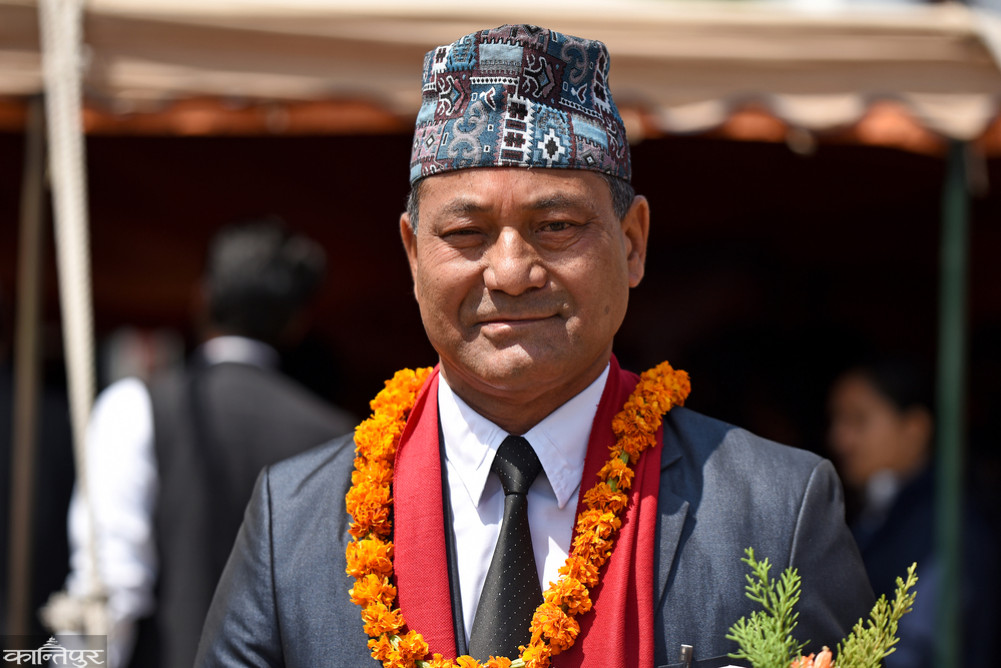
Four decades of collaboration with social organizations and continuous contributions to party organizations have given him the confidence to play an effective role in parliament.
We use Google Cloud Translation Services. Google requires we provide the following disclaimer relating to use of this service:
This service may contain translations powered by Google. Google disclaims all warranties related to the translations, expressed or implied, including any warranties of accuracy, reliability, and any implied warranties of merchantability, fitness for a particular purpose, and noninfringement.
Madan Krishna Shrestha from Bhaktapur was far behind in the proportional list of the Nepali Congress. He has now become an MP. The party sent him to the parliament under the disability quota under the indigenous nationalities group.
When the proportional list was prepared, Shrestha's chances of becoming an MP seemed very slim. His name was at number 16 in the closed list of the Nepali Congress for indigenous nationalities men. The Election Commission had given political parties time to submit their lists on Poush 13 and 14. His name was placed at the end of the list submitted by the Nepali Congress on Poush 14. Later, after Romi Gauchan Thakali from Mustang withdrew his name, Shrestha moved up one place to number 15. But that did not change his chances of becoming an MP much. According to the mathematics of the proportional system, his name was far below the list to be selected.
The turning point in the political situation came on Poush 18. The Supreme Court issued a directive order to the Election Commission, saying that it should ensure the representation of people with disabilities in the proportional closed list of political parties. According to the House of Representatives Election Act, 2074, the court had given clear instructions to review the closed list and ensure representation of people with disabilities.
This order turned Shrestha's possibility of reaching parliament into a reality. 'After the Supreme Court's order, the party was forced to have representation from the disability group, so I got the opportunity to become an MP,' Shrestha said.
Shrestha's life journey was a struggle from the beginning. His father passed away when he was 6 months old. His health condition became complicated after he contracted typhoid at the age of 7 months, and polio appeared as a result. Since his legs were weak since childhood, he had to move forward with the challenge of physical disability. But this situation made him determined towards life instead of making him depressed. Instead of locking himself within boundaries, he chose to be active in society and politics.
His political journey began when he was studying at Adarsh School in Thimi, Bhaktapur. His family environment attracted him towards politics. His brother Prem Krishna Shrestha was a well-known politician in Bhaktapur during the Panchayat period and served as the Pradhan Panchayat for two terms. The political discussions at home and the movement of leaders influenced him from an early age.
'There was a political atmosphere at home, so I became interested from an early age and started being active in student politics from the age of 13,' he recalls. At that time, he used to go to listen to the speeches of leaders. He still remembers a speech he heard in Bagbazar that deeply affected him. He has an experience that the idea that a parrot wants a free sky even if kept in a golden cage taught him the value of freedom and democracy.
After completing his school education, he enrolled in Nepal Commerce Campus. From there, his student politics progressed institutionally. He was elected a member of the Independent Students Union and became active in the movement. While participating in the Satyagraha movement of 2042 BS, he was arrested and spent two months in Nakkhu Jail. That experience became an important turning point in his life. 'Jail removed my fear, and after that I became more committed to the political struggle,' he says. He feels that his imprisonment gave him the opportunity to understand the meaning of the movement, the value of democracy, and political risks closely.
After his release from prison, he began playing an active role in the Nepali Congress organization. After becoming a member of the Bhaktapur Congress, he was appointed treasurer in 2046 BS. After the people's movement, he worked continuously to expand and strengthen the party organization. In 2048 BS, he was elected as the president of the election regional working committee and served two consecutive terms. He got the opportunity to build the organization, mobilize workers, and expand his influence in local politics during this period.
Continuing this political journey, in 2074 BS, he was elected as the mayor of Madhyapur Thimi Municipality. At that time, the local government structure was new, administrative practices were limited, and resources were not sufficient. It was difficult for him to run the municipality for five years amidst challenging conditions. He gained experience in making local development plans, managing the budget, communicating directly with citizens, and making administrative decisions during this process. He says that the practical knowledge of how local government is run later gave him confidence in national politics as well.
After leading the local level, he continued his efforts to enter the party's central politics. Although he contested for the position of central member in the 12th General Convention, he was defeated because he did not belong to any faction. Although he filed his candidacy in the 13th General Convention, he withdrew his name accepting the leaders' request. After a long wait, he succeeded in being elected as a central member in the 14th General Convention, which he considers as a significant achievement of his political journey.
The opportunity to become an MP had come to him long before. In 2051 BS, saint leader Krishna Prasad Bhattarai had proposed that he contest the election from Bhaktapur. But he decided to back down, giving priority to a leader more senior than him. After that, it became difficult for him to get a ticket. Despite trying to contest the election repeatedly, he did not get the opportunity. In 2074 BS, although his name was included in the proportional list for the Provincial Assembly, he removed his name due to the belief that he had to contest the election directly. In the 2079 BS election, although he was included in the proportional list for the Provincial Assembly, he could not become an MP. Despite not getting an opportunity for a long time, he did not leave the party and remained active in the organization.
Along with politics, he was equally active in the social sector. He worked in various public bodies, including the central member of the National Association of Municipalities, a member of the Water Supply Board, and a member of the Road Board. Programs related to the German Development Fund and collaboration with social organizations such as SSOS Balgram gave him experience in the field of development and social services. While mayor, he also had the opportunity to visit more than a dozen countries and study international practices of local governance.
Long political experience, practice of local government operation, collaboration with social organizations, and four decades of continuous contribution to party organizations have given him the confidence to play an effective role in parliament. 'I have the experience of what an MP should do once he reaches parliament,' he says, 'I will not let the question of what kind of person the party made an MP arise.'
Other profiles of proportional representatives:
Tukabhadra Hamal: From underground struggle to MP
Journey from the wound of defeat to 'honorable'
Mingma Gyabu's journey to Parliament, who set a record in mountaineering
Rima Bishwakarma: Journey through the journey of artistry to Parliament
Radhika will now speak in Parliament, the voice of women and marginalized people of Karnali