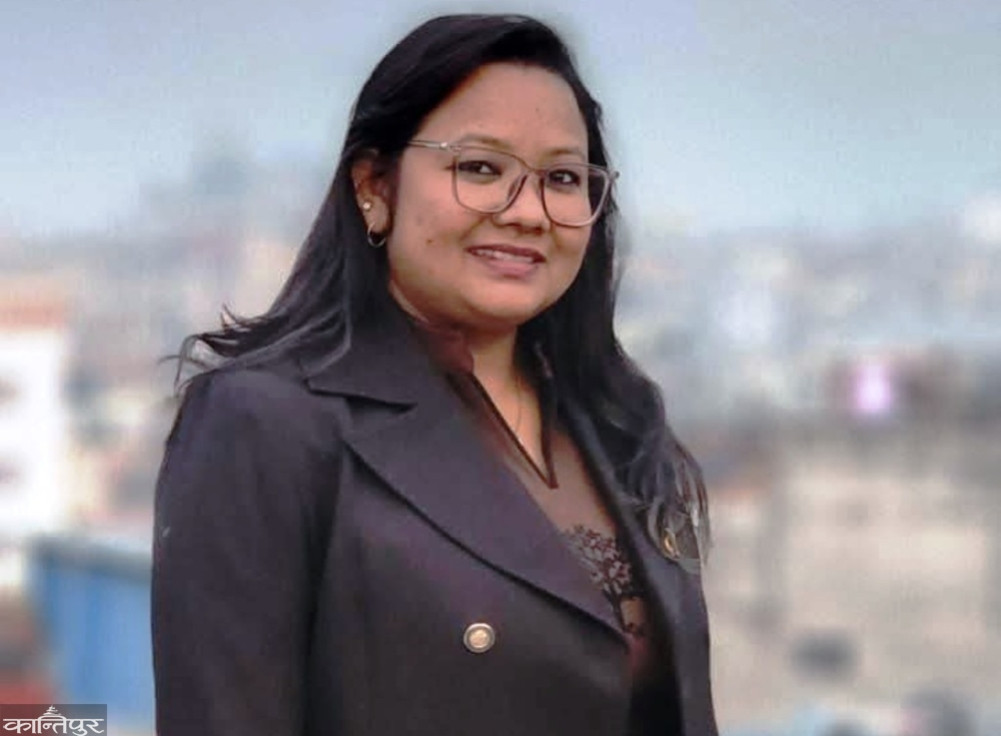
Emerging from student politics, she made the leap into politics in a short time. This year, she achieved double success, first as a central member and now as a member of the House of Representatives through proportional representation.
We use Google Cloud Translation Services. Google requires we provide the following disclaimer relating to use of this service:
This service may contain translations powered by Google. Google disclaims all warranties related to the translations, expressed or implied, including any warranties of accuracy, reliability, and any implied warranties of merchantability, fitness for a particular purpose, and noninfringement.
More than three dozen youths under the age of 40 were included in the central committee of the CPN-UML from the 11th general convention. One of them was Nita Ghatani from Jhapa. The same Ghatani's footsteps are now stretching towards the parliament.
Emerging from student politics, she made a leap into politics in a short time. This year, she got a double achievement, first a central member and now a member of the House of Representatives from the proportional representation.
The UML had put Ghatani's name at number two on the proportional closed list. Last Saturday, the UML secretariat meeting finalized the names of 16 MPs including Ghatani. The Election Commission gave her a certificate of election on Thursday.
At the party's general convention held in the first week of December, 2,263 representatives elected Ghatani as a central member. She was 'missed' in the selection phase of the general convention representative and finally returned to Jhapa after winning the central committee. A few weeks later, the first secretariat meeting of the UML included her in the closed list of proportional candidates from the Dalit cluster.
UML leaders say that UML Chairman KP Sharma Oli had put her forward not only as a Dalit, but also as a representative of women and youth. After her name was included in the list prepared by Oli, she was discussed both inside and outside the party. 'The organization trusted her because she fulfilled the responsibility she received with honesty,' Ghatani said over the phone, 'Now I will shoulder the responsibility given by the party with honesty.'
Reaching the party's central leadership from the Dalit community and becoming an MP is a milestone in her political journey.
Raised in a family full of communist consciousness, Ghatani entered organized politics in 2067 BS by becoming a ward committee member of UML. In 2072 BS, she became a member of Birtamod Nagar Committee. When she was elected as a Dalit woman member in the 2074 BS local level elections, she got the opportunity to understand politics in practice. ‘Being a people’s representative gave me a great opportunity to understand society and learn politics,’ she says. ‘It not only gave me confidence, but also gave me more energy.’
During the NCP era, she became a district committee member and took on the responsibility of student in-charge. In 2080 BS, she was elected as a member of the UML Koshi Province Committee and became the in-charge of the student wing. She reached the central leadership based on her continuous activism and responsibility in the organization.
Her first political defeat was the defeat of the standing committee member in the 23rd National General Convention of ANNFSU held in Falgun 2079 BS. However, she did not take that defeat as a break, but as a lesson. ‘That defeat taught me a lot,’ she says, ‘I did not give up and continued to work in the organization.’
She rejects the comment that UML gave opportunities to the youth only because of the influence of the Gen-G movement. She argues that the decision to introduce an age limit of 32 in the ANNFSU and bring the new generation into leadership is proof of that. ‘It is not right to say that the youth were given opportunities only after the 11th general convention,’ she says, ‘UML has always brought youth into leadership.’
As a central committee member, she says that she will actively raise the issues of youth, women and Dalits. After becoming an MP, she plans to work mainly in these three areas. Equal access for the Dalit community, especially in the education sector, is her main agenda. She emphasizes that the discrimination in the name of English and Nepali medium within government schools should end. ‘The perspective on students from vulnerable communities should be changed,’ she says, ‘I will raise my voice for the right of citizens to receive equal education at the policy level.’
Other profiles of proportional representation MPs:
Tukabhadra Hamal: From underground struggle to MP
From the wounds of defeat to ‘honorable’
Mingma Gyabu’s journey to Parliament, who set a record in mountaineering
Rima Bishwakarma: Journey to Parliament through the journey of artistry
Radhika will now speak in Parliament, the voice of women and marginalized people of Karnali