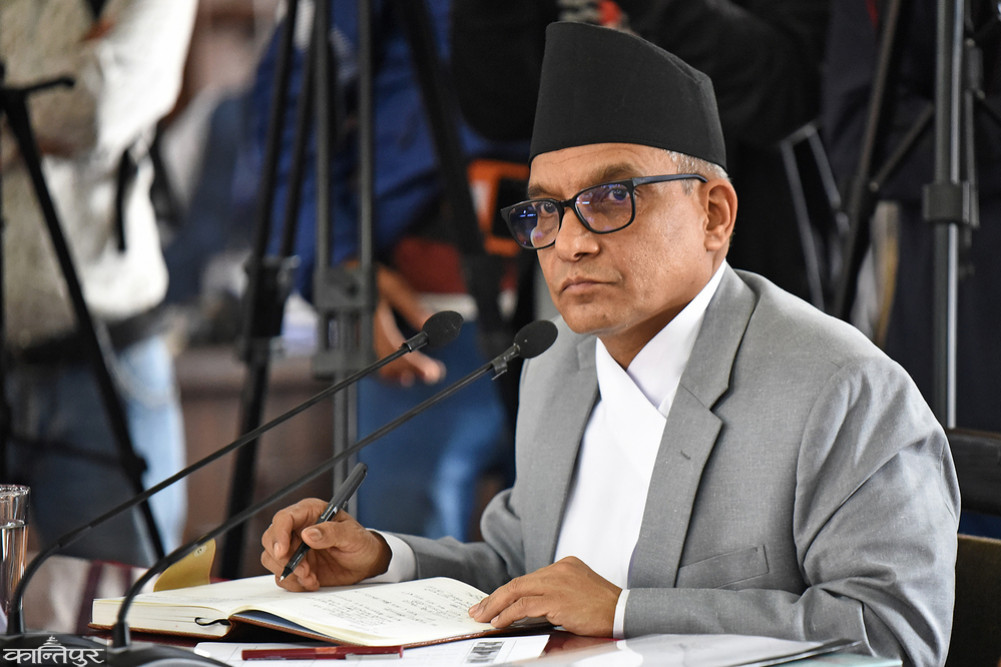
An analysis of all (1,263) judgments published in the 'Nepal Kanun Patrika' after his appointment shows that Chief Justice Sharma often did not write the judgments himself, but rather was a witness who signed the consent to the judgments of others.
We use Google Cloud Translation Services. Google requires we provide the following disclaimer relating to use of this service:
This service may contain translations powered by Google. Google disclaims all warranties related to the translations, expressed or implied, including any warranties of accuracy, reliability, and any implied warranties of merchantability, fitness for a particular purpose, and noninfringement.
Despite having a wife with two children, Sanjeev Roka of Rupandehi got married again in 2062 Magh. His first wife Chanda filed a complaint in 2065 Jestha. The district court sentenced Sanjeev to one year in prison and a fine of five thousand rupees for polygamy.
However, at the end of a 16-year-long legal journey (2081 Baisakh), the Supreme Court overturned that decision. And, it said that polygamy had indeed taken place, but since Chanda did not file a complaint 'within three months of knowing', Sanjeev is exempted.
The full bench of the Supreme Court had already settled this question in 2063 BS, saying that the time limit of 'three months from the date of knowledge by the government body' authorized to prosecute polygamy is calculated. This increases the time frame for holding a person who commits polygamy accountable.
The 2081 verdict changed the old interpretation and made the limitation period count from the day the first wife came to know about it.
According to legal experts, this interpretation will now prevent the first wife from filing a complaint for three months. The polygamist will be forever protected from prosecution.
The judge who wrote that verdict by a majority of three to two in a large full bench of five judges was the current Chief Justice Manoj Kumar Sharma.
That was the first and only opportunity for Sharma to write a decision for a large full bench of the Supreme Court. That and other similar decisions are a window into Sharma's judicial career.
Breaking the tradition of appointing the most senior judge, the Constitutional Council led by Prime Minister Balendra Shah recently appointed Sharma as the head of the judiciary for a period of six years. The argument for choosing Sharma is that he has disposed of a large number of cases. However, the authenticity of the number of cases disposed of is questionable. What was Sharma like as a judge in the Supreme Court, who surpassed his senior judges and gained leadership? The answer to this can be found in his judgments. For that, ‘Kantipur’ has analyzed all the judgments published in 74 issues of ‘Nepal Kanun Patrika’ (NCAP) from the month Sharma was appointed to the Supreme Court (Baishakh 2076) to the latest available issue (Bhadra 2082). (For details on the analysis method, see the end – Data Collection Method). ‘NCAP’ is the official publication that publishes only judgments deemed by the Supreme Court to be unprecedented. Sharma sat on 143 of the 1,263 judgments published in ‘NCAP’ during that period. Of these, he wrote only one-third (48) of the judgments.
(This analysis does not include judgments not published in ‘NCAP’.)
In the legal system adopted by Nepal, the precedent of the Supreme Court is always binding on the lower courts and lower courts. However, not all judgments of the Supreme Court automatically become long-lived precedents. Only after being cited by subsequent courts do judgments become ‘living law’. The judgments published in law journals show how qualitatively a judge has written judgments, says former Supreme Court Justice Balram KC. ‘How many judgments has a judge made? That depends not on how many judgments he has sat on, but on how much he has written,’ he says. ‘If a qualitative judgment is written, it is published in law journals. And, it is evaluated on that basis.’
// Sharma: Author or just a signatory?
Sharma's supreme journey began in Baisakh 2076.
In the first year, only 11 sessions and three judgments that Sharma sat on found a place in 'NCAP'. In 2077 BS, 30 and 35 sessions that he sat on found a place in the Kanun Magazine. That was his most active year. Looking at his entire tenure, 143 sessions and only 48 judgments that he was the author of have been published in 'NCAP'. In the remaining 94, he was only a signatory at the end of judgments written by others. In one, he wrote a separate concurring opinion. That is, the judgments of two out of every three sessions that he sat on were written by someone else.
In the six and a half years since 2076, there are 10 judges in the Supreme Court, apart from Sharma, who have made it into the verdicts published in 'NCAP' - Vishwambhar Prasad Shrestha, Ishwar Prasad Khatiwada, Anand Mohan Bhattarai, Anil Kumar Sinha, Prakashman Singh Raut, Prakash Dhungana, Sushmalata Mathema, Sapna Pradhan Malla, Kumar Regmi and Hari Prasad Phuyal. When compared with the verdicts written by these judges, the gap between Sharma's bench number and the verdict writing is even clearer.
In this group, Shrestha wrote the most with 109 verdicts, Phuyal 105 and Malla 102. Sharma, who has written a total of 48 verdicts, is in ninth place out of 11.
Shrestha has written the verdicts himself in about 78 percent of the benches he has sat on, while Malla's rate is around 70 percent. Sharma's is only 34 percent. When calculating the number of verdict writers in proportion to the number of benches, she is the only one below Sharma among these judges.
Deepak Kumar Karki, who spent less time in the 'NCP' than Sharma during the same period (6 years), wrote one and a half times more (84) verdicts than Sharma. Since he was appointed after Sharma, Judge Nahakul Subedi, who was only in the 'NCP' for 5 years during that period, has also written more (56 verdicts) than Sharma wrote in 6 and a half years.
See the 5 chart for Chief Justice Sharma's judicial 'track record'
Not all benches in the Supreme Court are equal in terms of precedent-setting power. The decisions of a three-judge bench and above that of a grand bench are more powerful than the decisions of a joint bench of two judges. A large bench can overturn the decisions of a small bench. Those large benches direct the judicial system.
As the size of the bench increases, Sharma's rate of writing judgments seems to be decreasing. That is, the more complex the issue, the less writing.
Former Supreme Court Justice KC says that these figures will refute the argument given by the Constitutional Council that Sharma is the judge who decides the most when he was appointed. ‘They calculated how many decisions the judge has finalised.’ When calculating in that way, even though the judge concerned did not write, his share of the decision was counted based on his sitting in the bench,’ he says, ‘But, who wrote how many? They did not count that. When they did not do that, Sharma was also counted more because he signed the decision written by another judge. That is not how the calculation is done. The efficiency of a judge is judged by how many decisions he has written and what is the quality of it.’
For comparison, the median of the writing rate in a joint bench of 10 judges excluding Sharma is about 55 percent. In a full bench, it is about 37 percent and in a grand full bench, it is 25 percent. More than Sharma in all levels of the bench. That is, Sharma rarely got the opportunity to write judgments in big cases. In most of them, he was only a signatory. Writing the judgment on polygamy of the 5-member large full bench was an exception.
The imbalance in Sharma's judgment writing is still clear compared to that of any particular judge. Sharma sat in the bench together with Judge Vishwambhar Prasad Shrestha 13 times, but not a single judgment was written by Sharma. Sharma sat in the bench with Judge Malla 21 times, Sharma signed 16 judgments written by Malla, but Sharma himself wrote only two. The remaining three judgments were written by other judges of the full bench. Sharma did not write in any of the benches he sat with Kumar Regmi.
Sharma's writing load seems to be relatively balanced with that of Harikrishna Karki (Sharma wrote 8 out of 12), Prakashman Singh Raut (7 out of 12) and Anand Mohan Bhattarai (6 out of 12). However, sitting next to the judge who wrote the most judgments in the Supreme Court, Sharma rarely wrote judgments, often signing the judgments of the same judge as an agreement.
Another former judge of the Supreme Court said that since it is the tradition for the senior judge leading the bench to decide who will write the judgment, they may not have made much of an 'offer' to the junior Sharma. 'I often gave Sharma and others the opportunity to write,' he said, 'maybe not everyone did the same.' But I never knew that he came forward saying, ‘I am interested in this subject, should I write, sir?’ The former judge, who did not want to be named, said that senior judges should ‘mentor’ the new ones and that this work should be done only after they are given the opportunity to write the judgment. ‘Judges who like to write are tempted to write the judgment of the full bench. I was too,’ he says, ‘but, one should not be too greedy about that either. Otherwise, when will the new ones learn?’
‘They come to the courtroom with an iPad. They also try to look up ‘case law’ on it. They write the judgment assigned to them on time. It is exciting to work,' said another former Supreme Court judge, who did not want to be named, about his experience of sitting with Sharma in the bench and writing the judgment, 'But, you cannot theorize the subject and dive deeply into it. Among the new ones, I see depth in Hari Phuyal, Sunil Pokharel, Meghraj Pokharel. But, I have not seen such a remarkable judgment by Manoj till date.'
Judgment Citation: Only in his own bench
Out of the 48 judgments written by Sharma, only two (three times) have been cited by the later bench. First, Sharma has cited his previous judgment written in the bench with Justice Anand Mohan Bhattarai later while sitting in the same bench.
The second citation was made by Justice Bhattarai, on 22 Asar 2077. That day, Justice Bhattarai was in the same bench with Sharma and both of them wrote one of the two judgments delivered simultaneously.
The last quotation was made by Justice Tej Bahadur KC in the judgment he wrote while sitting in the same bench with Sharma. That is, out of the more than 1,200 judgments published in 'NCAP' in 6 and a half years, if we leave out the three judgments that Sharma was not involved in, no one has ever quoted his judgment.
Like Sharma, among the judges who published judgments in 'NCAP' in 6 and a half years, Anand Mohan Bhattarai's 14 (20 times) have been cited the most, followed by Vishwambhar Prasad Shrestha's 13 (15 times), Ishwor Prasad Khatiwada's 12 (22 times) and Sapna Pradhan Malla's 12 (18 times).
In fact, citations of previous judgments in the Supreme Court are rare. For example, since it can take time for disputes of the same nature to reach the Supreme Court, when analyzing the 1,053 judgments published in ‘NCAP’ up to 2080 BS, leaving aside at least one and a half years, only 12 percent were cited.
When comparing the citation rates of the same 10 judges who published at least as many judgments in ‘NCAP’ as Sharma during the analyzed period, the picture is as follows: Bhattarai’s citation rate is the highest at 14. 3 percent, followed by Khatiwada’s 13.6 percent. Anil Kumar Sinha (12.3), Vishwambhar Prasad Shrestha (11.9) and Sapna Pradhan Malla (11.8) are also above 10 percent. Hari Prasad Phuyal has about 8 percent, while Kumar Regmi (4.3 percent), Manoj Kumar Sharma (4.2 percent) and Prakash Man Singh Raut (3.8 percent) are at the bottom.
Senior advocate Raju Chapagain, who was on the same committee with Sharma in the ‘Constitutional Lawyers Forum’ before becoming a judge, says that he does not remember any notable judgments given by Sharma on matters of public interest, human rights, social justice, etc. ‘I do not have such information about the judgments on private disputes.’ However, no judgments on matters of public concern are ‘remarkable’. I do not remember,’ he says, ‘there are no judgments that will guide future jurisprudence.’
A grand bench is formed to decide the most complex and controversial questions of the constitution and law. The judgments of that bench are binding on lower courts for years like law. The judgment on polygamy that Sharma wrote from the grand bench will continue to influence future jurisprudence until a larger bench overturns it or Parliament further clarifies the law on limitation.
With the support of Justices Sharanga Subedi and Sunil Kumar Pokharel, Sharma wrote in that judgment that ‘a person who expects justice should himself seek legal treatment in time.’ That is, the burden of bringing a polygamist to justice lies solely on the shoulders of the first wife.
Sharma did not stop there. The provision in the new code that if there is polygamy, the second marriage is automatically nullified, he wrote that ‘the very justification for punishing polygamy may be questioned.’
Justice Tek Prasad Dhungana of the same bench (supported by Til Prasad Shrestha) wrote a different opinion, calling such an interpretation ‘against the precedent set by the full bench of the Supreme Court, the legal reforms that Parliament has been pursuing for almost two decades to discourage polygamy, and the basic essence of criminal justice.’
In Dhungana’s opinion, the case should not have come to such a large bench. Because the dispute over when the limitation period should be calculated had already been settled by the full bench in 2063. The bench of the same level had not refuted it. Some smaller benches (joint) had not followed it. Therefore, based on the stubbornness of the joint bench to not accept the decision of the full bench, the dispute of Sanjeev Roka should not have been suddenly brought to a larger, larger full bench.
Coincidentally, Justice Sharma himself was in the bench that sent the dispute from three to five judges along with Anil Kumar Sinha and Nahakul Subedi. When Chanda filed a polygamy complaint with the police against her husband Sanjeev, she probably did not think that the case that started with that complaint could become a hurdle in justice for women victims of polygamy across the country after a decade and a half. Even if it is found that the elder wife has already come to know about it more than three months in advance, it may lead to an order to stop the case from proceeding.
While Chanda was filing the complaint against Sanjeev, the law on polygamy in the country was being reformed and made more stringent. The punishment for polygamy, which was already punishable by the Civil Code, was increased in 2058 BS. In 2063 BS, the time to file a complaint was calculated not from the date the elder wife came to know about it, but from the date the state body entrusted with the responsibility of prosecuting the case found out. And, that had widened the scope of time during which action could be taken against those who had married polygamists. Then in 2074 BS, the Parliament enacted a law that automatically invalidated the second marriage.
In 2081 BS, a bench led by Sharma suddenly put a 'break' on such changes in the law on polygamy. In his dissenting opinion, Justice Dhungana wrote that the meaning of the decision is that while the elder wife can be prevented from filing a complaint for three months due to financial dependence or social pressure, ‘there is no obstacle to polygamy, the state is not even concerned.’
Data collection method
This analysis was done on the basis of all (1,263) Supreme Court judgments published in ‘Nepal Kanun Patrika’ from 2076 Baisakh to 2082 Bhadra.
All judgments published in 74 issues of NCAP (one issue in 2077 BS and two issues in 2078 BS were not published) from the month when Chief Justice Manoj Kumar Sharma was appointed as a judge in the Supreme Court (Baisakh 2076) to the latest available issue (Bhadra 2082) were examined.
‘Nepal Kanun Patrika’ is the official publication that publishes only judgments deemed by the Supreme Court to be unprecedented. All those judgments
are available here
A hierarchical database was initially created by ‘scraping’ all the judgments during the study period . From each judgment, the author, signatory, dissenting opinion, concurring opinion, type of court, and citation number and rate were extracted and categorized . This data was analyzed using ‘Python’ in Google Colab .
Here, ‘author’ is the judge who wrote the judgment of the court, ‘signatory’ is the judge who concurred in the judgment written by others . ‘Cited’ is the reference made by a later judgment to an earlier judgment, as an example, and is counted in two ways .
First, the total number of times a judge’s judgment was cited and second, the number of different judgments that were cited at least once (citation rate) . During the period under analysis, Sharma sat on 143 benches, of which he was the author in 48, only the signatory in 94. And, in one, he wrote a separate concurring opinion. The author, signatory, bench and citation details of all 143 judgments involving Sharma have been manually checked and verified on the NCAP website. 90 judgments (samples) randomly selected from the judgments of other judges have also been checked and verified in the same way. This analysis is limited to the judgments published in NCAP, i.e. it does not include all the judgments of the Supreme Court. Judgments not included in NCAP or not cited there are not included. How many judgments did the judge write? That count only indicates who wrote those judgments, and not who contributed to the discussion.