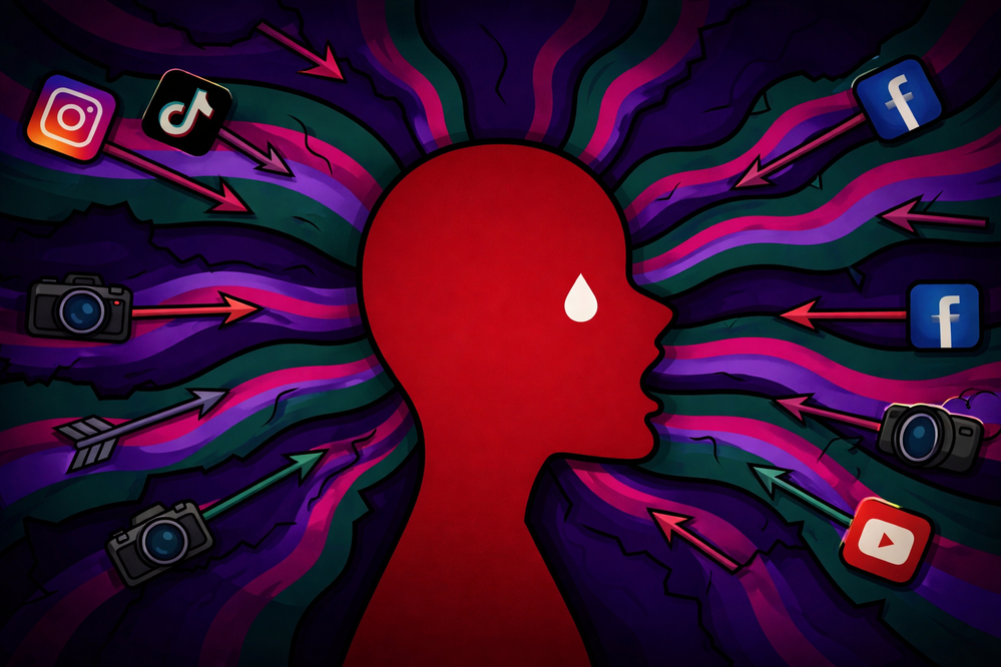
There has been a growing trend of 'digital lynching' targeting those who hold different views or criticize the government on social media. Such attacks are creating a frightening 'chilling effect' in society.
We use Google Cloud Translation Services. Google requires we provide the following disclaimer relating to use of this service:
This service may contain translations powered by Google. Google disclaims all warranties related to the translations, expressed or implied, including any warranties of accuracy, reliability, and any implied warranties of merchantability, fitness for a particular purpose, and noninfringement.
The Balendra Shah-led government arrested former Prime Minister KP Sharma Oli from his home on Chaitra 14. UML workers took to the streets in protest. Amisa Parajuli was in that crowd. She made a statement saying, ‘Arresting Oli is illegal’ and ‘No one is above the law’. Amisa’s statement spread on social media.
Amisa’s statement caused action and reaction on social media. But because of this statement, there was also a tendency to hate, threaten and abuse her obscenely. There were violent and obscene reactions in the comment section of Amisa’s video that went viral on social media. ‘Mimes’ with obscene meanings were also made on her statement.
‘The reactions in the comments were extremely scary and unbearable. Instead of expressing a different opinion, I had to face obscene abuse, character assassination and even rape threats,' Amisa told Kantipur. 'It was more of a digital violence response than criticism.'
Instead of expressing a different opinion, I had to face obscene abuse, character assassination and even rape threats - Amisa Not only obscene abuse was directed at her. Pictures of a person who looked like UML Chairman Oli applying vermilion were also circulated on social media. All of those pictures were created by AI. Similarly, some users also started giving personal 'threats', such as 'If you keep talking like this, I will rape you and throw you out'. The abuse against Amisa was not limited to social media. She started receiving such threatening messages personally. She had only kept her voice, but all the voices against her were of a kind that harmed her personally.
'It affected me deeply. It is not possible to read such violent threats and ignore them. It made me feel unsafe not only online but also in real life. When people start talking openly about sexual violence, it is not just a ‘simple comment’. It becomes a heavy burden mentally and emotionally,’ she says, ‘it has also exposed how unsafe it is to have a different opinion in our society.’
Amisha is neither the first nor the last to suffer violence through social media. According to the statistics of the Cyber Bureau of the Nepal Police, incidents of ‘harassment’ and ‘bullying’ through social media are increasing. According to the bureau’s Superintendent of Police Dilip Kumar Giri, looking at the statistics of the last 5 years, incidents of ‘harassment’ and ‘bullying’ have increased. While the number of complaints related to ‘harassment’ and ‘bullying’ in the fiscal year 2081/082 was only 1,801, it has increased to 2,678 in this fiscal year.
Statistics of the last five years
According to sociologists, such continuous cyber attacks are creating a frightening ‘chilling effect’ in society. People are taking to the path of ‘self-censorship’. Sociologist Samjhana Wagle Bhattarai argues that the trend of ‘digital lynching’ has increased recently against those with different opinions. ‘There has been an increase in the trend of ‘digital lynching’ targeting those with different opinions or criticizing the government on social media,’ she says. ‘This has created a situation where people are hesitant to express their opinions freely.’
AI expert Dobhan Rai also feels that many people have started censoring themselves when expressing their opinions publicly due to the fear of ‘digital lynching’ and being slandered. ‘Nowadays, the identity of the government and the people has been mixed in such a way that the narrative has been created that criticizing the government or leadership is an insult to the hopes of the people and their opinions,’ she says. ‘Nowadays, there is a clear division between ‘good’ and ‘bad’ in society. There is a growing tendency to immediately judge those who support the new party as ‘good’ and those who do not support it as ‘bad’ or ‘old party’s scum’.
Looking at the current scenario of Nepali social media, it is clear that political intolerance is at its peak here. The tendency of mobilizing an organized ‘troll army’ as soon as a particular party is supported or criticized is becoming common. Once trolling begins, an organized attempt is made to defame, harass, or ‘cancel’ a person on social media, with the aim of destroying his reputation, career, or mental health. In recent years, a name has been given to this phenomenon in Western countries—‘digital lynching’.
The latest example of this is Amisa. Some time ago, journalist Bishwa Limbu was ‘lynched’ by a ‘digital mob’ for expressing his opinion on social media. He had criticized the orientation program for the members of the House of Representatives of the National Independent Party (RSP) who were elected on February 21 at a five-star hotel. He praised the RSP's orientation program and questioned the venue of the program.
Going to the personal level, threats started coming in personal messages, including mother and father - Vishwa Limbu The 2-minute and 10-second video posted by a Facebook account called 'Vishwa Limbu Podcast' was filled with abuse against him. Questions were raised about his unverified involvement such as 'Hark's Jhole', 'Harke's Hali Mula', 'Harke's Journalist', 'Is this a journalist recruited by Harke?', 'Eat Harke's Gu'. Not only that, threats started coming in personal messages on identity and personal matters Various types of comments have been received. 'It is normal in the comment section. But on a personal level, threats started coming in through personal messages, targeting my mother and father,” Limbu said.
Smriti Timalsina also has the bitter experience of being abused for commenting against the government on social media. She is affiliated with a political party and is commenting, but she says that she has been receiving abuse and threats in the comments section of her social media because she has a different opinion. “Let alone obscene abuse in the comments section, I personally receive a lot of hateful messages in my inbox. It is disgusting to watch and read,” Timalsina said.
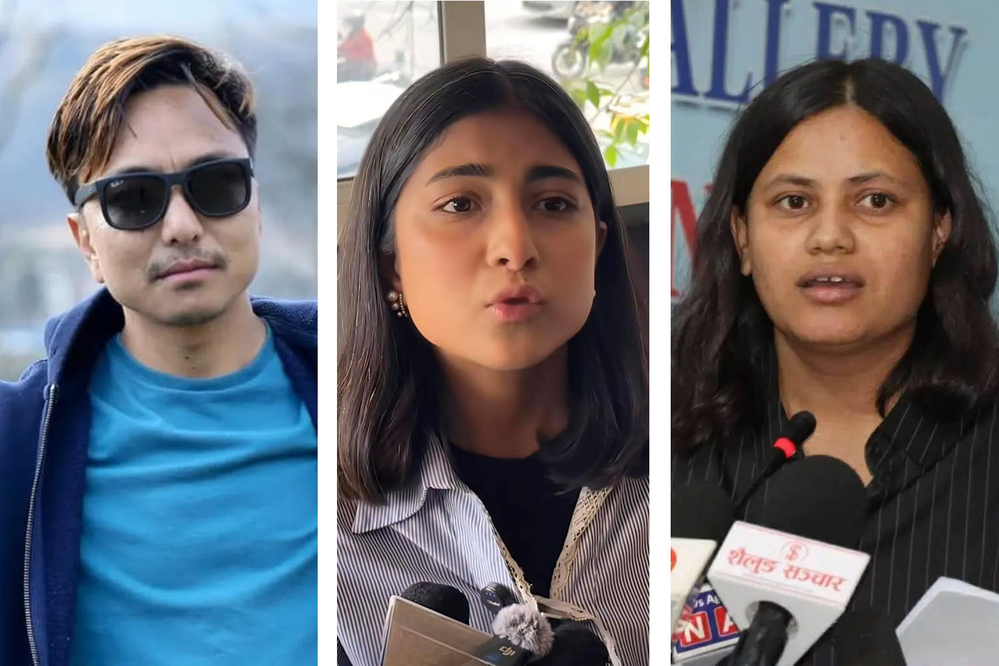
Timalsina has the experience of being arrested and interrogated by the police for uploading a video on social media. ‘I had uploaded a video related to the government’s Home Minister, and I was arrested because of that video,’ she said, ‘I was interrogated for 3 hours to find out who made me make that video.’
Not to mention obscene abuse in the comments section, he also received a lot of hateful messages in his personal inbox – Smriti Some time ago, ‘Comedy Champion’ director Vishal Bhandari had also been subjected to similar abuse on social media. Bhandari was criticized for inviting UML Secretary Mahesh Basnet as a guest on his reality show ‘Comedy Champion’.
As soon as UML Secretary Basnet appeared on the show, the program’s host and director Vishal Bhandari started being abused. ‘Rest in peace brother Vishal Bhandari’, ‘Jhole’ were used as abuse.
Some people made violent comments saying, ‘It’s time to skin Vishal Bhandari and make him lie on the road.’ Not only that, Bhandari has also been subjected to obscene abuse. Even people with Nepali flag profiles have used obscene abuse against her parents, children, and sisters.
Another artist who has been targeted by a mob on social media for making political comments is Navina Silwal. Known as 'Khuili', she spoke about the involvement of Rashtriya Swayamsevak Sangh (RSS) President Ravi Lamichhane in the cooperative fraud case and the general public being cheated. Because of her speaking on the same subject, content that assassinates her character began to appear on social media. Her photo was made viral on social media with objectionable messages attached to it with UML President KP Sharma Oli. She has been receiving threats ranging from rape to death. 'There are many who abuse her using obscene words and threaten to rape her, and they even attack her directly in personal messages,' said Navina. Content creator Suruchi Budhathoki has also experienced the intolerant trend seen on social media. After RSP President Ravi Lamichhane was released from Nakkhu prison during the Gen-G movement, she released a video saying 'Go back Ravi Lamichhane'. In the video, she stated that she did not agitate to release anyone from prison and expressed her opinion that it was wrong for anyone to be released under the cover of the Gen-G movement.
However, after the video was made public, abuse began against her on social media including Facebook, Reddit. The attack was not limited to her alone. Photos of her family members were also shared on social media. A page called 'Troll Tollywood' made a collage with family photos and made it public, calling them 'Nepo Kid', which was later made viral on pages including 'NEB Nepal'.
The film itself has even been boycotted because the actors expressed their opinions publicly. Singer Prakash Saput, while praising KP Sharma Oli at the launch of the book ‘KP Sharma Oli: Dreams, Struggles and Resolution’ on 19 Falgun 2081, said that we should learn from his struggle. He was not only insulted based on caste, but a campaign was launched to boycott his film ‘Basant’. Unable to bear the pressure, he finally had to publicly say ‘I made a mistake’. Similarly, model Smarika Dhakal was forced to apologize with folded hands before the video was released because she acted in a party song during the election.
‘Self-censorship’: A new era of silence
According to Santosh Sigdel, Executive Director of Digital Rights Nepal, this trend is a serious threat to democracy. "If political parties do not move forward saying they are ready to listen to questions and different opinions, an open society and democracy will not be promoted," he says. "Such practices risk the disappearance of dialogue and questions from society, and the growth of a leader-oriented system."
Former Deputy Inspector General of Nepal Police Rajiv Subba, who has a PhD in social media, also believes that freedom of expression is weakening in the digital space. Recalling John Suller's 'disinhibition effect' theory, he said, "In the digital world, people consider themselves 'anonymous' (secret). The thought that no one knows me and no one can do anything increases the tendency to behave aggressively, which is called the 'disinhibition effect' in social science." That's why they make hateful statements against others.'
The persecution of 'digital violence' against women
Thus, those who experience 'digital lynching' on social media can no longer speak openly. ‘I used to express my thoughts openly, but now I only express them after thinking about it a lot,’ says journalist Limbu. ‘I have started to have doubts in my mind that I will be insulted before I say anything.’
Smriti, who was questioned by the police for uploading the video, is now afraid to express her thoughts. ‘I am starting to be afraid to express my thoughts confidently. Yesterday, when our leaders were not afraid when the price was set for the head, why should we be afraid,’ said Smriti, ‘but now I am worried that I will not be able to speak freely.’
Content creator Budhathoki has also decided not to express her opinions on social media. After Ravi Lamichhane made a video saying ‘Go back’ when he was released from jail, he was trolled not only by him but also by posting pictures of his parents. परिवारमाथि नै प्रहार भएपछि उनी भन्छिन्, ‘म र मेरो परिवारमाथि आएको घृणा देखेपछि सामाजिक सञ्जालमा बोल्न नसक्ने अवस्था आएको छ।’
यस्तो लिन्चिङमा पनि सबैभन्दा बढी महिलाहरू नै प्रभावित छन्। ‘सामाजिक सञ्जालमा हुने गालीगलौजको प्रभाव पुरुषको तुलनामा महिलाहरूमा अझ बढी र डरलाग्दो छ,’ समाजशास्त्री भट्टराई भन्छिन्, ‘हाम्रा सामाजिक मूल्य–मान्यताभन्दा बाहिर गएर गरिने असभ्य र सुन्नै नसकिने खालका गालीहरूले महिलाहरूको अभिव्यक्ति दिने साहसलाई कमजोर बनाइरहेको छ।’
कानुनको अभाव
यसरी जथाभावी टिप्पणी र गालीगलौजको प्रवृत्ति बढ्नुमा बढ्दो ‘डिजिटल कल्चर’ र अल्गोरिदमको प्रभाव पनि छ। ‘फेसबुक, टिकटक र एक्स (ट्विटर) जस्ता प्लेटफर्मका अल्गोरिदमहरूले उत्तेजक, नकारात्मक र घृणा फैलाउने ‘कन्टेन्ट’लाई बढी प्रोत्साहन गर्छन्। प्रयोगकर्ताहरूलाई आफ्नै विचार मात्र सही लाग्ने ‘इको च्याम्बर’ भित्र कैद गरिन्छ,’ एआई विज्ञ राई भन्छिन्, ‘दलका ‘बट आर्मी’ र नियोजित अभियानहरूले यही अल्गोरिदमको फाइदा उठाउँदै फरक मत राख्नेहरूमाथि सङ्गठित आक्रमण गर्छन्, जसले गर्दा स्वस्थ राजनीतिक बहसको सट्टा ‘डिजिटल लिन्चिङ’ को अवस्था सिर्जना हुन्छ।’
महिलामाथि डिजिटल हिंसा बढ्दो : ४ महिनामै २ हजार उजुरी
तर यस कानुनको कार्यान्वयन प्रक्रिया यति सुस्त र झन्झटिलो छ कि पीडितले तत्काल न्याय र राहत पाउने अवस्था छैन। उजुरी दिए पनि नक्कली आइडीबाट गरिएका आक्रमणका दोषीसम्म पुग्न प्रहरीलाई प्राविधिक कठिनाइ हुने गरेको छ। अमिसाले पनि साइबर ब्यूरोमा यही दफा अन्तर्गत गत चैत १८ गते उजुरी दिएकी छन्, तर अहिलेसम्म एक जना मात्रै पक्राउ परेका छन्। ‘कसैले अरूको फोटो र नाम प्रयोग गरेर सजिलै नक्कली आइडी बनाउन सक्ने भएकाले वास्तविक दोषी पत्ता लगाउन गाह्रो हुन्छ। फेसबुक जस्ता प्लेटफर्मले आइडी, यूआरएल र आईपी ठेगाना उपलब्ध नगराएसम्म वास्तविक व्यक्तिको पहिचान गर्न सकिँदैन,’ साइबर ब्यूरोका प्रवक्ता गिरी भन्छन्, ‘फेसबुक, एक्स (पुरानो ट्विटर), इन्स्टा लगायत कुनै पनि सामाजिक सञ्जालहरूको नेपालमा क्षेत्रीय कार्यालय छैन। हामीले सबै विदेशमै लेख्नुपर्छ, तर उहाँहरूले ‘क्विक’ रेस्पोन्स दिनुहुन्न। लामो समयसम्म कुराउनुहुन्छ, कुनै त रेस्पोन्स पनि आउँदैन। त्यसले हामीलाई सकस भइरहेको छ।’
साइबर ब्यूरोमै काम गरेका पूर्व एसपी पशुपति राय कानुनी स्पष्टताको अभाव र प्रक्रियागत ढिलाइलाई मुख्य चुनौती मान्छन्। राय भन्छन्, ‘अहिलेको कानुनी व्यवस्थामा गालीबेइज्जती सम्बन्धी मुद्दाहरू अनुसूची ४ अन्तर्गत रहेकाले पीडित आफैं अदालत जानुपर्ने बाध्यता छ, जसले गर्दा प्रहरीले सिधै अनुसन्धान गर्न पाउँदैन। यदि यस्ता मुद्दामा प्रहरीलाई नै जिम्मेवार बनाउने हो भने मुलुकी अपराध संहिताको दफा ३०६ र ३०७ लाई अनुसूची १ मा समेट्नुपर्छ।’
उनका अनुसार विद्युतीय कारोबार ऐन, २०६३ को दफा ४७ ले मात्र साइबर अपराधका सबै पाटोलाई सम्बोधन गर्न नसक्ने भएकाले प्रचलित कानुनलाई अझ स्पष्ट र परिमार्जित बनाउनु आवश्यक छ।