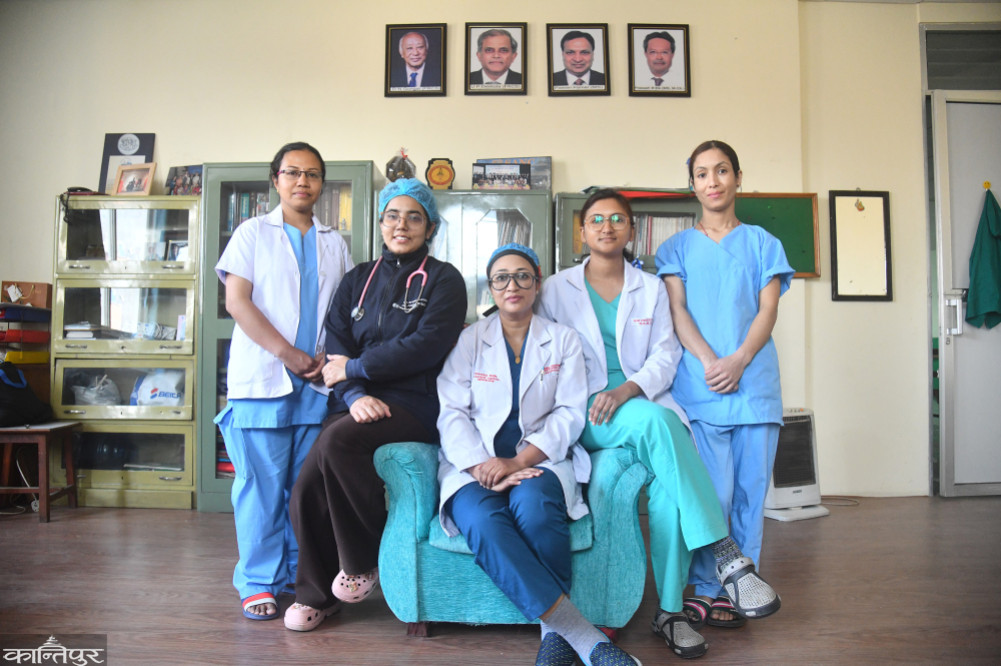
This team of female doctors has so far completed 60 surgeries in two weeks at National Trauma Center and Veer Hospital
We use Google Cloud Translation Services. Google requires we provide the following disclaimer relating to use of this service:
This service may contain translations powered by Google. Google disclaims all warranties related to the translations, expressed or implied, including any warranties of accuracy, reliability, and any implied warranties of merchantability, fitness for a particular purpose, and noninfringement.
In the operation theater of the National Trauma Center in Kathmandu, an operation to remove a brain tumor was going on. Complex surgeries involve a team of mature surgeons, anesthetists and nurses. Like other times, the group was led by Prof.Dr. Rajiv Jha had to do it. However, he Dr. Moving Namrata Khadka forward, he said, 'You should do this operation.'
Dr. Under the leadership of Namrata, the neurosurgeon Dr. Pooja Chaurasia, Anesthetist Dr. Smriti Acharya, Anaesthesia Nurse Poonam Maharjan, Nurse Ishwari Rajbhandari were deployed. The patient had a tumor on the left side of the head. The tumor was carefully removed by incising the scalp. In such a situation, if there was a slight disturbance, the right side could not move. After a few hours of continuous efforts, the operation was completed. The patient's senses were opened. A CT scan showed everything was fine.
The first surgery performed by the women's team in the second week of February was successful. Since that day, the women's team for neuro surgery has started to become active. "This is probably the first time I have seen a complete team of female doctors and nursing staff for neurosurgery," said Prof. Dr. Jha says, "I have not seen such a team of female doctors not only in Nepal, India, but also in America." This team of female doctors has successfully completed 60 surgeries in two weeks. They have been operating at National Trauma Center and Veer Hospital. "Both body and mind should be strong for neuro surgery," Dr. Namrata said, "Those who are in a hurry and reluctant cannot do such a thing."
Dr. Dr. Dr. Pooja belongs to Chaurasia. "The patient's condition can be anything with a little time difference," she says, "We have saved many patients who were dying." The brain is a very sensitive part of the body. It controls all parts of the human body. "Therefore, while performing brain surgery, one should be very careful not to damage other organs," she says. In this team of
female surgeons, Dr. Smriti Acharya works on anesthesia. "We analyze whether the patient can be made unconscious or not," she says. "Surgeons operate the brain, there are important nervous systems of the body," Dr. Smriti said, 'In such a situation, the patient should be kept in normal condition. Whereas, during brain surgery, there is a risk of heart rate changes, breathing problems, blood pressure being lower and bleeding more.'
Prof.Dr. According to Jha, neurosurgery is comparatively more complicated than other surgeries. "There is a risk of the patient being paralyzed or even dying if the surgery is slightly below the pre-planned," Prof. Dr. Jha says, ``Emergency surgery should be decided immediately. You have to stand and work for hours. It is exemplary how the female medical team is doing the mentally and physically very challenging and difficult surgery easily.' Namrata said. She said that she did not feel uncomfortable even during the surgery because of her desire and determination. Dr. It has been seven years since Namrata started surgery. It has been only three years since he started participating in neurosurgery. From Bhaktapur, Duwakot, she studied medicine on scholarship. "Even when I was a child, I used to operate on dolls," she said with a laugh. Chaurasia also wanted to become a doctor since childhood. Mother is a housewife, father is a worker. I wanted to be a doctor. I thought I would become a neurosurgeon if given the opportunity," she said. "Maybe it's because of my desire since childhood. Smriti Acharya's father works in a hospital and mother is also a nurse. "That's why I have grown fond of this area," she said.
While working as a medical officer in the anesthesia department of Dhulikhel Hospital, he became interested in becoming an anesthesiologist. She made her career in this. "During surgery, we also have to work like surgeons," she says, "I have taken this work as a passion." So it doesn't seem difficult. They say that they are moving forward in a complex field like neurosurgery because of their 'inner passion and desire'. "We want to see the patients we operated on recover and return home," said Dr. Namrata says, 'We forget all our sorrows at that time.'
Tabassum's Sanskrit love
Being born in a Muslim community, getting higher education was not an option at a time when it was difficult to even walk outside the house. Tabassum Siddiqui of Nepalgunj-11 is lucky in this sense. With the support of family members, Tabassum has recently completed her graduation from Nepal Sanskrit University on 'Comparative study between Hindu architecture and Islamic architecture and its impact on Nepali architecture'. To make this long journey, Tabassum said that she completed her research by reaching India, Malaysia and Pakistan.
father Dr. Tabassum said that Saladin Akhtar Siddiqui and mother Sarwar Jahan always inspired her to study. His father is a former judge. Tabassum said that the correct guidelines of the parents made them excited for studies. She felt sad that other women in the community did not have the same opportunities as she did. According to the community, it is customary to go to an Islamic school to preserve the culture, but Tabassum and her siblings were able to study in a boarding school.
Tabassum Siddiqui's
She completed her SLC from Brightland School in 2053 and completed plus two from the local Mahendra High School. Ever since she was young, she thought that she could have built her house according to her own design, then she decided to study architecture. "My father said yes," she said, "my heart would be happy if my house and many others would be built according to what I said." After that, she completed her master's degree from the National College of Arts in Lahore, Pakistan.

She said that she was surprised when she met friends from other countries during her studies abroad and understood their culture and architecture. After completing her studies, she returned to Nepal and started teaching in Kathmandu. His sister is a medical doctor and his brother is an engineer. Tabassum, who has been teaching architecture at Kantipur International College in Kathmandu since 2014, is also helping women from the Muslim community to study. Earlier, she worked as a teacher and researcher in other colleges in Pakistan, UAE and Nepal.
She says that she is very happy to make history as the first woman from her community to graduate from Sanskrit University. He said that he chose the subject of education to inform the people of Muslim countries about the art and architecture of his country and to introduce Muslim art and culture in Nepal. "My father taught me that in order to move forward, I should understand the society I live in," she said, "I studied Hindu society, understood it and studied to understand it." Tabassum says that she studied in Malaysia, Pakistan, Saudi Arabia, UAE, India and other countries while completing her studies. .
She said that she studied at Sanskrit University to change the discriminatory mentality that people think. His father also completed his studies from Sanskrit University. Tabassum said that she chose Sanskrit University to convey the message that the university creates a non-discriminatory learning environment for anyone who wants to study, not just Hindus. She said that many topics related to architectural studies are related to Vedas and since Vedas are in Sanskrit language, Sanskrit University was her choice.
After Tabassum completed her education, there is a happy atmosphere in her family. She says that the happiness of her parents has given her more energy. Tabasmum said that an organization named 'The Mother Foundation Nepal' has been registered and a platform has been prepared for those who want to understand and move forward through discussions.
Sutkeri Syahar Nai Ilam
78-year-old Hiramoti Chaudhary of Birendranagar Municipality-9 Tilpur does not remember how many deliveries and babies she has massaged with oil. He only remembers glimpses of children of various colors, mothers struggling with labor pains. Hiramoti, who has 37 years of experience in maternity care, learned this job from her elder sister. I worked as a midwife for a long time. Since it is not customary to take the child to the hospital for delivery, I did everything from taking out the baby, cutting the umbilical cord to taking care of the delivery," she said.
Oiling newborns and pregnant women is not as easy as you think. Mustard oil is heated and fenugreek and jawana are heated and massaged, changing the clothes, bathing and massaging the newborn baby, understanding the sensitivity, requires experience. As she is skilled in this work, Hiramoti is known as 'Sutkeri Syaharne Didi' by all the surrounding villagers. In the early days, his skills did not earn him the respect of the profession. She used to get meager wages for a week of maternity care. Now she understands up to 5 thousand. ``And everyone gives me a piece of cloth,'' says Hiramoti, who has brought up her five daughters and two sons by taking care of them during childbirth. Earlier, I used to earn all my household chores like this.'
Hiramoti has left this profession for 2 years. However, being experienced, some call by hand. Some of the women from their own community also come to ask for job training.
63-year-old Lalu Chaudhary is still in this job. Lalu, who lives in Tilpur, is not busy taking care of the pregnant woman. After the birth of her grandson in 2063, she started working as a midwife. When she started working 17 years ago, she used to get a salary of 2000 rupees for a week of maternity care. Now she takes 6,000 for the same amount of time. Experienced Lalu is also called by people from far and wide. However, the sorrows of going and returning do not go far.

41-year-old Neeta Chaudhary of Birendranagar-2 Koldanda was left by her husband after the birth of four daughters in a row. And she came to the profession of maternity care in search of an opportunity to earn money. A daily wage of 700 rupees and some sweet khanki is helping him to meet his household expenses. Like Neeta, 40-year-old Kamala Chaudhary of Birendranagar-9 Kalimati has been working as a midwife for seven years. This skill is useful to her to avoid the financial crisis that occurred after the death of her husband a year ago. Kamala learned this job from her mother. She initially earned Rs 500 and now earns Rs 1,000 a day.
Around Surkhet, women from the Tharu community are often involved in the nursing profession. This work is helping them to earn money and avoid family problems. There is a need for professionalism in this profession as it is being done in a traditional way. The profession also has its own practical difficulties as it relies on mutual trust between the client and the service provider. Tharu women involved in maternity care share the common experience of being respected and well paid for this work.
Tharu community leader Man Bahadur Chaudhary said that Tharu community women have been working as midwives for a long time. In the Tharu community, midwives are called Sorinya. "Sorinyas used to take care of women from the moment they were pregnant. They were also present during childbirth. Paddy and clothes were given for this work.' According to Man Bahadur, the interest of the new generation towards the profession of midwifery care is decreasing. Dr. Obstetrician and Gynecologist working in Province Hospital Surkhet. Lalitjung Shahi said that heating the oil and massaging it will help to strengthen the weak body. Even tired muscles are active with massage. On the whole, it is good," he said, "but it is equally important to pay attention to the fact that using very hot oil can affect a small child."