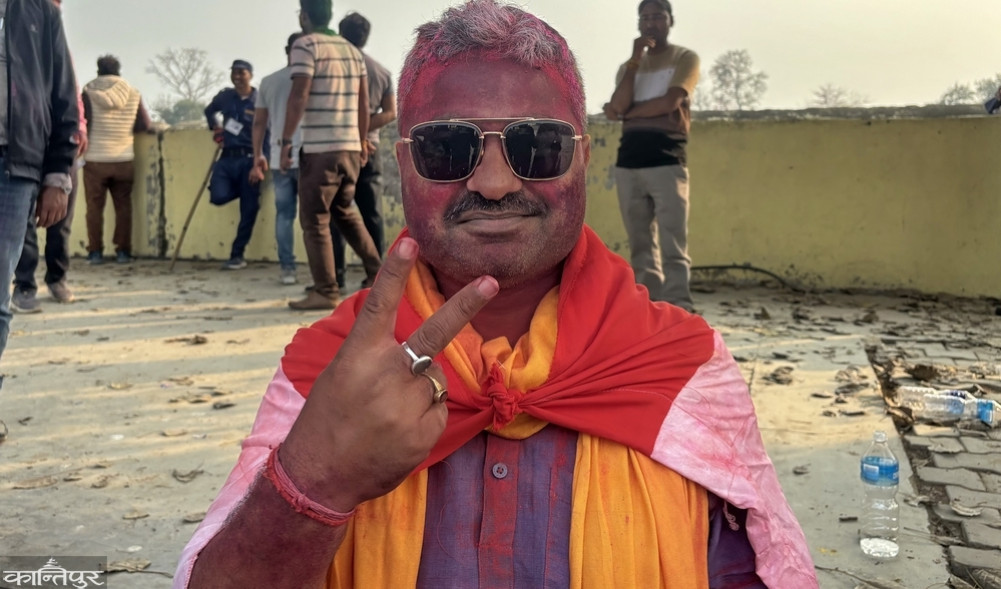
In this election, both Abhishek Pratap Shah and Birendra Kumar Kanodia were aspirants from the Congress in Kapilvastu-3, and one of them was certain to get the ticket. Three days before the filing of candidacy, Kanodia suddenly changed parties and filed his candidacy from the UML. Meanwhile, Shah, after struggling within the Congress, got the ticket and won the victory.
We use Google Cloud Translation Services. Google requires we provide the following disclaimer relating to use of this service:
This service may contain translations powered by Google. Google disclaims all warranties related to the translations, expressed or implied, including any warranties of accuracy, reliability, and any implied warranties of merchantability, fitness for a particular purpose, and noninfringement.
Abhishek Pratap Shah, who became a member of the Constituent Assembly at the age of 25, is entering parliament for the fifth time at the age of 43. Shah, from Krishnanagar Municipality-2, Krishnanagar Bazaar, has defeated a powerful person from Kapilvastu Constituency No. 3 on behalf of the Nepali Congress to enter parliament.
He has defeated former federal ministers of state Birendra Kumar Kanodia and Ishwar Dayal Mishra, Nepali Communist Party's central advisor Ehsan Ahmed Khan, and the Rashtriya Swayamsevak Sangh candidate Prakash Rajouria, who is running in the country. Apart from Mishra and Rajouria, Shah, Kanodia and Khan are residents of the same village.
In the Falgun 21 election, both Shah and Kanodia were aspirants from Kapilvastu-3 from the Nepali Congress, and one of them was sure to get the ticket. The regional committee of the Nepali Congress had recommended Kanodia's single name. However, three days before the candidacy registration, Kanodia suddenly changed parties and filed his candidacy from the UML. Meanwhile, Shah got the ticket after struggling within the Congress and won the victory garland.
Kanodia was elected as a member of the Lumbini Provincial Assembly from Kapilvastu 3 (2) in 2074 and played a long role as the leader of the main opposition party, the Congress, in the Provincial Assembly. Mishra, who won the Constituent Assembly from Tamalopa in 2064, also served as the Minister of State for Physical Construction for some time. Shah has now registered victory, leaving these top politicians behind.
Although it was difficult to compete with experienced leaders and former ministers in the election, he has secured a huge vote of the people and has set his path to parliament. He used his youthful spirit and the experience of skilled eloquence in parliamentary practice this time. He said that the people's vote has made him excited and responsible. 'The people have once again given them a huge vote with great confidence.' The responsibility to work by respecting this vote has been added to me,' he said, 'This is both an opportunity and a responsibility for me.'
He said that he has had a strong attachment to religion and culture since childhood. He also said that he is harsh towards those who go against religion and culture. He did not tolerate injustice and tyranny since he was in school. He is considered to be of a rebellious nature, always raising his voice against corruption and injustice. He is equally firm in good governance and discipline.
The Shah family had a 'legacy' of Congress since before 2015. In 2015, Abhishek Pratap's grandfather Shiva Pratap won the election and became a minister. Abhishek, who started politics in 2063, joined the Congress in 2074.
He said that his victory was possible only because of his ability to understand the feelings and aspirations of the youth and work. ‘I have a lot of plans for the youth to do and how to make them employable and entrepreneurial, that is why they are attracted to me,’ he said.
He was first nominated as a member of the House of Representatives in 2063. Girija Prasad Koirala nominated Abhishek after the death of his father Ajay Pratap Shah, who was elected from the RPP.
Shah was elected as a member of the Constituent Assembly from the Madhesi Janadhikar Forum in 2064 and 2070. In the House of Representatives elections held in 2074, he was elected as a candidate from Kapilvastu-3 on behalf of the Nepali Congress. In 2064, he was the youngest member of the Constituent Assembly in the country and was 25 years and 3 months old when he was elected. After completing his BBA from BBNITM College in Lucknow, India, he joined the Nepali Congress in 2074. After that, he became an invited central member. After joining the Nepali Congress, he has been elected as a member of the Mahasamiti every time. Before joining the Congress, he was the party's central joint general secretary in the forum. He said that he had the experience of four parliamentary trips at a young age. He said that he now has many plans for small enterprises and employment to keep the youth in the country. He said that there are local issues and needs, and he will take the initiative to implement policies and plans to increase trade with three nearby countries to strengthen the country's economic position. 'Money is indispensable for development and employment.' For that, foreign trade and business are the main thing in the current situation, he said. 'Now it is necessary to strengthen the country's economic position by running the government under the leadership of the youth.' He also said that since the youth of today have started looking for a future in cricket, he has planned to build an international-level stadium in Krishnanagar for them. "Whether it is NPL games or one or two IPL matches, it is possible to develop the sports sector if it can be played in the district," he said, "I have made a plan to earn good income from sports tourism as well."
Shah won by a margin of 4,645 votes. He got 23,535 votes, while his nearest competitor Prakash Rajouria of the National Independent Party got 18,890 votes. Rajouria, who had become a candidate from the Rastriya Prajatantra Party in 2079, joined the Rashtriya Swatantra Party and became a candidate this time. This constituency, which includes the western part of the district, is particularly in the news during elections. Shah won the victory by defeating 12 of the party's and 23 independent candidates.