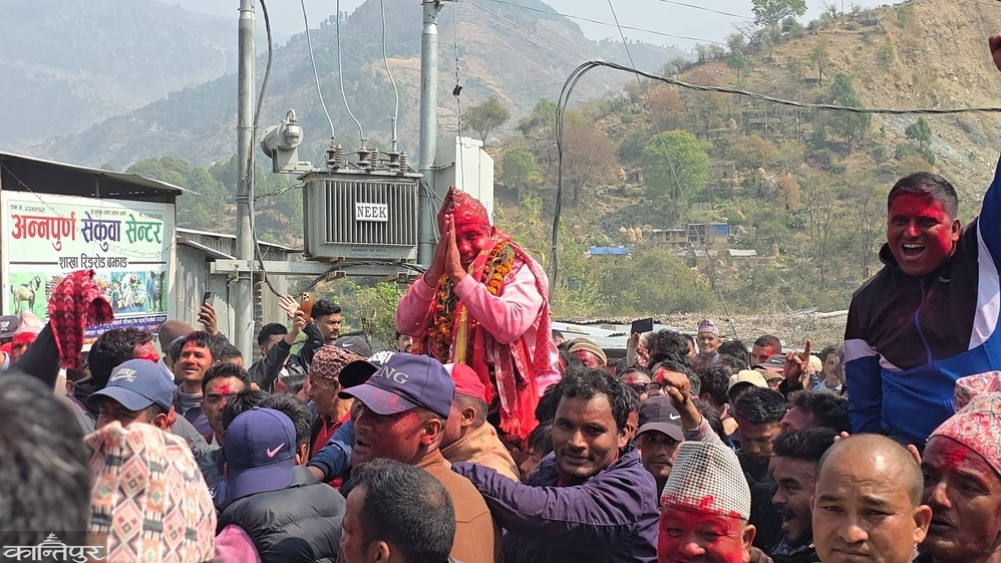
Mahar's sister Chandani Mahar says that his strength was his confidence, as he did not give up his political stance despite the non-cooperation of his father, who had also become the VDC chairman from the Congress, while working in a student organization close to the UML.
We use Google Cloud Translation Services. Google requires we provide the following disclaimer relating to use of this service:
This service may contain translations powered by Google. Google disclaims all warranties related to the translations, expressed or implied, including any warranties of accuracy, reliability, and any implied warranties of merchantability, fitness for a particular purpose, and noninfringement.
On the one hand, the unprecedented unity seen in the Congress of Bajhang, on the other hand, the intense dissatisfaction with the ticket tussle within his own party. It was not easy for UML candidate Ain Mahar to turn the results in his favor in both these situations. He was much more likely to please the leaders and workers of his own party than the people's votes.
Realizing that reality, he finally organized a press conference a few hours before the start of the silence period. In the press conference, which was held together by all the leaders of the district, from Afilal Okheda, who was upset over the loss of his ticket, to Constituent Assembly member Lal Bahadur Rawal, former Speaker of the Provincial Assembly Arjun Thapa, all the leaders said that there was no dissatisfaction within the UML and called for Mahar to win. As a result, this strategy of Mahar brought him victory.
In the vote counting held on Saturday, he managed to beat his nearest competitor Prakash Rasaili by a margin of 2,239 votes. UML's Mahar won by getting 18,543 votes, while Congress's Prakash was reduced to 16,304 votes. Out of the 58,944 votes cast in Bajhang, NCP's Min Bahadur Kunwar received 9,757 votes and Rashtriya Swayamsevak Sangh's Shailesh Kumar Singh received 9,263 votes, according to the Office of the Chief Electoral Officer.
Journey from student leader to MP
Mahar, who was born on 2 Chaitra 2040 in Bajhang's Subeda VDC (currently Jayaprithi Municipality-7) to father Ram Bahadur Mahar and mother Ratna, has had a political journey full of ups and downs. Mahar, who is studying MPhil after completing his master's degree, had previously suffered defeat in the 2079 BS election. He was 998 votes behind Bhanubhakta Joshi, the candidate of the CPN-Socialist party, who became a candidate from the alliance.
Mahar started his politics with the ANNFSU from Askal Campus in 2055 BS. Mahar, who became a central member at the 19th session of the ANRFSU held in Pokhara in 2065, became a secretariat member in 2067, became vice-president in 2070, and became president of the same organization in 2076. He is the first person to become president of ANRFSU from Karnali and Sudurpaschim provinces. Mahar, who won the central member seat at the UML general sessions held in 2078 and 2082, was an active participant in the People's Movement 2062/063. Mahar, who was active in social work during the earthquake and the Covid pandemic, raised a loud voice for the reform of Nepal's education sector as a student leader.
The family members of Ain, who became a leader of the UML after rebelling against his father, Ram Mahar, who was active in Congress politics, are happy that his struggle was successful. Despite the non-cooperation of his father, who had also become the VDC president of the Congress while working in a student organization close to the UML, Mahar's confidence was his strength, says his sister Chandani Mahar. 'He was never distracted in his nature and stance. When he was injured repeatedly during the movement, his father pressured him to quit politics. But, he did not agree,' says Chandani, 'Finally, his dream of leading the people of Bajhang has come true. Today, not only our family, but also the dream of Bajhang to make Ain Mahar its representative has been fulfilled.'
Mahar, who remains in touch with the locals of all wards of Bajhang, has committed to addressing the basic problems of Bajhang and moving the district forward on the path of development during his tenure. While touring the villages of the district during the election campaign, he has committed to gradually fulfilling the demands of the locals and making Bajhang a center for roads, communication infrastructure, hydropower production, and creating employment opportunities through tourism, agriculture, and herbal medicine. 'I will make every effort to bring the voice of Bajhang to the center and to bring the center's resources to the remote settlements of Bajhang, and to highlight the potential of Bajhang district,' he said, 'I will not let the trust placed in the people of Bajhang turn into disappointment.