Forty-three candidates are vying for two constituencies in Gulmi. Will they debate the issues of stalled development plans, development infrastructure that has been incomplete for years, and empty villages?
We use Google Cloud Translation Services. Google requires we provide the following disclaimer relating to use of this service:
This service may contain translations powered by Google. Google disclaims all warranties related to the translations, expressed or implied, including any warranties of accuracy, reliability, and any implied warranties of merchantability, fitness for a particular purpose, and noninfringement.
The mid-hill district of Gulmi does not have any problems different from other neighboring districts. But there are some special difficulties in development and infrastructure. Such issues come to the surface in every election and over time, the parties forget about them. Due to poor access to development and infrastructure, the population in Gulmi is decreasing by 1.23 percent. The literacy rate of this district, which has 65,049 households, is slightly above 80 percent.
There is a large population dependent on traditional agriculture, but the parties have not been able to bring the issue of how and according to which plan to transform it into a debate. Kiwi and orange cultivation has started in the area planted with millet and corn, but there has been no debate on how to promote it in the long term. Currently, 480 metric tons of kiwi have been produced in the 90 hectares of the district. Kiwi production has increased by 19 percent this year compared to last year. But the candidates do not seem to have discussed how to market and modernize it.
Gulmi is a hilly district. The district has produced 5,017 metric tons of oranges in an area of 816 hectares, bringing in an income of Rs 206.78 million. But this income is 32 percent less than last year. Despite the fluctuations in production, orange farming is attractive. But how to diversify production and how to keep farmers involved in orange production has not become an election issue.
There are very few young women in the village. Most of them are in foreign employment, either in India or third countries. Gokarna Nepali, who is cultivating grass through Galaxy Agriculture and Livestock Farm in ISMA Rural Municipality-3, is an exception. The 26-year-old Nepali, who has been cultivating grass for seven years, is producing plants through a nursery along with grass farming on 120 ropanis of land. He, who also raises goats, is keen to make his interests and concerns an election issue.
Young Meghnath Aryal, who has been raising more than 35 buffaloes, both small and large, in Dhurkot Rural Municipality-6, Sistung, also has similar expectations. Aryal is marketing local Dhurkote rice through the Food Processing and Packaging Industry. He is cultivating rice on 72 ropanis personally and 28 ropanis on rent. He also shared his experience of not being able to hear what the candidates have planned for entrepreneurs who are trying to do something in the village.
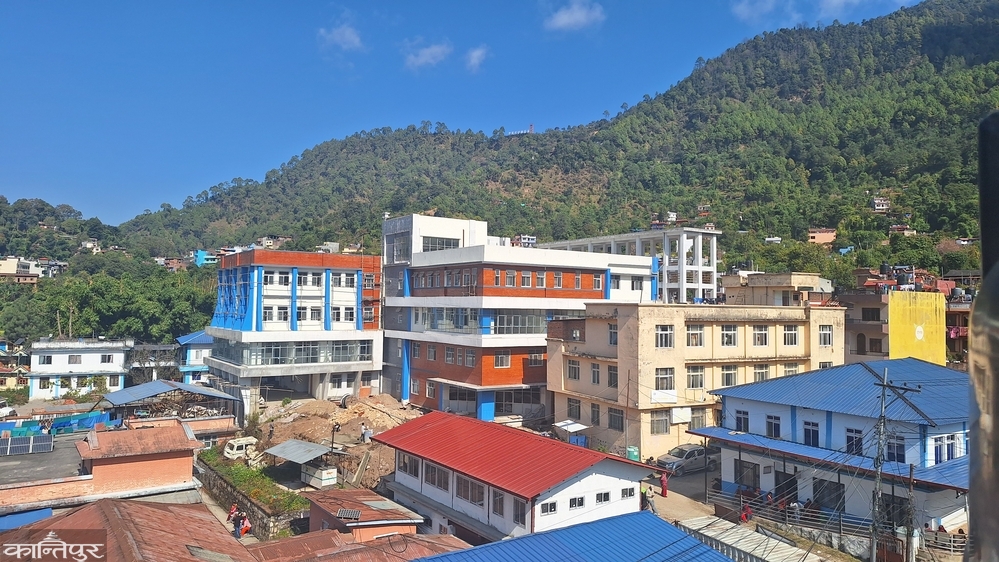
Another young man, Bishal Thapa, is currently raising 150 goats in Gulmidarbar Rural Municipality-6, Bansatari. Along with goat farming, he is cultivating coffee, oranges and lemons through Resunga Agro and Research Farm. He has also cultivated rice and corn on 300 ropanis personally and 500 ropanis on rent. He is cultivating Akbar chillies on 70 ropanis of land, vegetable farming in 18 plastic tunnels, 500 orange trees and 300 banana trees. They have five buffaloes and two siroi, four bier and 15 local goats. Young people like Vishal are concerned about the role the state plays in the prospects of local agriculture.
Kavita Bishwakarma of Nayagaun, Dhurkot Rural Municipality-1, has cultivated oranges commercially. As the outbreak of diseases and pests is increasing in the area, there is a problem of irrigation. We have to rely on rainwater. ‘The main problem is irrigation,’ she said, ‘There is also a shortage of fertilizer for farmers.’
Farmers like Gokarna, Meghnath, Vishal and Kavita, who are engaged in agricultural enterprises in their villages, are disappointed that the youth have left due to the lack of fertilizer, irrigation and skills. Locals cite the fact that the local level is providing many services by reaching every nook and corner and house to house, and the compulsion to go to the district headquarters to collect social security allowance, as was the case a few years ago, as examples of recent developments.
In the health sector, Resunga Municipality is providing incentive allowances equal to the salary of 6 specialist doctors at Gulmi Hospital in Tamghas, the district headquarters. This has provided reliable service. The municipality has been conducting free health camps in every ward every year. Due to which the patients have benefited. Due to the social security allowance, senior citizens do not have to depend on others for basic food, clothing and treatment. They have become self-sufficient.
Gulmi district is crossed by three main highways, namely Madanbhandari Highway, Saljhandi-Dhorpatan and Kaligandaki Corridor. Although the Kaligandaki Corridor road has been paved, there is no bridge over the Khahare River. The process of contracting for the bridge is in progress.
The work on the Chidichaur playground in Tamghas, the district headquarters, is at a snail's pace. Resunga Municipality had secured a budget from Lumbini Province as a multi-year contract to plant trees at the Chidichaur playground. Ramechhap Construction, Kathmandu, was given the responsibility of constructing the Chidichaur playground at a cost of Rs 10 million through the Lumbini Province Government's Social Development Division Office, Palpa in the last week of Baisakh. The work was stalled for some time and is now progressing at a very slow pace.
The construction of the 50-bed Gulmi Hospital building, which was supposed to be completed in two years, has not been completed for four and a half years even after the third extension of the deadline. The last time the building was supposed to be completed by mid-Poush, the work has not been completed. The work was being done through the then Intensive Urban and Building Construction Office, Rupandehi, through PMC Consultant CSIR with full financial support from the Government of India. Currently, this road is being implemented by the Urban and Building Construction Project, Palpa. The responsibility for the construction of the hospital building was awarded to the Swachhand/Baniya JV, Makawanpur on 2078 Ashad 18 for a total of Rs 259.4 million excluding VAT and to be completed on 2080 Ashad 17.
The construction of the 'Simaltari-Sautamare-Machhi' road in Gulmi under the Madan Bhandari Highway is being carried out at a slower pace than a turtle. Even though the deadline for completing the construction of the 16-kilometer road section of the Gulmi section and the 15-kilometer road section of the Pyuthan section has expired, only 26 percent of the work has been completed.
An agreement was signed between the Madan Bhandari Highway Planning Office, Tamghas and Shrestha Saksham JV on 2079 Kartik 6 to blacktop the 31-kilometer road from Simaltari in Gulmi to Sautamare and from Sautamare in Pyuthan to Machhi. It is said that the agreement was made to complete the construction on 2082 Shrawan 5 for a total of Rs 1.45 billion. Even though the deadline has expired, only 26 percent of the physical progress has been made. The strategically important 'Saljhandi-Sandhikharka-Dhorpatan' road, which connects five districts of two provinces and connects the Terai and the hills in close proximity and covers 10 municipalities, has not made the expected progress due to the low budget.
This plan was started in the fiscal year 2066/067 to blacktop 197.2 kilometers of roads, including 5 kilometers in Rupandehi of Lumbini Province, 17.7 kilometers in Palpa, 73 kilometers in Arghakhanchi, 40 kilometers in Gulmi, and 61.5 kilometers in Baglung of Gandaki Province. There is a total budget of 391 million rupees. Although it is estimated that 12 billion rupees will be needed to complete this plan, the budget has been allocated in a small amount. Although work worth four billion rupees has been completed so far, work worth eight billion rupees is still pending. If the budget is allocated at the current rate, it is likely that it will take 20 years to complete the plan.
There are narrow roads and difficult turns leading to the district headquarters. Although this road section is now Madan Bhandari Highway, the Road Division Office, Palpa, is supervising it until it is handed over. However, even though the road is wide from Reedi to Birbas, there is no finalization of the section from Gaundakot to Tamghas. There is no preparation for the contract for this road. Although the federal government said that the construction should be completed within two years of the foundation stone laying, only two out of the 15-bed hospitals in 11 municipalities of Gulmi have been completed. But such issues have not become election issues.
There is no finalization on when the hospital to be built in Malika Rural Municipality will be built. Because the local government had not finalized the land for the first two years. While building a hospital near Thulichaur, it was moved down a bit because the land was not available. Although Khadka/Sagun JV signed an agreement to build the hospital at a total cost of Rs 116.7 million, the contract was canceled and re-contracted citing land risks. Jagat Poudel, Information Officer of Malika Rural Municipality, informed that the ground floor work is underway after the previous contract was cancelled and re-contracted.
Currently, SCSPL/DLB JV, Bhaktapur is working at the site at a total cost of Rs 154.1 million. Although the construction period was two years, Malika Basic Hospital has achieved only 10 percent physical progress after five years. Although the construction deadline is until mid-Ashar 2084, there is no plan to complete the work.
‘Chhatrakot Basic Hospital’ was also in the midst of the foundation laying rush. The foundation stone was laid even though the land was not acquired as per the requirement. But even after five years of the foundation stone laying, there is no decision on the construction of the hospital. While the final preparations for the contract were being made after the land acquisition, the work was stopped after the Gen-G movement. The work of this hospital, which was to be built by the federal government through the municipality, was stopped by the previous government. After that, there is no decision on when the hospital building, which is currently estimated to cost Rs 180 million, will be built.
Such unfinished stories of structural construction are not limited to the district. While the construction of the hospital started at Rajasthal in Dhurkot Rural Municipality-6, the work was stopped due to a landslide. Then the work was resumed after revising the DPR and map. Currently, the physical progress is about 15 percent. Rabina/Arjun/New Liza JV is constructing the hospital at a cost of more than Rs 130 million.
Khimti/Shreshtha/Anjana JV is constructing the hospital at a total cost of Rs 123.7 million in Kaligandaki Rural Municipality-3, of which 50 percent physical progress has been made so far. A 15-bed hospital is also being constructed in Satyawati Rural Municipality-6, Johang. Ashish Nirman Sewa is working at a cost of Rs 120 million, of which 40 percent physical progress has been made.
A 15-bed hospital is being constructed in Musikot Municipality-7. Khimti/Shreshtha/Kaligandaki JV is working at a cost of Rs 111 million. Physical progress has reached 70 percent. Sunil Samir Nirman Sewa is constructing a hospital in Gurunggade, ISMA Rural Municipality-4, Dohali, at a total cost of Rs 108.5 million. The physical progress has reached 32 percent.
A hospital is also being constructed in Purkotdaha, Madane Rural Municipality-6. Himdum/AC Construction Company is working at a total cost of Rs 124.8 million. Currently, 40 percent physical progress has been made.
A 15-bed hospital is being constructed in Ward No. 1, Ratamata, Rurukshetra Rural Municipality. Prakriti-PTR-Adhikari-Rajeshwari JV, Sandhikharka is working at a cost of Rs 144.2 million. Currently, 85 percent of the work has been completed.
What are the reasons for such incomplete and slow pace of construction? What are the candidates' views on this and how they will solve such problems if elected? There is no discussion in the district election debates about it.
The payment for the completed concrete bridge in Dhurkot Rural Municipality of Gulmi district has not been made. Even after almost eight months of the bridge being put into operation, the construction contractors have not been able to receive the money. The 45-meter-long bridge was constructed under a contract from Dhurkot Rural Municipality. Shrestha Anjana JV, Tamghas was responsible for the construction of the bridge. The bridge, which was built at a total cost of Rs 39.7 million 26 thousand 111, was completed in the month of Jestha last year. More than Rs 9.5 million of the bridge is still outstanding.
Traffic has been blocked due to non-payment of the concrete bridge built on Dahare River. The bridge was built on Dahare River in Satyawati Rural Municipality-6 after it was always in trouble during the rainy season. But after not receiving payment, the construction contractors have blocked traffic by piling soil on the sides.
Rajeshwori-Lumbini JV is carrying out construction work on four rivers in the Rudrabeni-Bami section including Dahare River under the Road Division Office Palpa. The construction contract for the four bridges was signed for a lump sum of Rs 223 million including VAT, said Engineer Durga Gautam, Information Officer of the Road Division, Palpa.
BS. The bridges, which were signed on 22 Jestha 2080, have a deadline of completion by 22 Shrawan 2082. Other bridges are under construction. However, the construction of Dahare Khola has been completed to allow vehicular movement. Bridges are being constructed on Dahare Khola, Gidi Khola, Bharse Khola and Nadeva Khola.
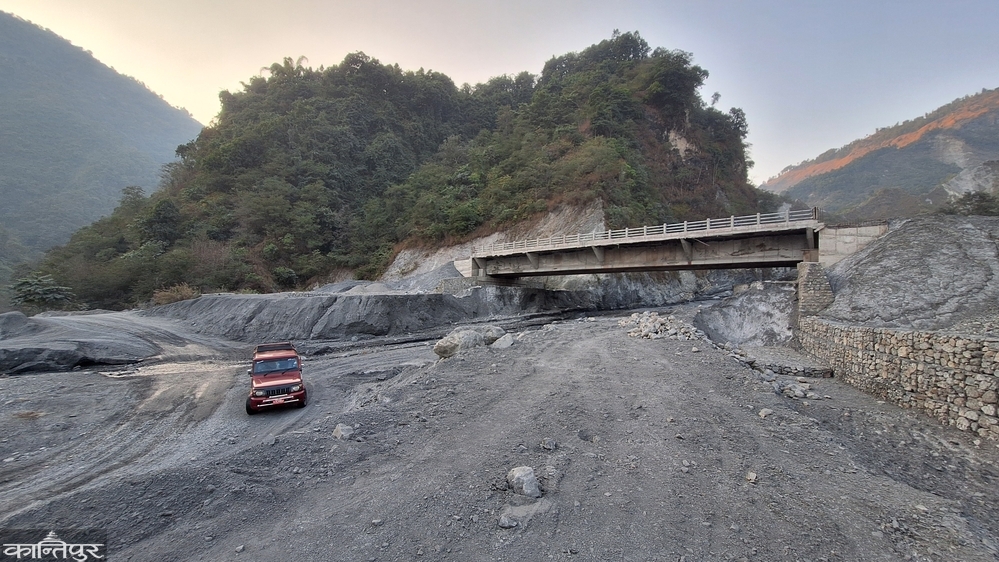
Dahare Khola used to cause a lot of trouble during the rainy season. The river, which is closed even after a single rainfall, swept away many vehicles during the last rainy season. Passengers have had to suffer repeatedly in the river flowing with black mud.
Construction entrepreneur Bhagwat Giri said that the movement was stopped after the amount was not paid. ‘पुलमा आवतजावत गर्न बजेट भुक्तानी पनि हुनुपर्यो,’ उनले भने, ‘डहरे खोलाकै साढे तीन करोड रुपैयाँ भुक्तानी पाएको छैन ।’ उनले सबै पुलको एकमुष्ट हिसाब गर्दा १३ करोड रुपैयाँ भुक्तानी बाँकी रहेको बताए ।
सडक डिभिजन कार्यालय पाल्पाका प्रमुख सिनियर डिभिजनल इन्जिनियर राम पुकार जयसवालले संघीय सरकारले बजेट नै नठेक्काएका कारण भुक्तानी रोकिएको बताए । ‘बिल आएको छ तर हामीसँग बजेट छैन,’ उनले भने, ‘भुक्तानी गर्न बजेट छैन, आवतजावत खुलाउन भन्न पनि अप्ठ्यारो छ ।’ उनले कार्यालयसँग भएको बजेटबाट भुक्तानी भइसकेको तर नयाँ बजेट नआएकाले समस्या भएको बताए ।
सडक डिभिजन पाल्पाअन्तर्गत निर्माण हुन थालेका त्यस क्षेत्रका चार पक्की पुलको निर्माण कार्य राजेश्वरी–लुम्बिनी जेभीले गरिरहेको छ । निर्माण कम्पनीले भ्याटसहित २२ करोड ३१ लाख ६० हजार २१० रुपैयाँ लागतमा उक्त चार वटा पुल निर्माण गरिरहेको छ ।
तिव्र बसाइँसराइका कारण जिल्लाका कैयौँ गाउँ सुनसान भएका छन् । पुल र सडक निर्माणमा भइरहेका यस्ता उदाहरणहरू जिल्लाका हरेक क्षेत्रमा छन् । तर यस्ता विषयहरू चुनावी मुद्दाका रूपमा उठ्न सकेका छैनन् ।
गुल्मीसँग अर्को पनि सरोकारको विषय छ । त्यो भनेको यहाँको तीव्र बसाइँसराइ दर हो । आर्थिक वर्ष २०८१/०८२ मा गुल्मीबाट अन्यत्र बसाइँसराइ गर्ने ११ सय ७४ घरपरिवारका ४ हजार २५ जना थिए । जबकि यही अवधिमा जिल्लाका १२ पालिकामा २०३ घरपरिवारका ६५१ जना मात्रै बसाइँसराइ गरी आएका थिए । स्थानीय पालिकाको पञ्जीकरण शाखाका अनुसार प्रमाणपत्र नलिई बसाइँ सर्नेहरूको संख्या अझै ठूलो भएकाले जिल्लाभित्रको बसाइँसराइ दर तथ्याङ्कमा देखिएभन्दा निकै ठूलो देखिन्छ ।
बसाइँसराइको यो दरका कारण जिल्लाका कैयौँ गाउँ सुनसान भएका छन् । गाउँघरमा रहेका थोरै परिवार बाँदर र बँदेलजस्ता जंगली जनावरको आतंकबाट पीडित छन् । रेसुंगा नगरपालिका–१२ का खिमबहादुर थापाले बाँदर र बँदेलको आतंक नै किसानको मुख्य समस्या रहेको बताए । ‘जंगली जनावरले कुनै खेतीपाती गर्न दिँदैनन्,’ उनले भने, ‘यसकै कारण बसाइँसराइ तीव्र छ ।’
२ लाख २९ हजार ५ सय ४९ जना मतदाता रहेको यस जिल्लामा शिक्षा, स्वास्थ्य र खानेपानीका समस्या पनि उत्तिकै छन् । तर किसानका लागि जंगली जनावरको आतंक सामूहिक समस्या बनेको छ ।
गुल्मीका दुई निर्वाचन क्षेत्रका लागि ४३ जना उम्मेदवार चुनावी प्रतिस्पर्धामा छन् । क्षेत्र नम्बर १ मा कांग्रेसका चन्द्र भण्डारी, एमालेका प्रदीप ज्ञवाली, नेपाली कम्युनिस्ट पार्टीका सुदर्शन बराल र राष्ट्रिय स्वतन्त्र पार्टीका सागर ढकाल मुख्य प्रतिस्पर्धामा छन् । निर्वाचन अधिकृत कृष्णप्रसाद पौडेलका अनुसार दलीय र स्वतन्त्र गरी जम्मा २१ जनाले यहाँ उम्मेदवारी दिएका छन् ।
क्षेत्र नम्बर २ मा एमालेका गोकर्ण बिष्ट, कांग्रेसका भुवनप्रसाद श्रेष्ठ, नेपाली कम्युनिस्ट पार्टीका श्रीराम महत र राष्ट्रिय स्वतन्त्र पार्टीका गोविन्द पन्थी मुख्य प्रतिस्पर्धामा छन् । निर्वाचन अधिकृत हरिहर पौडेलले यहाँ दलीय र स्वतन्त्र गरी जम्मा २२ जनाको उम्मेदवारी परेको बताए ।
अहिले उम्मेदवारहरू पार्टीका आन्तरिक बैठक र घरदैलोमा व्यस्त छन् । के उनीहरूले स्थानीय सरोकार र चासोहरूको सम्बोधन गर्न सक्लान् ? सबै मतदाताको चासो यहीमा छ ।
सम्बन्धित अन्य समाचारहरु

