In an agreement with Prime Minister Matrik Prasad Koirala, the 17 soldiers who were stationed in Nepal returned to the checkpoint after 18 years in 2026, but King Mahendra remained silent about the Kalapani camp in Baljafti Darchula. That is why 370 square kilometers of land in Kalapani has been encroached upon.
We use Google Cloud Translation Services. Google requires we provide the following disclaimer relating to use of this service:
This service may contain translations powered by Google. Google disclaims all warranties related to the translations, expressed or implied, including any warranties of accuracy, reliability, and any implied warranties of merchantability, fitness for a particular purpose, and noninfringement.
India maintained 18 military check posts in the northern region of Nepal for 18 years when the Nepali rulers were weak. The 17 check posts that entered Nepal in 2008 through an agreement between the two countries will be returned in 2026, but the army that has voluntarily settled in Kalapani has been here for 63 years. The panchayat system along with King Mahendra became a silent spectator when Indian army was occupying Kalapani. After the coming of the multi-party system, the discussion on this matter started, but no meaningful initiative has been taken regarding the return of the army.
It was decided to send back the 17 military checkposts maintained by India for a long time in 2026, but the camp at Kalapani in Darchula was not operational. Due to the Kalapani camp, 370 square kilometers of land up to Gunji, Nabi, Kuti, Lipulek Pass and Limpiyadhura have been encroached.
After the British left India in 1947, India tried to keep military camps in Nepal in an attempt to balance the strategy with China. But the request was made to the then Prime Minister Matrik Prasad Koirala's government.
India announced to send a 'military mission' to Nepal on 23 February 1952 (11 February 2008) upon request from the Nepalese government to reduce the number of Nepalese army and increase its professional skills and capabilities. It was also said that the number of Nepalese army will be reduced from 25,000 to 6,000 in the military reorganization program.
India issued an official statement and said, 'The Government of India has agreed to send a military mission to assist in the training and reorganization of the Nepali Army at the request of the Government of Nepal. In the first phase, the mission consisting of 20 officers will leave for Kathmandu on February 27. Later, it can be further strengthened if the government of Nepal deems it necessary. The mission will be led by Major General.'
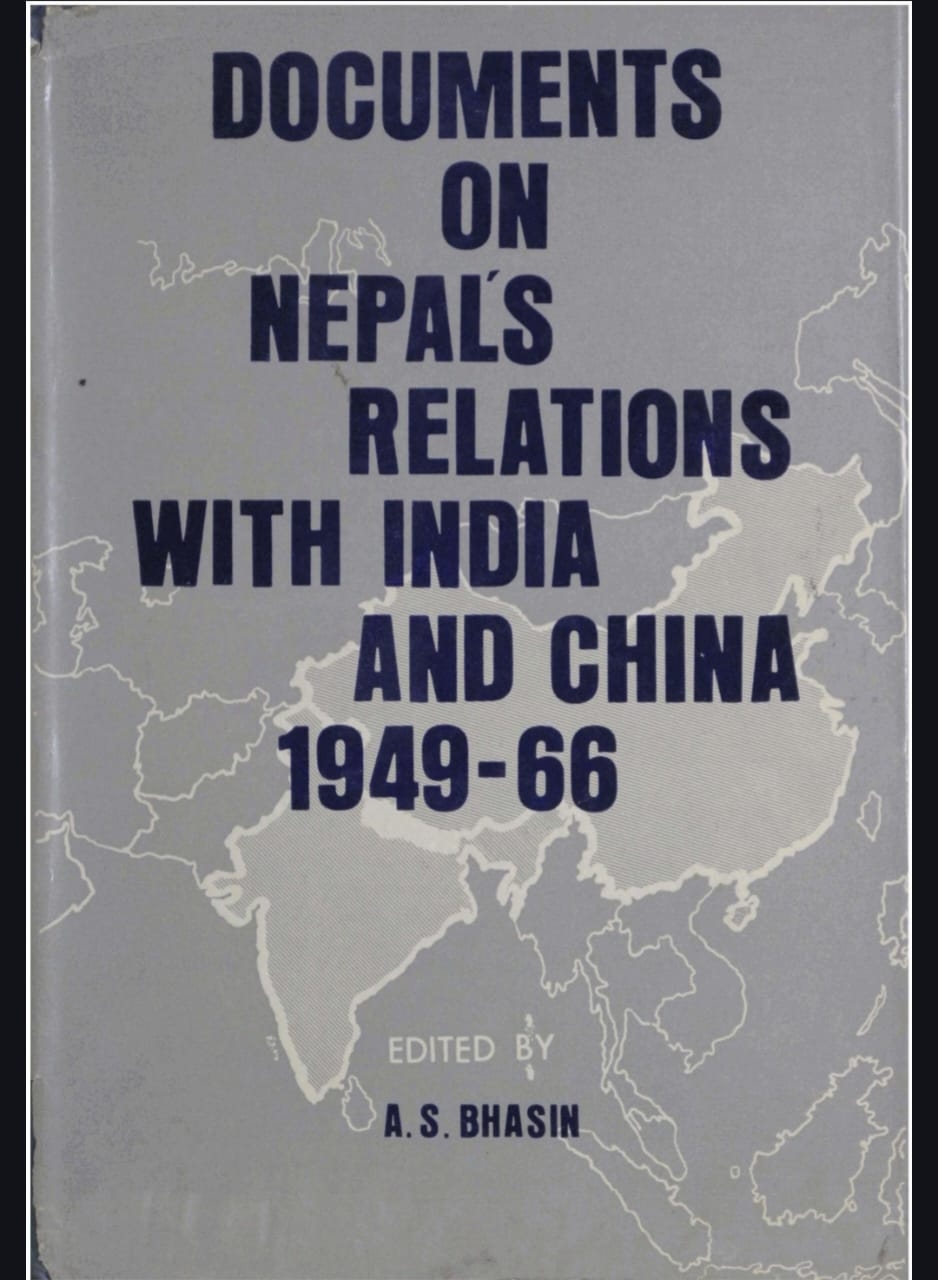 Indian diplomat Avtarsingh Bhasin's book 'Document on Nepal Relations with India and China (1949-66)' has published this information. The Indian 'Military Mission', which came with a one-year work schedule, did not return. Instead, the military numbers continued to increase.
According to the same process, Indian 'Military Mission' was placed in Muchu (Humla), Mugu Village (Mugu), Charkavot (Dolpa), Kaysang/Chusang (Mustang), Thorong (Manang), Larke Pass (Gorkha), Atharsay Khola (Gorkha). Similarly, Indian soldiers were also deployed in Somdang (Rasuwa), Rasuwagadhi (Rasuwa), Tatopani (Kodari, Sindhupalchok), Lamabagar (Dolakha), Namche/Chalsa (Solukhumbu), Chepuwa Darra (Sankhuwasabha), Olangchungola (Taplejung) and Thechumbu (Taplejung).
Meanwhile, in 1962, during the India-China war, the Indian army entered the Nepalese land of Kalapani. In 1962, India-China war took place. On the eastern side, many Chinese soldiers had entered the Assam region. King Mahendra's Home Minister Bishwabandhu Thapa has said in various contexts that what Nehru thought at that time was that if the Chinese soldiers had entered from Mansarovarpatti instead of the east, they would have reached Delhi soon. India then adopted a policy of strategically using the Kalapani region. Because there is a big square.'
At that time, King Mahendra ousted the government of BP Koirala and took power in his hands. So he was waiting for India's support in this step. Therefore, his colleagues have been confirming that he has remained silent about the presence of Indian troops in Kalapani.
It was during the war between China and India, he did not speak at that time, even after that Mahendra was the king for a long time, he should have spoken at some point, if he had spoken at that time, Nepal's claim would have been stronger: Nilambar Acharya, diplomat Former foreign minister Bhesh Bahadur Thapa, who worked closely with King Mahendra, has also made it clear in his book 'Rashtra-Pararastra' that King Mahendra had information about the presence of Indian troops on Nepali soil without permission. It is written in the book, "In 1962, the war between India and China was intense. In that battle, India was attacked from place to place by the Chinese.
Indian map shows that (Kalapani) is an unprotected area without security mechanisms. There was no security post in Nepal either. It was a somewhat uninhabited area, as there were no settlements. Indians analyzed that if the Chinese enter from there, they can reach Delhi. During the fighting, the Indians kept security personnel at the place overnight. Even though they know that it is the territory of Nepal, they have kept soldiers without any discussion.'
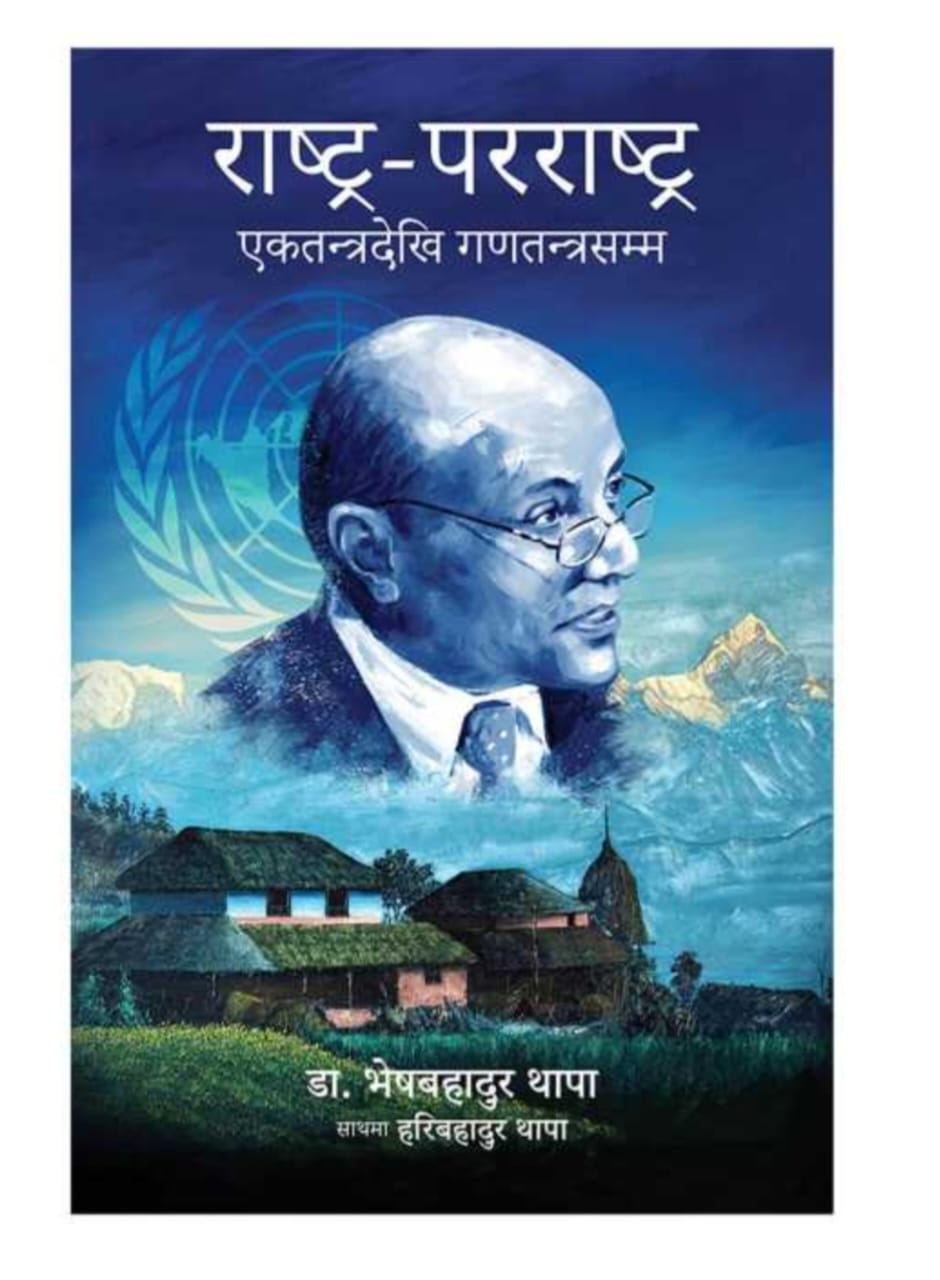 Raja Mahendra's words have been quoted by Thapa in the book, "There is currently a war between India and China." It's like we're taking sides when we bring up this topic. This issue should be raised after the war is over and a solution should be found. Former Foreign Minister Thapa's analysis is that the silence shown by Nepal in the harsh situation of India-China war was misinterpreted by the Indian side. According to him, there is no record of any dialogue or decision with the palace regarding Kalapani.
Similarly, writer Vinod Sijapati says that Vice President Tulsi Giri and Home Minister Vishwabandhu Thapa of the King Mahendra-led government also told him about the king's decision to remain silent. It reached the king that the Indian army was stationed in Kalapani and had to be sent back. But the king calls me anti-Indian, now they are angry rather than withdrawing the army. "Nepal did not respond after being told to keep silent," says Sijapati, quoting Giri.
It was Prime Minister Nehru who contacted King Mahendra to let India stay at that time and told him to stay silent. "Our platoon is stationed on the land of Nepal, Nehru requested the king to come back from there after settlement," Vishwabandhu Thapa said, "The king consulted the council of ministers, consulted others as well, about what to do." It was advised to accept that it is time for India to suffer.'
There was a 32-day war between India and China from 20 October 1962 (4 November 2019) to 21 November 1962 (6 November 2019). Fierce fighting took place in Ladakh region (Aksai China) and Arunachal Pradesh region. Nepal remained neutral during the war between the two neighbors. However, due to this war, the Nepali land Kalapani area was encroached upon.
There is a comment of old politicians and diplomats that King Mahendra used it as an opportunity to anger India by not protesting when the Indian army came and settled in Kalapani. Former politician and diplomat Hiranyalal Shrestha says that the psychology of how much to provoke India was seen in Mahendra. "King Mahendra turned a blind eye at that time to protect the panchayat by improving relations with India," he says, "if the king had spoken about the presence of the Indian army in Kalapani, the situation would have been different now."
Another politician and diplomat Nilambar Acharya says that King Mahendra made an extraordinary mistake by keeping silent despite the fact that Indian soldiers were stationed in Kalapani. "It was during the war, he didn't speak then, even then he was the king for a long time, he should have spoken at some point," he says.
King Mahendra turned a blind eye to protect the panchayat by improving relations with India, the psychology of how much to provoke India was seen in him: Hiranyalal Shrestha, diplomat He says that after the war situation changed, even though the then King Mahendra had plenty of time, he did not use it. He says, "In those days when the King and the Prime Minister of India had direct contact, if he had kept a record of his disagreement in a letter or a meeting, the situation would have been different now." Acharya, who has been active in student politics since 2019, was the Minister of Law and Justice in the interim government led by Krishna Prasad Bhattarai in 2047. He has been ambassador to Sri Lanka and India.
On the basis of the 'Delhi Agreement' in 2007, a joint government of Rana-Congress was formed by agreement between the king, Rana and Congress. At that time, Delhi's interference in Nepal's internal affairs was very high. King Tribhuvan's private secretary and advisor was also an Indian. Indian Ambassador was present in the Council of Ministers. One group of Indian experts came to Nepal one after the other for improvement in various fields.
The Rana-Congress joint government was dissolved and the Congress government was formed in 2008 under the leadership of Matrikaprasad Koirala. At that time, the Nepalese government asked India for the help of Indian experts to streamline, organize and modernize the Nepalese army. After that, the Indian "Military Mission" entered Nepal. They were stationed in the northern region and focused on collecting information on the Chinese border area.
In the book "Nepal Strategy for Survival" published in 1971 by the American writer Leo E. Rose, it is mentioned that the Indian "Military Mission" also took responsibility for radio communication between the northern border and Kathmandu.
 "Nepal and India had been cooperating in various fields before that, but the decision of military cooperation directly hit the sensibilities of the Nepalese people," says Rose's book, "Gorkhas had gained fame as fighters. Being taught by others how to be a soldier hurt their self-esteem. On the other hand, there was extreme resentment among those dismissed from service when the army was reduced.'
At that time, diplomat Hiranyalal Shrestha said that Nepal could only get information from the North through the Indian government or the Indian ambassador. He adds, 'Indians had control over the communication system.' Shrestha's book 'Nepal-India Relations' (1950-1970) published in 2038 has a 'chapter' on the Indian 'military mission'.
As mentioned in it, the cost of check posts on the northern border of Nepal was 42 thousand dollars in 1952, but in 1953, India increased it to 280 thousand dollars. It is mentioned in Shrestha's book that the Indian Air Force conducted an aerial survey of western Nepal at that time and Indian military engineers built roads and airports in various parts of Nepal. At that time there was a protest about the presence of Indian soldiers in Nepal.
According to border expert Buddhinarayan Shrestha, 5 to 11 Indian soldiers were sitting at a check post. They were armed and wireless. "They used to deliver information as far as Calcutta and Delhi," said Shrestha, a frontiersman.
On 25 March 2025, Kirtinidhi Bista, who became the Prime Minister for the first time, planned to remove the Indian military checkposts by assuring King Mahendra. In an interview on 'The Rising Nepal' on 10 Asar 2026 (24 June 1969), Bista called on India to recall all its military personnel from Nepal. Then there was a wide debate about it in the Parliament of India.
The then foreign minister Dinesh Singh gave an answer about it in the debate in the Lok Sabha on 21 July 1969.
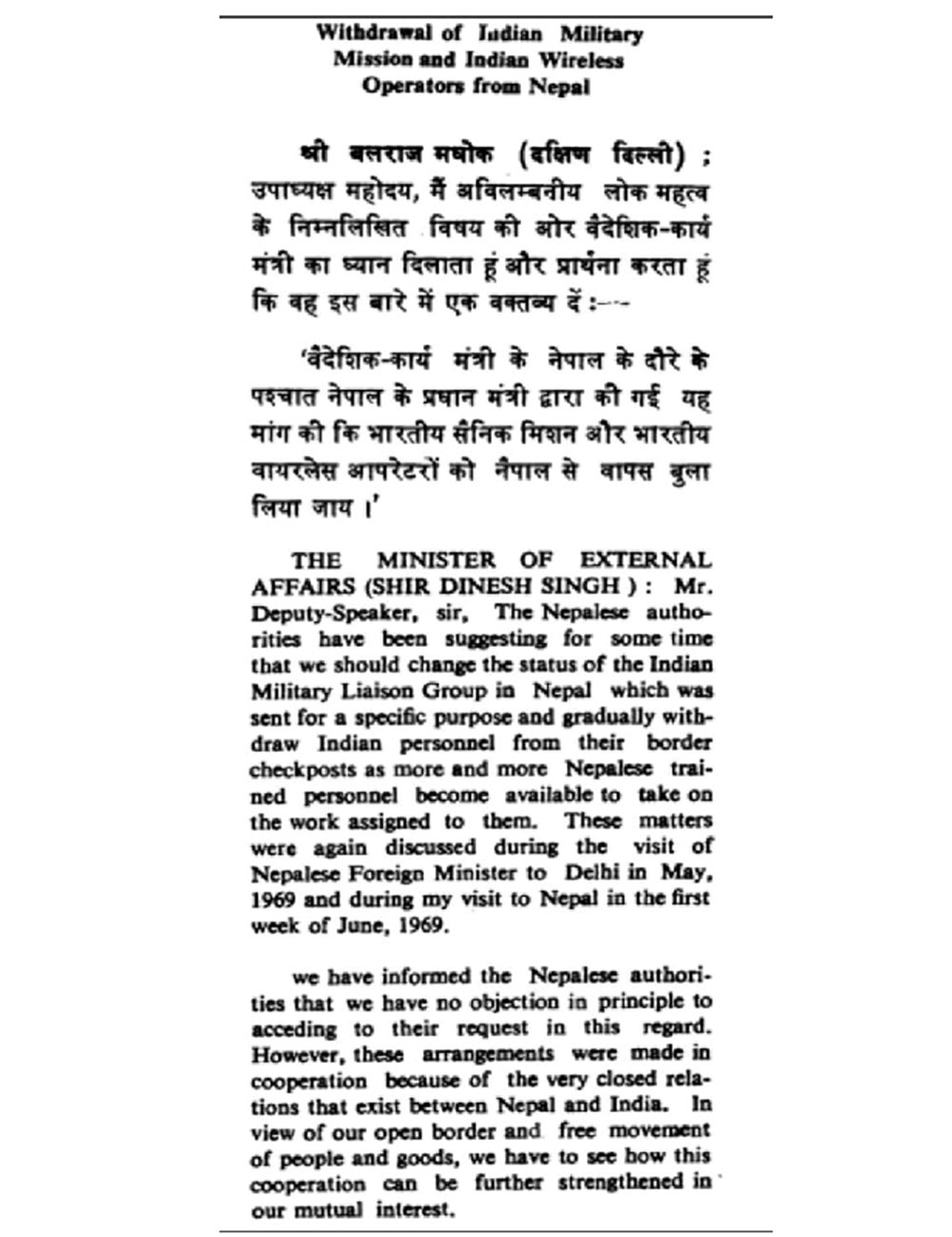
"We have informed the Nepali authorities that we have no objection in principle to accept their request," he said while answering questions in the Lok Sabha, "The collaboration was done because of the very close relationship between Nepal and India." Given our open borders and free movement, we should look at how we can strengthen this cooperation in our mutual interests.'
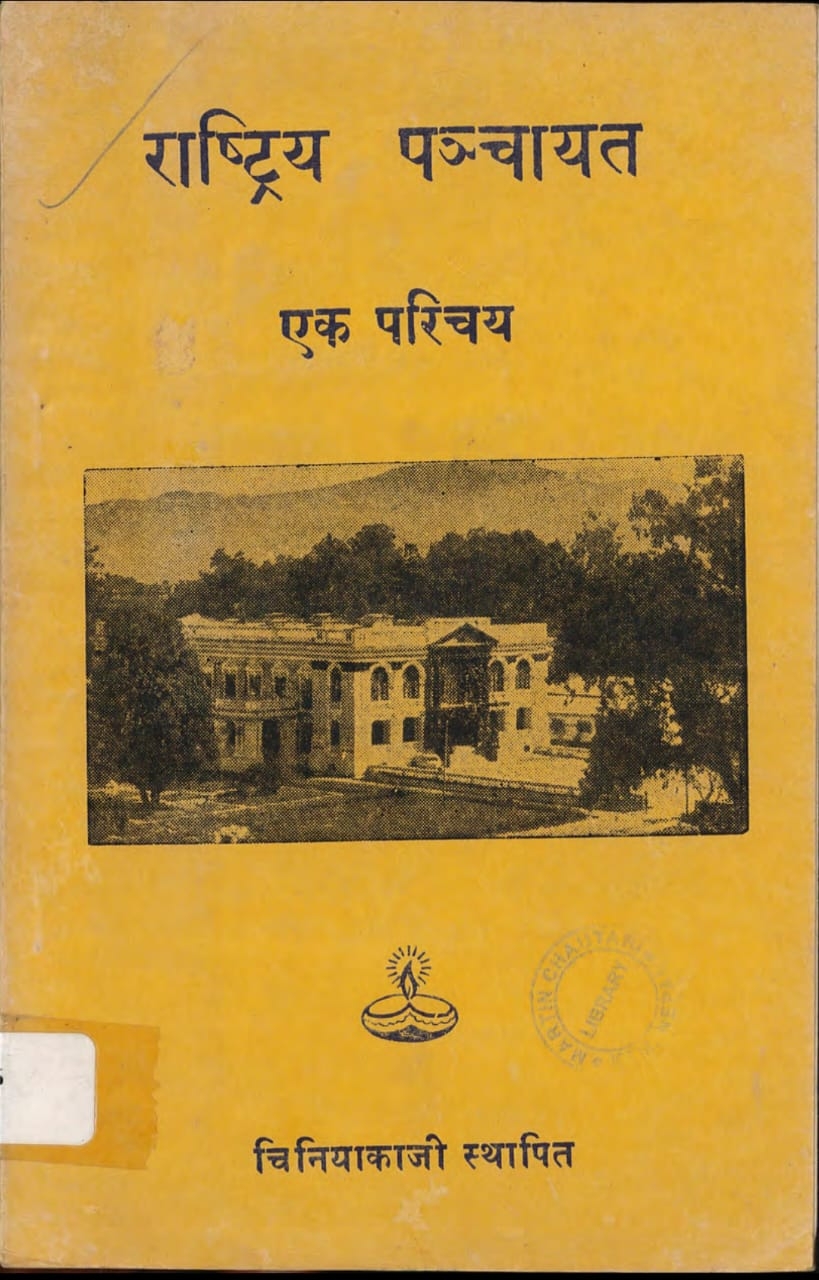 The Rashtriya Panchayat passed a non-governmental resolution resolution when both sides were debating about the withdrawal of Indian military posts. It said, "Since the Indian technicians at the checkpoints on the northern border and the Indian military contingent at the capital have completed their work, His Majesty's government should make arrangements to send those contingents back from Nepal immediately." The resolution included a list of 17 military checkpoints.
Indian Prime Minister Indira Gandhi was irritated by Bishta's expression. 'Gandhi asked me directly - Prime Minister, what statement did you make?' Bista wrote in an article, 'The conversation between us was very tough.' In the article included in the book 'Nepal-India Relations Past, Present and Future' published in 2073, Bista said, 'I had a kind of 'confrontation' with India.'' However, Kalapani's army stayed here. After Raja Mahendra, Raja Birendra, who ruled for a long time, seems to have kept silent about the Indian army being stationed in Kalapani. During the 30-year Panchayat period, the question of encroachment of Nepali land by India did not arise. After the arrival of the multi-party system, even though there has been a reaction on various platforms, the question is getting more complicated. Diplomat Shrestha says that if the
is not resolved among themselves, they should not hesitate to seek international assistance. "In the 21st century, you cannot occupy someone else's land. "The Chukche map is not made just for showing, Nepal should be able to play a practical and dynamic diplomatic role for its practical implementation," he says, "If necessary, bring it to the United Nations, tell America, tell Russia close to both China and India, or whatever else can be done, try to return its land." tells They understand that Nepal's position is strong in this regard. But, they have not been given that space," he says. "They don't show any desire to talk about it. No argument is given. Consensus at the political level is necessary to create an environment for negotiations to end it.'
Also read:
India-China agreement to open border trade through Lipulek
Diplomatic note to India 8 times in 10 years, all unanswered



