The Parliamentary Committee on Thursday passed a 'Bill to amend some Nepal Acts related to land', avoiding the loopholes that could seize land in the Giribandhu-style Chalkhel, forest and intermediate areas. Now the ruling party is preparing to pass it in the House of Representatives soon. However, the opposition parties are expressing dissatisfaction.
We use Google Cloud Translation Services. Google requires we provide the following disclaimer relating to use of this service:
This service may contain translations powered by Google. Google disclaims all warranties related to the translations, expressed or implied, including any warranties of accuracy, reliability, and any implied warranties of merchantability, fitness for a particular purpose, and noninfringement.
The government has proceeded with the process of passing the 'Bill to amend some Nepal Acts related to land', which has been heavily influenced by political disputes and pressure from interest groups. It was passed by the parliamentary committee on Thursday with the majority of the Congress and UML amid disputes between the opposition parties.
There was strong opposition to this, especially as it was allowed to sell and distribute land exceeding the limits of Giribandhu or similar nature, and it was being tried to establish settlements even on vacant land in forests, forests and intermediate areas.
It was possible to pass the bill through the meeting of the Agriculture, Cooperative and Natural Resources Committee after the government was ready to accept the amendment proposed by the Congress to prevent the misuse of legal loopholes with such intentions and to tighten the misuse of vacant land in forest and intermediate areas.
However, the opposition parties have disagreed saying that the report of the committee was passed in a hurry without being able to study it. They also have different views on the report.
Jaspa Nepal has decided to retaliate against the report passed by the committee saying that encroachment in the forest area will not be stopped. As JSP Nepal is in opposition, it seems that the government should be able to pass the bill through the National Assembly. Congress and UML have 27 (nominated) MPs in the 59-member National Assembly. He is a member of the Democratic Socialist Party participating in the government. 30 MPs are required for a majority, even if all the MPs from all the ruling parties are added, there are 29 MPs. Even though the ruling party is trying to deceive JSP Nepal, which has three members, JSP is not even in favor of the current amendment.
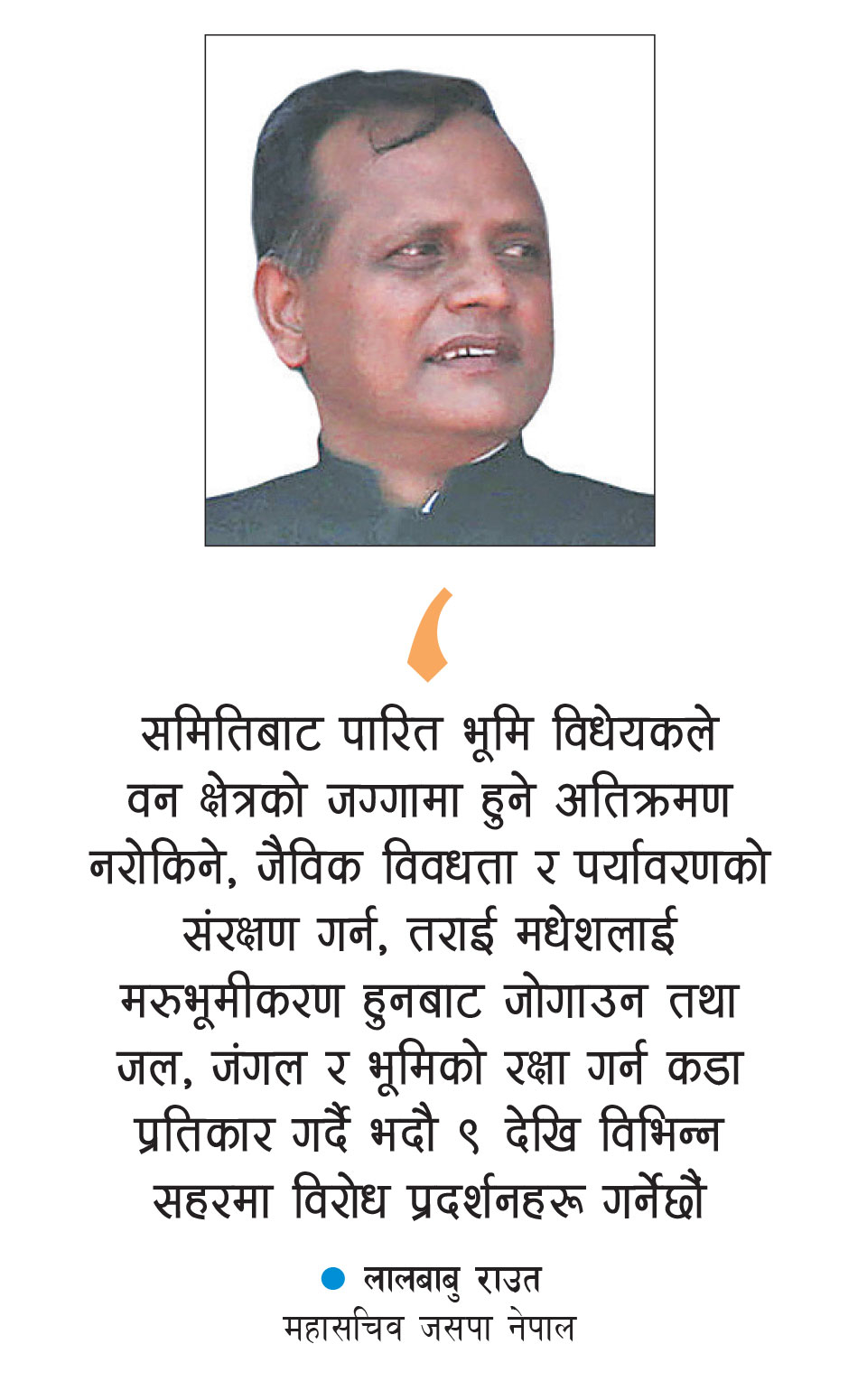
If rejected by the National Assembly, the bill must be passed again by the House of Representatives. Jaspa General Secretary Lalbabu Raut claims that even with the revision of the committee, the interests of land mafia and land brokers have not ended.
"The land bill passed by the committee will not stop the encroachment of the land in the forest area, to protect biological diversity and the environment, to protect the Terai Madhesh from desertification and to protect water, forest and land, it has been decided to take a strong response and protest against the land bill under the campaign 'Save land and forests, protect Madhesh from desertification,'" Raut said in a statement issued on Saturday. Jaspa Nepal has also decided to hold demonstrations against the bill in various cities of the country from 9th to 15th August.
The government was in the process of passing the bill through 'fast track' with the goal of distributing land to more than 5 lakh landless Dalits and landless squatters and unorganized residents within the current financial year. The bill was also put on the agenda of the Parliament on June 25 on the instructions of the Prime Minister KP Sharma Oli to be passed directly from the "full house" without being sent to the committee.
Two general ministers of Congress, Gagan Thapa and Vishwaprakash Sharma, took the position that amendments should be sent to the committee and the bill was removed from the agenda. Even after that, Prime Minister Oli repeatedly discussed with the Congress leaders to pass it through the 'fast track'. He also requested to accept the amendment between the two parties without sending it to the committee. However, after the Congress decided to send it to the committee, the bill was taken to the committee on July 8.
"The Prime Minister was ready only after the Home Minister Ramesh Akhtar promised to pass the bill from the committee within a week and send it to the 'full house'," said a Congress official, "but after the delay in passing the bill from the committee, the prime minister kept putting pressure on him." The prime minister's haste brought the opposition party with him and the bill could not be passed unanimously, but the committee has succeeded in amending it to remove all the suspicions that have come out.' The Maoist and RSVP MPs in the
committee demanded to go for a decision only after studying the draft. However, the bill was passed by the majority of the two parties. The discussion was focused on the amendments put forward by the two general ministers of the Congress. As there was no easy solution in the committee, in the meeting a few days ago, Kusum Thapa, the chairperson of the committee, requested the Home Minister to agree on the main points to be amended in the high-level political mechanism. She was a
er. The bill was passed by the committee after an agreement was reached between the two parties to accept the amendments put forward by Congress General Minister Thapa and Sharma through the discussions in the committee and an informal meeting with the top leaders of the two parties. According to lawyer Pratap Paudel, a legal expert of the
committee, the agreement was reached after the government was ready to amend the four main points of the amendment put forward by the two general ministers of the Congress and other MPs. The government bill has been amended to stop the loopholes like Giribandhu and Giribandhu which are beyond the limits of nature which can be misused. According to the report passed by the
committee, there is now a clear provision that no real estate business can be done on land that exceeds the limits set for purposes other than residential and commercial areas. In the bill introduced by the government, there was a legal provision to allow organizations and companies that had previously taken more land than the limit to use it in real estate business.
To prevent this, section 2 sub-section (1) of the bill and clause 12 (g) of the proposed bill have amended the restrictive phrase after sub-section 4. According to the amendment, the language given by Congress General Minister Thapa and Sharma is said to be true, "However, when taking a limited exemption according to the prevailing law, the land exempted or approved for the purpose of any commercial agricultural industry such as an agricultural farm, tea industry, establishment, educational institution, health institution, etc., is kept empty (barren) without being used for the same purpose in accordance with the specified conditions, or is used for a different purpose, or later sets up a real estate business company and conducts real estate business on that land in the name of that company, or has been approved or approved to do such business." Even if an application has been submitted for commercial agriculture, industry and other purposes, it is not allowed to do real estate business on the land that has been exempted or approved for commercial agriculture, industry, etc.
Section 12 (a) of the Eighth Amendment of the Land Act provided that industries, companies, establishments and institutions that have illegally purchased land exceeding the limit can be legalized by submitting an application within three months. The industries, associations and organizations holding such land illegally were allowed to keep the land within the limits as per the notified order of the government by charging a fee of 1 lakh 50 thousand per bigha in the case of Terai and inner Madhesh, 50 thousand rupees per plant in Kathmandu valley and 10 thousand rupees per plant in the case of other hilly areas. It was suspected that the government would allow the industries, companies and establishments that have been approved to keep land in excess of the limit by amending the law and turning it into a real estate business. The
 amendment provides that apart from residential and commercial land, land in other classifications cannot be sold by developing houses and housing. The amendment also includes the provision that the company holding land in excess of the limit should get the detailed project report (DPR) and environmental study report (EIA) approved. Earlier, the government had removed the provision in section 12 (g) of the Act. Another clause amended by the
committee is 12 (b). When the government brought the bill, in this section, it tried to create a single standard for land distribution by putting landless Dalits, landless squatters and settled settlers together.
The provisions of Section 12 (b) of the currently implemented Act refers to landless Dalits and landless squatters, while Section 12 (c) refers to unorganized residents. However, the government also wanted to include the provisions of 12 (c) in 12 (b). According to the amendment demand, the government is ready to separate the provisions of these two sections.
The issue of how much land can be given to unorganized residents based on what criteria and where has become complicated. The committee did not accept the bill when the government introduced a bill to give land to all the unsettled people under the same criteria. All the members except UML in the committee demanded that the land should be given only by classifying the unorganized according to the scientific model. This issue was also included in the amendment of Congress General Minister Thapa and Sharma.
It does not mean not giving land to unorganized residents, but how much to give and where to give it? How often to give? The main issue was how much to charge. The government had introduced a 'flat model' that could be given. But the MPs of the committee demanded classification based on scientific basis. That too has been accepted by the government," said Paudel, a legal expert of the committee. Many places have houses, houses. On the other hand, some have no home, some have moved to the coastal area due to the conflict, some have stayed to occupy the land. Some may have stayed with good intentions. The government has also accepted the issue that it is not justified to distribute land in 'flat model' between different varieties, it should be classified. Many questions raised on the land bill have been resolved.'
The restrictive phrase of Section 3 of the Forest Act 2076 has also been amended. The provision brought by the government in the bill has been reined in through amendments so that even unoccupied open land within forest and intermediate areas can be distributed. Now, it has been arranged that land can be distributed only in the areas that have been approved before January 28, 2066. It is said in the amendment, "However, among the land designated as forest, forest area or Bhutan area in the record, only the land that has been in Awadkamod before January 28, 2066 is determined and re-mapping for one time. Even if the land designated as forest, forest area or Bhutan area in the record is not a forest, but is vacant or Bhutan or is important from the point of view of wildlife conservation, management, biological diversity and situational system, then the land must be maintained in the forest area."
Section 61 (a) added after section 61 of the Land Act proposed by the government has been removed by the committee. The section included provisions that would allow the government to make guidelines and procedures. There was a suspicion that the government might abuse the right to exercise such rights.
A similar provision in the National Parks and Wildlife Protection Act 2029 has also been amended. In section 3 b (1) of the Act, the restrictive phrase proposed by the government has been amended and added, "In the case of remapping, even if the land designated as forest, forest area or butane area is not a forest but is empty or butane or if it is an important area from the point of view of wildlife protection, management and biological diversity and situational system, the land shall be retained in the forest area."
Last December-January, the government tried to amend the land-related act through an ordinance. However, since the Congress and UML do not have a majority in the National Assembly and other parties are in the opposition, the land ordinance introduced by the government could not be approved. According to the constitutional provision, if the House is not approved within 60 days of its sitting, it will automatically become inactive. The Ordinance was automatically repealed after it was not approved by both Houses of the Federal Parliament within 60 days.
According to the National Land Commission, more than 1.3 million 50 thousand families have applied for land acquisition and many more applications are coming. Politically, there was a strong opposition to the Land Bill, saying that even fake settlers in the name of unorganized people could increase their efforts to register land. Out of the applications submitted to the Land Commission, the data of 1 million 354 families have been entered into the computer, while 765 thousand 543 are unorganized residents. Similarly, there are 154,885 landless squatters and 79,926 landless Dalit families. So far, 4,440 families have received Lalpurja. The Commission has estimated that this figure may increase to 1.5 million.
'There is a lot of demand for land registration of unorganized residents. It is not certain how much land will be given to unorganized residents based on the suggestion of the local level. As a result, even in 8/10 places, it will be decided after the criteria are established whether they came with the intention of occupying the land or those who are really in trouble. Now they only get as much land as they get, they don't get more.'
A few days ago, the Ministry of Forestry gave the committee the data that there are squatters and unorganized residents in about 140,000 hectares of forest area. However, he could not give the data of the people living in the intermediate area, Bagar and Gouchar. The government is challenging that the government will manage to exacerbate those living in such areas. & Nbsp;
& Nbsp; the demand for distributing the disorganized land while distributing land by distributing land by distributing land, the demand for the revision is now. In which there is other lands, there is no land to make criteria for looking at his economic capacity. "Worrying for earthquakes to benefit geo-Mafia, who was tried to 'take advantage of the classmates without classification, has been expressed concerning that it was expressed to prevent amendment. The revolution has now been distributed in the map, "said a member of the committee. & Nbsp; What was the
bill of the modified? & nbsp;
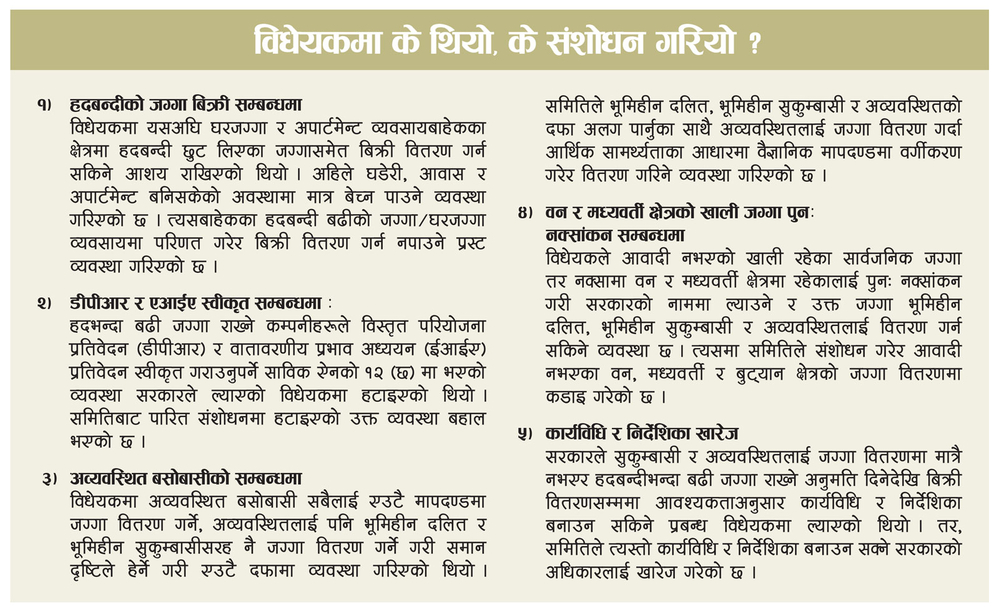
1) उहाँच Earlier and Nbsp to the
Business in the Salvice Bill in the selling the land of extremism. In the area, the extent exempted land was placed on sales. Arrangements have been made to sell the housing, housing and apartment only in the case of the housing and apartment. A claster has not been able to distribute sales by not being able to distribute sales by not being able to distribute sales by making sales of higher land / real estate business. & Nbsp;
2) DPR and AIA accepted relationships: & nbsp; The provision of the Creat (EIA) of the
-BREAK Land The provision of A detailed project report (EIA) and environmental impact report (EIA) was removed. The constitution has been restored to the amendment to the revision from the committee. & Nbsp;
& NBSP; 3) In the same case, the
Basque of Based on Disorganized Basal, held was arranged in the same period of distressing landless and landless squatters. The Story-BREA committee separates the demums of landless, landless squatters and disorganized lands on scientific criteria on the basis of financial capacity. & nbsp;
& Nbsp; 4) Restriction Relationship Relationship & NBSP; The
is not dominated by a popular area but to distribute the land and NBSP. In that committee, the land, intermediate and boot area lands are strictly in distributing land distribution. & Nbsp;
& Nbsp; 5) Procedures and Directory Dispute & Nbsp; The
government had been brought to the arranged bill for squatters to squattralise and the disorganization by allowing more than land distributors but more than landworthy. However, the committee has revoked the government of the government that can create such procedures and guidelines. & Nbsp;
[Archib] Why don't the first-resolve the Minister of Detegoring the Ministry of Removing Land.?



![[अर्काइभ] भूमि सुधार गर्न नसकेका ‘भूमि नेता’ ले किन त्यागे मन्त्री पद ?](http://assets-cdn.ekantipur.com/uploads/source/news/kantipur/2025/third-party/jagannath-1932025121741-1000x0.jpg)