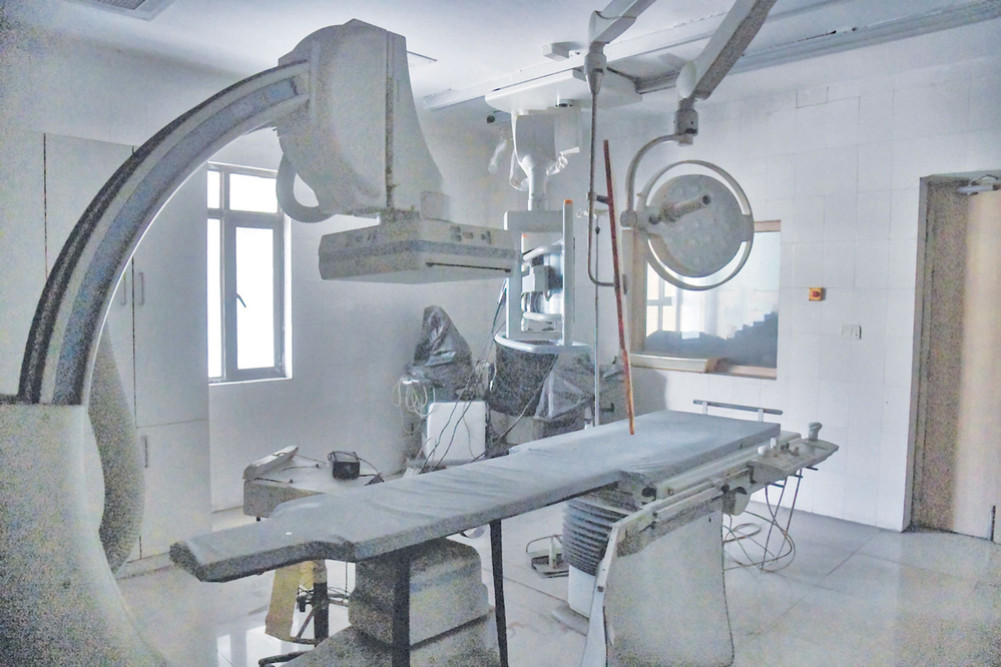
Due to the non-operation of 'cathlab', there is a compulsion to refer patients who have been injured and have 'blockage' in the heart or blood vessels due to accidents, natural disasters, injuries, etc.
We use Google Cloud Translation Services. Google requires we provide the following disclaimer relating to use of this service:
This service may contain translations powered by Google. Google disclaims all warranties related to the translations, expressed or implied, including any warranties of accuracy, reliability, and any implied warranties of merchantability, fitness for a particular purpose, and noninfringement.
The National Trauma Center's noninvasive heart treatment 'cathlab' has been idle for 13 years. Due to non-operation of 'cathlab', there is a compulsion to refer patients who are injured and have blockage in heart or blood vessels due to accidents, natural calamities, injuries etc.
Next door Veer Hospital has a cathlab. However, that also runs only two days a week. Even in Veer, if the heart problem needs to be treated, it should be referred to another hospital.
There is no cath lab in the civil hospital. Shahid Gangalal National Heart Disease Center has four operations. One of the three cath labs at Manmohan Cardiothoracic Vascular and Transplant Center and one at Trivi Teaching Hospital is 12 years old. Being old, it breaks down from time to time.
Due to non-operation of 'cathlab' in the capital's big hospitals, patients who want to undergo heart treatment are forced to wait for months. Due to overcrowding of patients, the number of people waiting for heart treatment at Gangalal Heart Disease Center and Manmohan Cardiothoracic Vascular Center alone is around 5,000. There are 6,000 patients who are waiting for their turn to be operated on for diseases such as heart disease at Veer and Trivi Teaching Hospitals.
30-year-old Mansingh Tamang of Nuwakot Dupcheswar Rural Municipality-9 in Veer got his turn to undergo heart treatment by 'Cathlab' only after 6 months. According to him, he had a heart problem last February. "Since then, he was taking medicine to prevent heart attacks," he said. Nowadays, most heart patients want to be treated without surgery. According to Veer's doctors, 130 to 170 heart patients visit Sardar OPD daily for treatment. If the patient has to undergo private heart treatment, it will cost at least 3 lakh rupees.
Cathlab in the trauma center was arranged by the Government of India in 2069 to provide immediate treatment especially to the victims of accidents due to blockages in their heart or veins. Trauma has not yet been put into operation due to lack of skilled manpower. The hospital complains that even the Ministry of Health and Population is not interested in running the cath lab. According to doctors, one cath lab can usually treat the hearts of 12 to 15 people per day.
According to the officials of the trauma center, it will cost at least Rs 40-50 lakh to upgrade and maintain the cath lab which has been unused for a long time. The German Siemens company also has a branch in Nepal to repair and upgrade catlabs. However, neither the trauma center nor the Ministry of Health and Population is ready to raise the cost of repairing the machine.
Trauma expert Dr. Vinod Sherchan said that if Cathlab is put into operation instead of being kept in storage, not only trauma patients but also Veer patients will get treatment. "If there is an injury to the hip bone and there is bleeding in the body, we need a cath lab to stop it," he said, "When there is a fracture, it is also used to see if there is a vein to join the bone."
Badri Rizal said that because the Ministry of Health was not interested, Cathlab was stalled. "We can't get the money needed to maintain the cath lab and manage the skilled manpower from the hospital's internal resources. Even the Ministry of Health does not invest," he said. "If Catlab is to be run sustainably, the Ministry had to create the necessary manpower positions. Otherwise, we had to play a role in identifying the hospital that needed the lab and handing it over.'
Veer's cardiology department chief Dr. Samir Paudel said that due to lack of manpower, he was forced to run the catlab only two days a week. "The Ministry of Health has not paid special attention to manpower management," he said. He said that even though the budget was requested for the purchase of Subas Acharya's new cathlab, the ministry did not give it.
Gangalal Heart Disease Center and Manmohan Cardiothoracic Vascular Center alone, the number of patients waiting for heart treatment is about 5,000, and the number of patients waiting for heart surgery at Veer and Trivi Teaching Hospital is 6,000. Prakash Budhathoki said that the problem will not be solved by leaving everything to the ministry alone. The hospital itself also had to earn. The ministry also wants to create new posts. However, the Ministry of Finance stops the file," he said. "There is a hospital development committee. is the director. They had to pay special attention. Cathlab requires interventional radiology, cardiologists, cardiothoracic vascular surgeons and nursing manpower to operate. Only cardiothoracic vascular surgeons are employed on trauma contracts.
Dr. Gangalal National Heart Disease Center Executive Director. Ravi Malla said that there is a plan to add a cath lab in the next financial year due to the patient load. Mohanchandra Regmi, Executive Director of Civil Hospital, said that after many efforts, the Ministry of Finance has allocated the budget for setting up a cath lab for the current financial year. "Many patients are in trouble due to the lack of cath lab," he said, "we will buy it on time."
Senior cardiologist Dr. According to Bhagwan Koirala, 1 percent of babies born have some form of congenital heart disease. 500,000 to 700,000 babies are born in Nepal every year. The main causes of heart disease are high blood pressure in 25 to 40 percent, diabetes in 6 to 10 percent, cholesterol in 20 percent, smoking in 20 to 25 percent, and obesity in 15 to 20 percent.
According to the World Heart Federation, 18.6 million people die of heart-related diseases every year. In which the number of deaths from heart disease is more than 80 percent in developing and underdeveloped countries. There are more than 4 million heart patients in Nepal. Cardiovascular diseases are the leading cause of death in Nepal. More than 46,000 people die from this disease every year. There is data that 70 percent of heart diseases are caused by heart attacks.