In Hemza, which is known for potato production, the settlement has increased by 52.10 percent in the last 10 years, due to rapid urbanization, the potato production is decreasing as houses and fields are destroyed by drought.
We use Google Cloud Translation Services. Google requires we provide the following disclaimer relating to use of this service:
This service may contain translations powered by Google. Google disclaims all warranties related to the translations, expressed or implied, including any warranties of accuracy, reliability, and any implied warranties of merchantability, fitness for a particular purpose, and noninfringement.
Sharda Paudel of Hemja has been active in potato farming for 27 years. Until 8/10 years ago, she used to grow potatoes up to 25 quintals annually from 2 plantations located in Pokhara Metropolitan City-25. She said that now they are barely producing 15 quintals. Sarada says about the reason for the low production, “There is no water in winter. Earlier, the water was coming round the clock. These days, settlements have increased in the fields, water sources are drying up.
52-year-old Sharda has decided not to grow potatoes anymore. Due to insufficient irrigation and expensive fertilizers, the production started to decrease continuously, so she tried to stay away from potato cultivation. "Earlier chicken manure was available for one and a half hundred rupees a bag, now it has reached 650 rupees. It is not possible to eat by farming,' she added, 'now it seems that nothing will be done by farming.' In Hemza, which has gained fame for its potato production, there is an increasing trend of house building in the potato growing fields. Arjun Timilsina, who has been cultivating potatoes for a decade and a half, says that the production has decreased because the soil has not been improved, houses have fallen on the arable land, and farming is expensive. There were no houses around my farm. Potatoes were cultivated everywhere. Now plots are made, houses and houses are built everywhere," he said, "I used to farm in 20-25 fields, now there are only 10 fields."
The statistics show that the settlement has increased by 52.10 percent in Hemza area in the last 10 years. According to the census of 2078, there are 4 thousand 592 houses in Pokhara-25 where Hemza is located. While according to the census of 068, there were only 3 thousand 19 houses in Hemza gavis (now Pokhara-25) of Savik.
1 thousand 573 houses have been added with an increase of 52.10 percent during 10 years. In 068, there were 2 thousand 113 farmers in Hemza gavis of Savik. The number of Hemja subsistence and commercial farmers listed in the Metropolitan Municipality has decreased to 1,624. 489 farmers have decreased. This data shows that the number of agricultural workers decreased after the construction of houses in the fields. Land for house building and farming should be separated. Valuable arable land has been destroyed in our area," said Timilsina.
After the development of the road, the residents of the villages around Hemja started migrating, the process of adding houses started here. The number of people living in the Hemza area has increased from Parbat, Baglung, Myagdi along with the neighboring Machhapuchhre rural municipality. As it descends from Magdi in the upper belt of Hemza, the place is named as 'Magdi Chowk'. In the lower belt where potato cultivation is more, there are more people who have come from Machapuchhre Rural Municipality. Close to Pokhara market, the availability of all food facilities is the main reason for the development of Hemja settlement. With the ease of settlement development and service facilities, Hemza has taken the form of a city from a rural area within a decade.
In the absence of a systematic settlement development concept, potato cultivation has been in crisis for years. According to the data of Krishi Gyan Kendra Kaski, potatoes are cultivated in an area of 1,789 hectares in Kaski. Among the 5 municipalities, 69.87 percent of the total area of cultivation is within Pokhara Metropolitan Municipality. According to the statistics of Pokhara Metropolitan Municipality Agriculture and Animal Development Division, there are many potato cultivation in 13, 23, 24, 25, 26, 27, 29 wards out of 33 wards of Pokhara. Farmers in Hemja plant MS 42.3 variety of potato. Elsewhere, Janakdev, PBS, Angure varieties of potatoes are produced in large quantities.
In Pokhara, potatoes are grown on an area of 1,250 hectares, according to the statistics of Agricultural Knowledge Center Kaski for 2080/81. Annually, 22,500 tons of potatoes are produced here. In Hemja alone, about 450 hectares of potatoes are cultivated where about 5,000 tons of potatoes are grown annually.
About 40 percent of the demand for potatoes consumed in Pokhara is met by Hemza. According to the data of the Metropolitan Corporation, potato production has increased in Pokhara from 2077/78 to 2080/81. In 2077/78, 21 thousand 3 hundred 1 tons of potatoes were grown on 1 thousand 253 hectares. In 2080/81, 22,500 tons of potatoes grew on 1,250 hectares. Manhar Kadaria, head of Pokhara Metropolitan Municipality's Agriculture and Livestock Division, said that despite the decrease in potato cultivation in Hemza region, potato production has increased in other areas of Pokhara.
Potatoes produced in Pokhara are 41.58 percent less than required. Based on the population, according to the data obtained by the Pokhara Metropolitan Municipality last year, only 16 thousand 12 metric tons of potatoes are produced here out of the annual need of 38 thousand 512 tons of potatoes. The remaining potatoes are imported from neighboring Annapurna Rural Municipality, Machhapuchhre Rural Municipality and Terai. In addition to branding Hemza's potatoes, the Pokhara Metropolitan Municipality has set a minimum support price of Rs 30. That is, the farmer does not have to sell at less than 30 rupees per kg.
Hemja became a cold store 3 years ago. 50% subsidy is given by the Municipal Corporation for potato seed production and cold storage. Kadaria says that despite the increase in investment by government agencies, the loss of houses in the fields is a matter of concern for Hemza's potato farming. "There is no land with those who say they will cultivate. It became expensive to take land and cultivate it. There is also a water problem in winter," he says about the reason. "I think another habit of suffering has also decreased. Otherwise, the government's investment has increased more than before.
Chief Kadaria claims that there is no shortage of markets to sell potatoes in Pokhara. He says that since it is planted after harvesting the rice, potatoes become a cash crop that gives good profits in a short period of time. "It does not mean that potatoes will not be sold and will not get a market. It is a cash crop that can earn good income in 130 days," he added, "producing 1 kg costs 23/24 rupees. Selling at 42 rupees is good.'
The reason for the increase in the market for potatoes produced in Hemza is also the potato festival held here every year. The festival started in 2066 with the aim of promoting and marketing potatoes produced in the village. But the organizers are worried that the festival itself will be in crisis due to the increase in slum development.
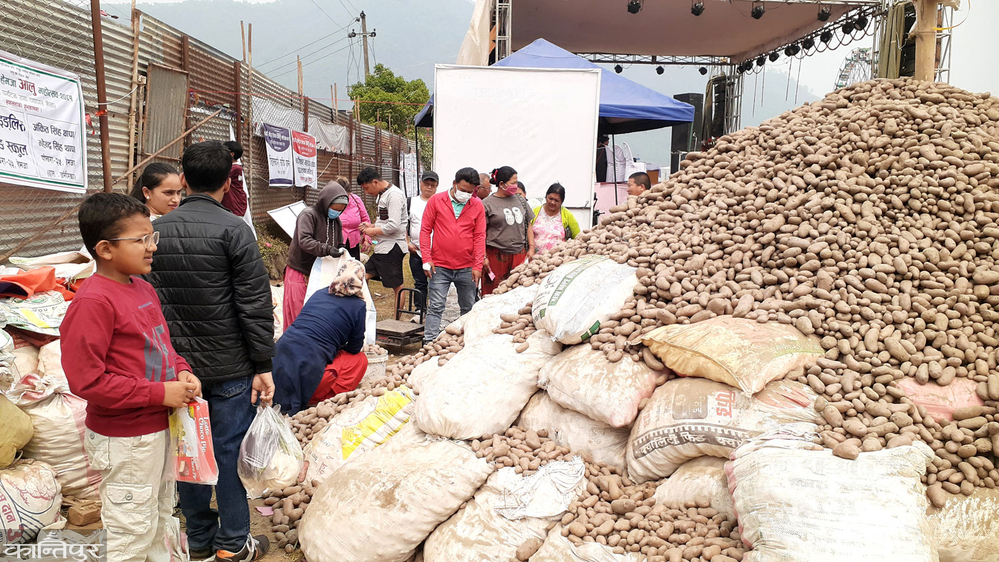
Vasantakumar Shrestha, the president of the local Bishnupadu youth club, says that the festival is being conducted because the production land has started to be destroyed due to the development from rural to urban areas in a short period of time. "The upper part of Hemza has grown a lot. Cultivable land there is less than the bottom. This process has also increased in Badhare, Maisthan, where potatoes are grown, he said.
President Shrestha says that the government needs to pay special attention to the protection of productive land through policy. He says that if arable land is not protected, there will be no potato production at all. It is an immediate challenge that will cause problems in tomorrow's production. There is a problem with the potato festival, but the potato is not produced," Shrestha said.
With the aim of protecting arable land, the Pokhara Metropolitan Municipality did land classification by separating agricultural and non-agricultural areas in November 079. After putting agriculture in non-agriculture and non-agriculture in the agricultural sector, a writ was filed in the High Court in Pokhara. After the court ordered to inform the local people and work, the Metropolitan Corporation had issued a notice last October to submit an application if there were complaints about the previous land classification. City chief Dhanraj Acharya said that preparations are being made to separate agricultural and non-agricultural areas soon after studying the application received.
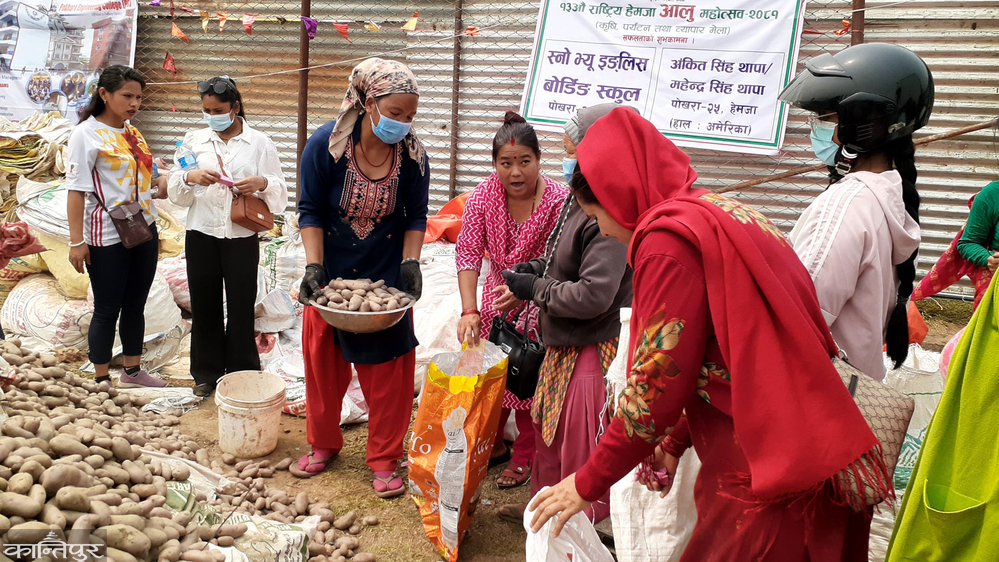
The potato festival of Chait 24th to 13th edition, organized by Vishnupada's youth club, continues till Wednesday. Jairam Timilsana, Coordinator of Potato and Agricultural Produce Management Sub-Committee, informed that about 62 thousand kilos of potatoes were sold in the festival till Sunday. Potatoes, which are priced at Rs 42 per kg, have been traded at around Rs 2.6 lakh till Sunday.


