Even though there are three levels of government in the country, there are many complaints that the people have not been able to realize it, victims of meter exploitation, victims of co-operative fraud, farmers who have not received the price of sugarcane and others have not been able to run to Kathmandu for justice.
We use Google Cloud Translation Services. Google requires we provide the following disclaimer relating to use of this service:
This service may contain translations powered by Google. Google disclaims all warranties related to the translations, expressed or implied, including any warranties of accuracy, reliability, and any implied warranties of merchantability, fitness for a particular purpose, and noninfringement.
Sangeeta Parajuli, a blind teacher, fell and broke her arm on 11 June 2080 when she went to teach in Ramechhap. She was selected as a permanent teacher after passing the teacher service in December 2079. Chitwan began to feel uneasy after he was appointed by the Bagmati state government and sent to Ramechhap, a hilly district.
Earlier, she taught in Gharpayak Janki Secondary School Meghauli for 14 and a half years as a relief teacher. There were also some handicap-friendly structures.
'I am a person living in Terai, it was difficult even geographically. Since the school was not disabled friendly, it was also a problem to teach," said Parajuli, "I approached the local people's representatives from the education minister and leaders with my problem, but there was no response. Then I chose Maitighar in Kathmandu as my last resort.
Along with her husband Ganesh Mahata, who is also a teacher, she staged a sit-in at Maitighar. "We sat on dharna from 20th to 27th of May 2081, demanding not to arrange placement in suitable and accessible schools for the disabled," Parajuli said, "We returned after a verbal agreement with the then Minister of Education, Science and Technology Sumana Shrestha, but the demand has not been addressed yet." Your demands are easily addressed. "Those of us who did not go to Kathmandu without work had a very uncomfortable stay. We spent almost 15 thousand rupees but our demands were not met," she told Kantipur, "I am still working in Ramechhap." Common people come from district to district as a last resort with the aim of coming to Kathmandu and raising their voices against economic, social discrimination and injustice. According to the police, the number of victims of rape, domestic violence and caste discrimination is increasing. Although it is claimed that the services provided by the Singh Darbar have reached the villages according to the federal system given by the new constitution, citizens are forced to come to the capital to have their demands heard.
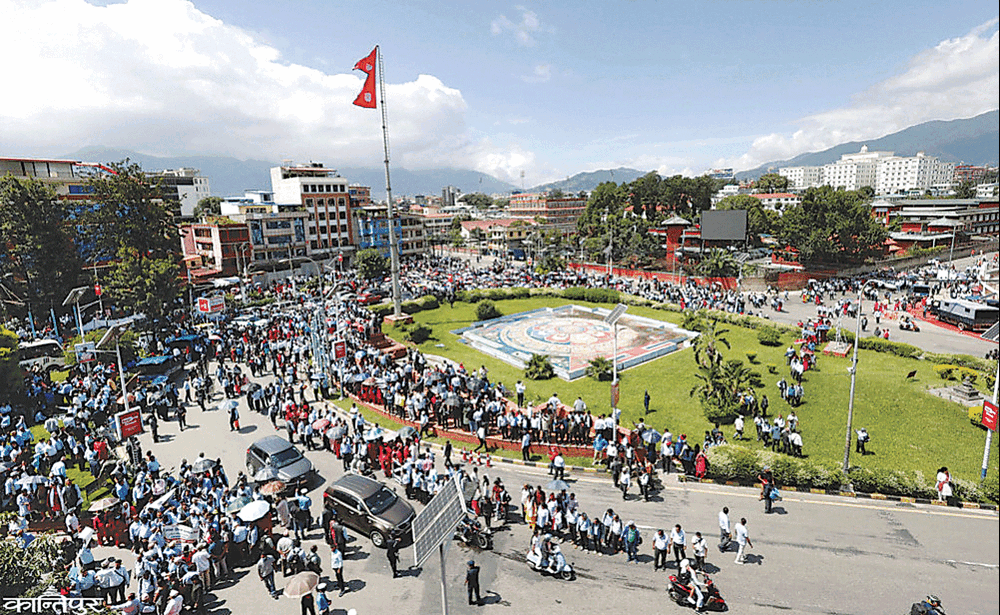
1 thousand 86 processions, corner meetings and dharna programs have been held in Maitighar in the 11 months from April 2081 to February. According to Superintendent of Police Apilraj Bohra, information officer of the district police complex, 84 in May, 88 in June, 82 in June, 89 in August, 133 in August, 75 in October, 92 in October, 93 in November, 93 in January, 139 in January and 118 processions, corner meetings and sit-ins were held till February 21.
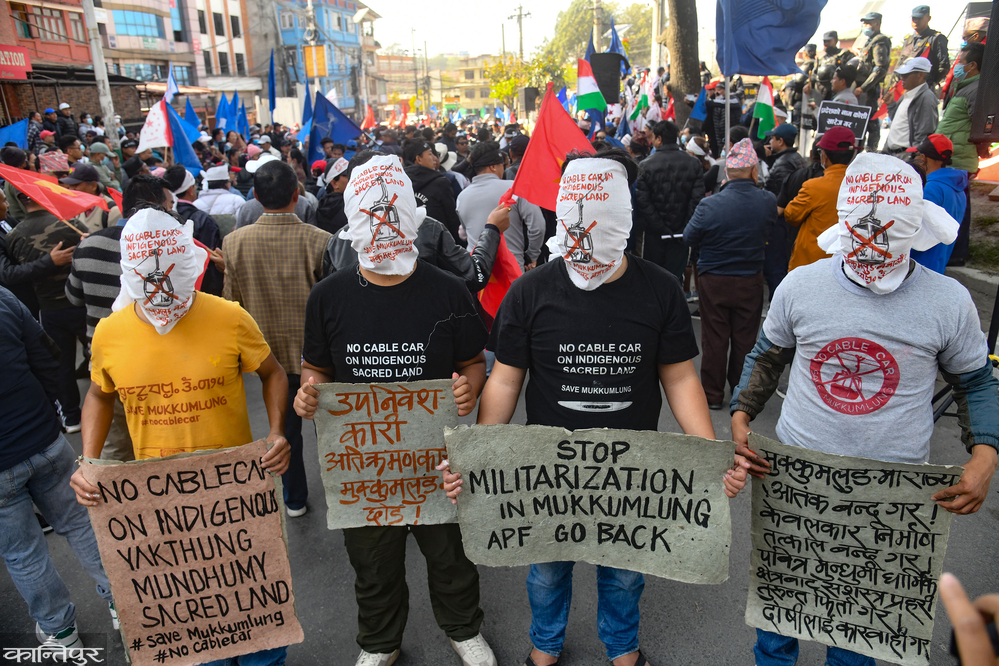
Controversy is currently at its peak regarding the cable car construction in Pathibhara area of Taplejung. Incidents of clashes and firing also took place in the Pathibhara area. The 'No Cable Car' supporters have been aggressively protesting since November. Their movement through Taplejung is now concentrated in Kathmandu. Activist Alok Mavohang says that he is also conducting a movement centered on Kathmandu in order to attract the attention of the state.
"Along with Taplejung, protest programs have been held dozens of times in various places by those in Kathmandu," Mavohang said, "We believe that the program in Kathmandu will quickly attract the attention of the state." Because everything from the state administration is concentrated in Kathmandu.'
Swargadwari Guthipidi Mohi farmers have also been on a sit-in for 37 days since they came to Kathmandu from Dang. 39 Mohi farmers from Dang have been on strike since January 20 at Maitighar in Kathmandu. Those farmers who have acquired rights to the land of Swargadwari Ashram have come to Kathmandu demanding the right to the land. Praveen Dahit, Joint Secretary of Swargadwari Guthipidit Mohi Kisan Sangharsh Samiti Dang, who came to Kathmandu to put pressure on the central government after protesting in Ghorahi for a long time and their demands were not heard.
'Even though we protested for months in the district, the government did not care,' said Dahit, 'We came to Kathmandu saying that it will become a topic of debate, the government will look closely and even help in drafting the law.' They have been protesting since 2045. The last generation came to Kathmandu and started a protest for the first time.
"We came dozens of times to submit the memorandum, to meet the ministers and leaders," Dahit said, "The government promised to meet the demands after repeated negotiations, but it has not been fulfilled." It was also agreed earlier to start the process of formulating a new unified Guthi law immediately. Twelve of them, who have been protesting in the cold for a long time, are now sick. Three people are being treated in the hospital.
Women's Rights Forum Banke's team has repeatedly staged a sit-in for 230 days in Kathmandu for the justice of Nirmala Kurmi. Kurmi is a single woman. Nirmala's husband of Banke's Nepalgunj sub-metropolitan city-17 died in 2062.
Then Kurmi, who was living with her two sons, died mysteriously in a space of 10 days in November 2066. After that, Badshah Kurmi took the citizenship of Lalpurja and Nirmala saying that he would keep the house property in the name of husband and son safe. Then Kurmi disappeared.
Ruby Khan, a human rights activist from Nepalganj, says that it is a sad matter to come to Kathmandu for justice in such a serious matter. "If the rules and regulations are followed, no one would want to hold a sit-in," she adds, "When the local government and the state government do not listen, it is compulsory to come to Maitighar to inform the central government in the hope of getting justice." However, after the demand was not fulfilled, on August 13, 2078, a group of women came to Kathmandu on foot. In the meantime, they came to Kathmandu 5 times and sit dharna for justice. After their program with a sit-in centered in Kathmandu, the Ministry of Home Affairs is working by forming an inquiry committee. The mother-in-law's voice tells Khan that the case is in the process of reaching the court. Although the constitution has given us full rights, he believes that there is a problem when local power and authority are concentrated in the central government.
Minister of Law, Justice and Parliamentary Affairs Ajay Kumar Chaurasia says that it is natural for him to come to the capital and make his point as he has the trust and confidence of the common people. "People have concentrated in Kathmandu because of the feeling that they will get a quick look," Chaurasia said, "because the central government has also played a role in such matters, the trend of coming to the capital rather than the local and state levels has increased." "If there is a problem with the law, it should be identified and moved forward," Minister Chaurasia added, "Federalism is a matter raised by common people." It has many good and easy aspects.'
Citizen activist and political scientist Bhaskar Gautam says that since the new constitution came into being, there is a problem of having to go to Kathmandu even for ordinary work in the country as there is no work according to the constitutionally acquired rights in accordance with the federal structure. According to him, he understands that there is a problem because the central government does not give authority to the lower level in some matters.
"There are things that work is not possible from other than the union," Gautam said, "The main thing is that there is no effective distribution of rights." According to Gautam, citizens do not come to Kathmandu all at once, they come to Kathmandu as a last resort when they are tired of wandering through municipalities and provinces in search of justice.
"Government forced them to come to Kathmandu," Gautam said, "The situation of having to come to Kathmandu to seek justice is unfortunate. It is a sad thing to come to a situation where we have to protest for justice in a democracy. People don't come here by desire. Even the natural problems that need to be solved at the district level have not been done.'
Gautam says that it is a practice for the union government to form a general inquiry committee under the illusion that it is with the people who came to Kathmandu for justice. "Confusion is done by the state," Gautam added. The Education and Guthi Bill that reached the Parliament was withdrawn due to protests by teachers and the Newar community that broke out in Maitighar. It is the experience of farmers who have suffered from the fraud of the cooperative operators, farmers who have not received the price of sugarcane, come from different districts and come here to protest and get the attention of the government.
Bharti Manandhar of Nepalgunj started a sit-in at Maitighar demanding that Yoga Prasad Dhakal, who is accused of murdering her husband Chetan Manandhar, be sent back to jail. Then Regal, who was released by the government without paying the sentence for the heinous crime, went back to prison. Victims have even lost their lives while sitting in the capital, and there are cases where many people have returned sick.
Narayan Rai Yadav, a 64-year-old farmer of Sarlahi, died of a heart attack while fighting for justice for sugarcane payment. There are also plenty of incidents where the administration repressed protesters who were peacefully protesting by pitching tents on the cold floor of the maitighar. Gautam says that although the new constitution and federalism say that all the rights have gone to the villages, it is necessary to end the compulsion to come to the capital after spending weeks and spending thousands of rupees.