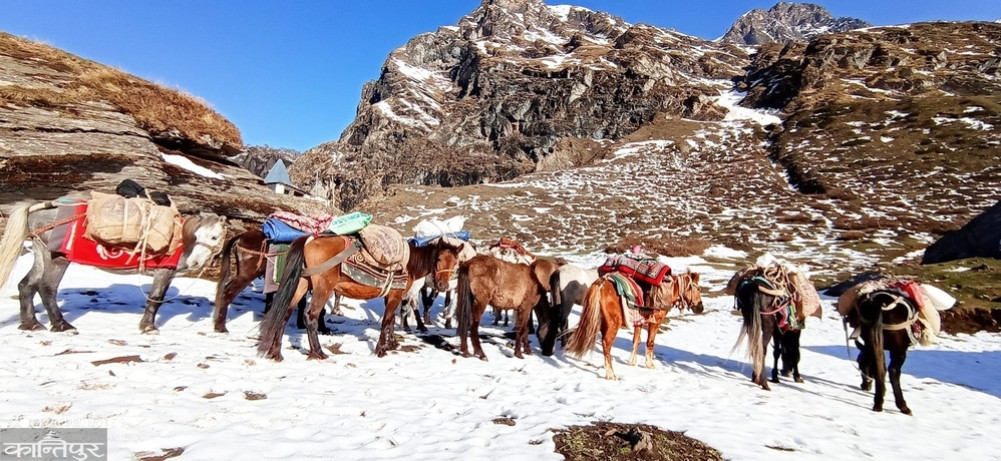
When it snows in the village, the firewood runs out, the grass runs out, and the water freezes. Seeking a little relief from their hard lives, they go to places where the sun shines brightly and where there is grass.
We use Google Cloud Translation Services. Google requires we provide the following disclaimer relating to use of this service:
This service may contain translations powered by Google. Google disclaims all warranties related to the translations, expressed or implied, including any warranties of accuracy, reliability, and any implied warranties of merchantability, fitness for a particular purpose, and noninfringement.
As the winter chill begins to creep into the windows and doors of the Himalayas, the high mountain villages become deserted. And the villages of Manang, Mustang, Rasuwa, Dolakha, Humla, Mugu, Dolpa, Solu (the list of places could be long) become deserted. Holding on to the old rhythm and tradition, people carry cattle, sheep, goats and small children down to the lower regions, i.e. the warm valleys, before the thick snow blocks the way.
This is a living tradition, a part of the culture that has been going on for centuries. When snow falls in the village, the firewood runs out, the grass runs out, and the water freezes. Looking for a little relief from the difficult life, they go to places where the sun shines well and grass is available.
Out of the 58 tribal groups of Nepal, 18 groups live in the Himalayan districts. All of these tribal groups go to their old barns in the valleys to escape the cold for three to four months of the winter, some to their own old barns in the valleys, some to remote settlements. Migration is also integral to our cultural life practices.
Like the Kirats, there are lively festivals of seasonal migration – Umbhauli and Undhauli. These festivals are integral to the seasonal cycle of Himalayan-Hill migration. Winter migration is not only a way to escape the cold. It also exchanges culture and harmony among the communities of the Himalayas, Terai, and mid-hills.
This tradition, which has been alive for decades, stays alive with the weather. As the snow melts in Falgun-Chait, the closed windows of the mountains open again, and the deserted villages become bustling. Colors return to the mountains. The tradition of descending to the valleys in search of warmth is a living history of the Himalayan trade, culture, and lifestyle intertwined with the environment.
In this issue of ‘Koseli’, we have tried to discuss the art of survival of the people of the Himalayas.
Schools also descend to the valley
Mustangs, evading the cold, selling warmth
Upper Dolpa residents descend to the valley
'The cattle climbed the lake, their own love fell into the valley'
Khumbu is dependent on the Heralu
Rasuwali farmers: Wherever the sheep are, there they live
They cannot stay in the village all year round, nor can they leave it forever