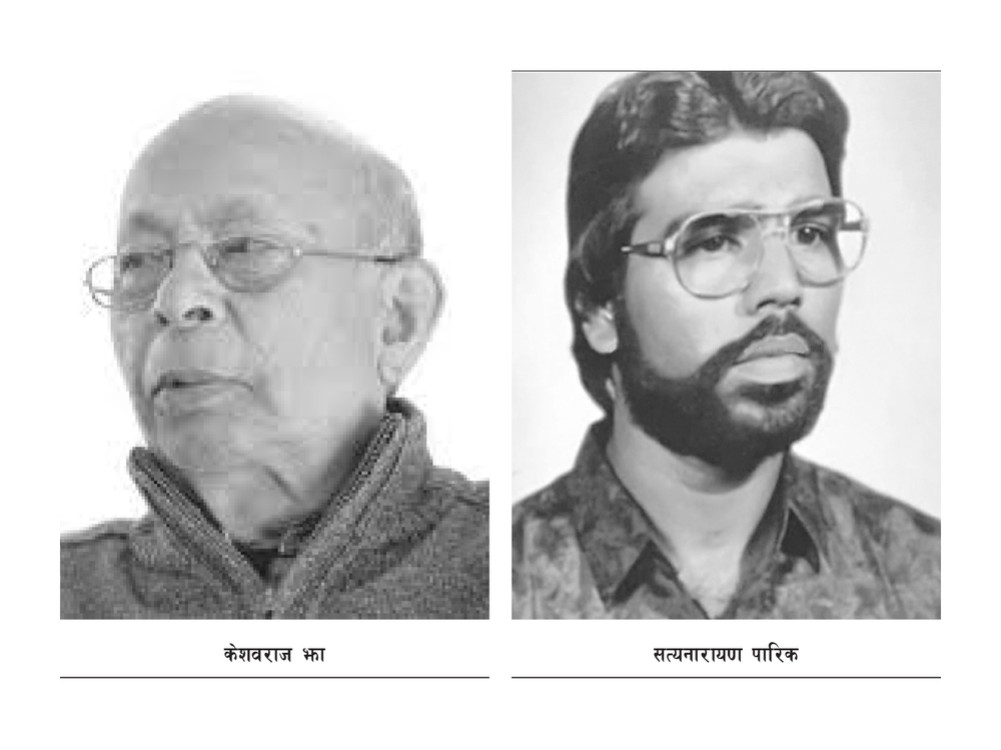
Former Ambassador to France Keshav Raj Jha was killed in his home in Babarmahal, and Indian citizen Satyanarayan Pareek was killed while sleeping alone in his flat in Sanepa.
We use Google Cloud Translation Services. Google requires we provide the following disclaimer relating to use of this service:
This service may contain translations powered by Google. Google disclaims all warranties related to the translations, expressed or implied, including any warranties of accuracy, reliability, and any implied warranties of merchantability, fitness for a particular purpose, and noninfringement.
A year after the killing of Sharad Gauchan, the president of the Federation of Nepalese Construction Entrepreneurs, which spread fear across the country, another ‘high-profile’ crime took place on 4 Bhadra 2075. Keshav Raj Jha, 80, a former Nepali ambassador to France who spent 34 years in the foreign service, lost his life inside his own home in Babarmahal. The night he returned after bidding farewell to his doctor son and daughter-in-law who were going to Ireland, turned out to be his last.
‘The room was locked, it looked like he had been stabbed,’ recalls a police officer who arrived at the scene, ‘there was a knife next to his bed, which was previously used in the kitchen.’
Who killed former ambassador Jha in the locked room? The investigation officers, who were looking for an answer to this question, immediately suspected Sanukancha Tamang. According to the police, he was not happy with the salary that former ambassador Jha was paying. His salary had barely increased to 16,000 rupees. To avoid trouble, he had even taken a loan of 50,000 rupees from Jha.
‘The background was that he was worried about when he would repay that loan,’ says an officer assigned to the investigation, ‘he was very angry when he started talking about the loan instead of the salary increase.’ Details of the loan were also mentioned in Jha’s diary, which he regularly wrote. Later, during police interrogation, Tamang admitted that he had taken the loan because his house had collapsed due to the earthquake.
Immediately after the incident, a trained dog was also deployed from the Nepal Police's Canine Division. The dog, which was released after sniffing out evidence, only roamed around the house, so the police focused their investigation there. After looking at the CCTV footage around the house, no new person was seen entering.
According to the police, only Jha's wife and Chef Tamang were at home on the night of the incident. The Jha couple used to sleep separately. The wife went to call him the next day after he fell asleep watching the news at 7 pm. However, Keshavraj Jha did not speak, and his wife felt cold. Then she called the cook Tamang. 'The room was closed from the inside, and when I went to look from behind and saw blood, we informed the police,' Tamang had said in his initial statement to the police.
According to the officer assigned to the investigation, since the incident took place inside a closed room, there was very little basis for the involvement of outsiders. The police initially took the cook Tamang and two gardeners into custody for investigation. But the District Administration Office, Kathmandu, released all three on bail, citing insufficient evidence. The police came under pressure after a complaint was filed by Tamang's family at the National Human Rights Commission alleging that he had been tortured while the investigation was ongoing. The complaint stated that he was forced to confess to the crime by being subjected to extreme torture.
A year later, the police took Tamang into custody based on the complaint of Jha's wife Gyanu. But he did not confess to the murder charge. Based on the case filed based on circumstantial evidence, the District Court, Kathmandu, ordered Tamang to be remanded in custody for trial. An investigation officer had met Tamang even while he was in jail. The officer says that even then he did not strongly deny his involvement in the crime. The police tried to conduct a 'narco' and 'polygraph' test, but Tamang did not prepare for it. This gave further grounds to suspect him. The police also submitted a document detailing his refusal to be tested as evidence.
In the statement mentioned in the police file, Keshavraj Jha's daughter Rajshree has revealed that she had also given Tamang the 'cat food' found at the scene of the crime some time ago. 'No one knew where it was except him,' she said. 'The little girl had also kept the pillow that covered her father's face in the store room.'
According to the statement made in court by Kumar Thapa, the trained dog's 'handler', when the dog was released after sniffing the scent of the knife used in the murder, it went to the roof of the upper floor. 'Since the accused indicated that he had escaped from there using a mango tree, we took him under it and sniffed the knife again,' he said. 'The dog indicated a pair of paws in the garden of the compound inside the house. Then the dog reached Tamang's room.'
But the Kathmandu District Court on 23 Chaitra 2077 ordered the acquittal of Sanukancha Tamang, saying there was not enough physical evidence against him. The district court had ordered that Tamang should not be found guilty of a serious criminal offense like murder based on suspicion and speculation.
Tamang was charged with indecent behavior when he was arrested immediately after the incident. The court has mentioned that the police had not been able to find Tamang's direct involvement in the incident even after conducting polygraph, narco test, collecting CCTV footage, and talking to neighbors. It is said that a year later, the deceased's wife Gyanu had submitted a complaint stating that Sanukancha was the only one who had the keys to the house and that she was the one who used the knife used in the murder.
The government attorney's office had filed a writ petition in the High Court against this court order. But after the high court upheld the district court's verdict, the investigation into the former ambassador Jha's murder case has returned to zero. In formal conversations, investigation officers from the Kathmandu Police, the Valley Crime Investigation Office and the Central Investigation Bureau (CIB) say that the Jha case is being investigated from a new perspective. In informal conversations, they say that the Jha murder case has been shrouded in mystery for a long time due to 'technical reasons'.
...
Satyanarayan Pareek, who hails from Rajasthan, India, had been living in Nepal for 20 years. He had rented a two-room flat. But he lived alone. His wife had passed away eight years ago. He had a daughter. The daughter was also married. His brother Sanjay Pareek had advised him to return to India. But Satyanarayan had made Kathmandu his old age home.
Satyanarayan used to go to the nearby Ram temple every day and perform pujas. According to locals, he was a quiet, solitary and disciplined person. He worked as a 'sales person' at the Atlantic Computer Company in New Road. It had been two years since he started working there. But after the accident a year ago, he used to work from home. He rarely left his room. Since he was lonely, two workers would come and go in the morning and evening to cook and clean.
Sita Adhikari (40) from Nuwakot had been working in the morning at Satyanarayan's residence in Gursingal Tol, Sanepa, Lalitpur-2 for nine years. Ruku Basnet (25) from Makwanpur had been coming to work in the evening for a month. On 18 Ashad 2078, around 8 pm, Ruku had informed him by phone that he would not be able to come to work tomorrow. On the morning of 19 Ashad 2078, Sita reached Satyanarayan's house as usual. But the gate was locked from outside. She called repeatedly. He did not wake up, and then she returned home.
When she reached the next morning on 20 Ashad, the light inside the house raised many questions in Sita's mind. She felt that something was wrong. She immediately informed the police. When the police arrived, they saw a pool of blood, a TV playing, a burning lamp, and a broken steel drawer in the room. 59-year-old Satyanarayan Pareek, wearing gray shorts and with his head buried in a blanket, was found dead on the adjacent bed.
When they arrived at the scene, the glass of the kitchen window had been broken. The mesh had been torn. The iron grill had been pulled out. The drawer in the room on the upper floor had been broken. A hammer was also found inside the room. Satyanarayan had been hit repeatedly on the head with the hammer. There was a pool of blood in the room that was about to dry up.
Looking at the situation at the scene, the police easily assumed that Satyanarayan had been murdered. The Metropolitan Police Complex, Lalitpur and the Metropolitan Crime Division team began an investigation. The police immediately mobilized a forensic team, dogs, and experts. The neighbors' statements were taken, mobile phone data analysis began, and the scene was studied. However, even after using dogs to investigate, no concrete clues were found. According to the police investigation, Satyanarayan had not contacted anyone else after talking to Ruku at around 8 pm on the night of the incident (18 Ashar).
The police had started the investigation on the assumption that the murder was committed after a robbery. But no concrete evidence was found. According to the police, the CCTV camera located 50 meters away from Satyanarayan's house showed four suspicious people moving around on two motorcycles between 10 pm and 12 am. The police have not been able to identify the four people yet.
The police had kept everyone from Satyanarayan's employees, including colleagues and friends, under surveillance and conducted the investigation. They also started investigating from the perspective of the RBI to see if there had ever been a fight. 'But no 'clue' of RBI, enmity or fight was found,' says an officer involved in the investigation.
About a month later, the police had arrested three people on suspicion. But they were released after the statements, documents and connection to the incident were not found to be sufficient. The Central Investigation Bureau (CIB) had started investigating the incident after the District Police Complex, Lalitpur and the Crime Investigation Division could not find any ‘clues’. The CIB also did not find any important ‘leads’.
SSP Hobindra Bogati, head of the District Police Complex, Lalitpur, said that the investigation into the incident is still ongoing. ‘Even when I was in the CIB, there was regular follow-up work on this. At that time, a dedicated team was deployed to work,’ he said, ‘Even after I came to Lalitpur, we have formed a team and are working.’ Bogati said that the work of questioning and recording statements of people related to him is underway. ‘We have found some ‘clues’. It remains to be verified. We are searching for the suspect by looking at the nature of other incidents like Satyanarayan,’ he says.