Although the 9-point treaty was signed by both the British and Nepal in Sugauli, India, on November 19, 1872, Nepal refused to implement it. Nepal, under pressure after the British forces started attacking again, surrendered the treaty to the British after only three months.
We use Google Cloud Translation Services. Google requires we provide the following disclaimer relating to use of this service:
This service may contain translations powered by Google. Google disclaims all warranties related to the translations, expressed or implied, including any warranties of accuracy, reliability, and any implied warranties of merchantability, fitness for a particular purpose, and noninfringement.
February 23 is marked as an important day in the pages of Nepali political history. In political history, 74 years ago in 2007, the Rana regime ended and democracy came to the country. The Nepali calendar always reminds us of the change that occurred on February 7.
Even though it is not written in the Nepali calendar, many explanations of the events of February 23 can be found in the pages of history. What happened that day? For that, you have to go back 29 years. On the 23rd of February 1872, the Nepalese-British war was formally ended. Nepal accepted the Sugauli Treaty with the British. Because of that treaty, Nepal had to lose one-third of its territory.
Nepal's unification and expansion campaign, which started from the time of Prithvi Narayan Shah, reached Thamin on the same day. The war between Nepal and the British that started in October 1871 was stopped in February 1872 when Nepal agreed to sign the Sugauli Treaty on the terms of the British. After a long battle, Nepal was under pressure. The British had increased their grip on the western states of Kangra, Garhwal and Kumaon controlled by Nepal. Nepal was forced to leave all the territories west of the Mahakali river to the British company government. On the other hand, the British had already stepped up their attack on the Nepalese army from the Central Terai in preparation for capturing Kathmandu. Under these circumstances, a treaty was signed at Sugauli between Nepal and the Company Government on November 19, 1872. Which is famous as Sugauli Sandhi. Even though it was signed, after taking months to accept it, the British company government attacked Nepal again. After the second battle, only three months after the treaty, Nepal put a red seal on the treaty and submitted it to the British.
Despite being forced to surrender to the English forces in the Far West, the Nepalese army was constantly suppressing the flow of the British forces in central and eastern Nepal. In the book 'Rise and Fall of Bhimsen Thapa' written by historian Baburam Acharya, it is written - 'Nepalese soldiers were keeping the invading British soldiers from entering the hilly areas of their country. However, the news from the far west also started to dampen the spirits of the Nepalese army heroes struggling in this region. Continuing the war was a big problem for the Nepalese government. They did not turn a blind eye to China's request for military and financial assistance. "It is no longer our custom to provide military aid to another state and to provide financial aid for the purpose of war," was the answer that Nepal has been getting time and again from the representatives of the Chinese king, the Ambans.
On the other hand, the war had almost destroyed Nepal's fortunes. Arms and ammunition were running low. It is mentioned in the book of the historian Acharya that under the same circumstances, the government of Nepal appointed Rajguru Gajraj Mishra as an envoy to negotiate a treaty with the company government. A 9-point treaty was signed by both parties on November 19, 1872 at 'Sugauli', an Indian land controlled by the Company Government. Guru Gajraj Mishra and Taksari Chandrasekhar Upadhyay signed the treaty as authorized by Lt. Col. Parris Bradsa and Maharaja Girwanyudhvikram Shah of Nepal as delegated by the Governor General of the Company Government. According to the treaty, Nepal had to lose a large territory.
As mentioned in the book 'History of Nepal Integration' published by the Nepali Army, Nepal lost the entire territory of Mahakalipari and could not have any kind of contact with its inhabitants. Also, Nepal had to lose all the Terai from Teesta to Mechi and Terai from Kosi to Mahakali. It was arranged that the company government would give two lakh rupees annually to Nepal as compensation for the territory of the Terai. Apart from this, it was stipulated that Nepal should not have any conflict with the King of Sikkim and in case of conflict, it should accept the mediation of the British government. In addition, it was mentioned in the treaty that there will be ambassadors of each other in both states and that Nepal cannot retain any British, American or European citizen in its service without the approval of the British government. Commenting on the issues in the
treaty, the authors of the book said, 'In short, Nepal had to lose more than one-third of its territory from this treaty, and on the other hand, it had to indirectly accept the dominance of the British government. Professor Dr. Triratna Manandhar, professor Dineshraj Pant, professor Malraj Singh Rathore and associate professor Dr. Written by Vinod Thapa.
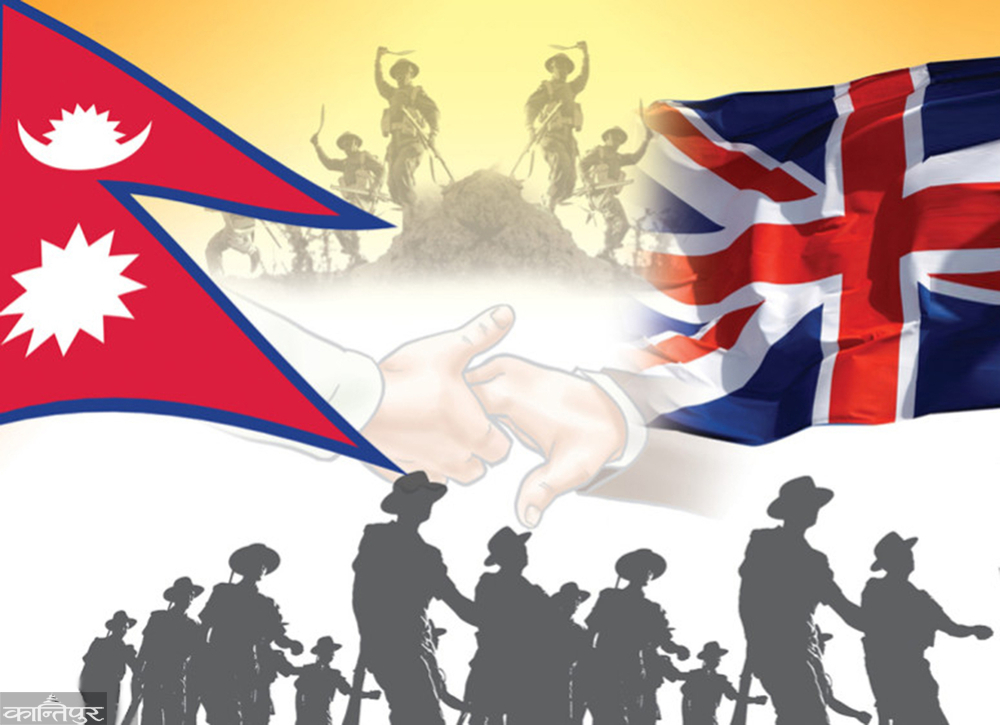
According to the Sugauli Treaty, Nepal had to withdraw from the entire territory of Mahakali West and Mechi East, the plains from Mahakali to Narayani River except for Butwal Bazar and all the plains from Narayani to Koshi which have been or will be under the control of the British. The treaty had to be ratified by both governments within 15 days. The British ratified the treaty within 7 days. The Governor General of the Company Government, Warren Hastings, duly signed the treaty at Williams Fort, Calcutta.
The government of Nepal refused to ratify the treaty. It is mentioned in the historian Acharya's book that after the treaty arrived in Kathmandu, Mukhtiar General Bhimsen Thapa and his chief aides refused to seal the red seal of the then King Girwanyuddha Bikram Shah. King Girvanyuddha was 18 years old at the time of the 'Sugauli Treaty'. Angered by the behavior of Nepal, the English army started preparing to attack Kathmandu.
As mentioned in the book 'Mukam Ranmaidan' by journalist Mainali, the battle which stopped for some time started again. The English had reached Hetaunda with a large force, meeting the Nepalese army. As the threat to Kathmandu itself increased, the government of Nepal was forced to bow down to the British.
The Nepali army did not try everything possible to prevent the soldiers of the company government from coming towards Makwanpur. But it was not so easy for the Nepalese army to stop the opposition forces in the vast population equipped with modern weapons. Therefore, it is mentioned in the book 'Bhimsen Thapa Utthan Ta Patana' that the Nepali generals were forced to accept their defeat at the end. Finally, the government of Nepal was forced to accept the Sugauli Treaty.
The Nepalese army failed to stop the speed of the British army in the battles at Makwanpur, Hariharpur Ghadi and Bhikkhori. As mentioned in the history book of unification of Nepal, the English army started the second phase of war against Nepal from February 5, 1872 after the delay in coming to the treaty with the king's red seal on behalf of Nepal.
In the second battle, the English army was able to advance without a major resistance. After the victory of Makwanpur, it was decided that the British commander General Octorlony would move towards Kathmandu with his army, and there was no other option for Nepal except to ratify the treaty and stop the war. Chandrasekhar Upadhyay was hurriedly sent to Makwanpur with a copy of the Sugauli treaty approved after a correct assessment of the situation. Upadhyay handed over the ratification copy of the treaty to Octorloni on 23rd February 1872 and the copy approved by the British was understood by Upadhyay from Octorloni. From that day the war ended.
According to historian professor Dineshraj Pant, the government of Nepal was saddened by the loss of Mechi East and Mahakali West, but was more worried by the loss of the Terai in the middle. Therefore, he told Kantipur that there was a delay on the part of Nepal in giving approval to the treaty. He says that Budhakaji Amarsingh Thapa came to Kathmandu after surrendering in the west and the British soldiers came to Makwanpur, and fear spread among the courtiers of Nepal. He mentioned that when Nepal, which was reluctant to accept the treaty, came under pressure, it hastily put a red seal and sent the copy of the treaty to the British camp.
Historian Acharya's book also mentions that Taksari Chandrasekhar Upadhyay took the certified copy of the red-sealed treaty on behalf of the king to the English camp at Makwanpur on 23rd February 1872.
Similarly, Professor Dr. Ram Prasad Upadhyay also wrote in the history book of Nepal that after the news reached the Nepal Darbar that Octorloni's army was advancing towards Kathmandu, Upadhyay, the representative of the palace, appeared at the camp of Octorloni on February 23 with a treaty that was approved with the red seal. At that time, Upadhyay, the Nepali ambassador, had to endure a lot of disrespect from the British officials, he said in the book.
In the book 'Mukam Ranmaidan' written by journalist Mainali, it is said that due to the arrogance and negligence of the Nepalese palace, fierce battles were fought in vain in Makwanpurgarhi and Hariharpurgarhi. Similarly, there were futile raids between Mechi and Teesta rivers at the same time. It is mentioned in the book that the British commander Octorloni expressed his anger to Upadhyaya, the Nepali envoy who reached the British camp, saying that 'Nepal was changing the word at every step, acting stupidly and dishonestly'.
Mainali said that the contact between Nepal and the British was established on February 23. However, it is said in his book that the Sugauli treaty with the red seal was cut at midnight on February 24 and handed over to Octorloni shortly after the 25th. At the end of the 17-month long war, Nepal lost all the lands of Mechi East and Mahakali West and all the plains from Koshi to Mahakali except Butwal. According to the treaty, ambassadors started living in Nepal on behalf of the company government. It is mentioned in the book 'Bhimsen Thapa Utthan and Fall' that Lt. Byalu arrived in Kathmandu on 6th Baisakh in 1873 as Acting Ambassador (Resident) according to the provisions of the Sugauli Treaty.
9 months after taking control of Terai territory, on 25th December 1873, the company government returned most of Terai territory to Nepal government. Reconciliation with the Maharaja of Nepal was desirable and in order to keep the heart of the Nepalese king, it was decided to return the Terai areas under the control of the company government to the Nepalese government according to the Sugauli treaty.
Terai areas between the Koshi and Gandaki rivers, which were previously under the control of the Government of Nepal, and between the Terai areas between the Gandaki and Rapti rivers, which were under the control of the Government of Nepal before the start of the war, were returned to the Government of Nepal. According to the first treaty after the return of the Terai regions, the British decided not to give the two lakh rupees promised to the Nepalese government on behalf of the company government. At that time, after returning the territories to the government of Nepal, if there is any deviation in determining the border between the two countries, a supplementary treaty was signed between the two parties to determine the border in such a way that the territories of the government of Nepal to the north and the territories of the company government to the south will be determined by the Amins of the two countries after consulting each other so that there will be no disputes forever.
44 years later, in 1917, through another supplementary treaty, the British returned the Terai territories from Rapti to Mahakali to Nepal. Rana Prime Minister Jung Bahadur of Nepal helped the company government in the rebellion against the British government in India. For that, Nepal got back the territory of West Terai. That's why Banke, Bardia, Kailali and Kanchanpur in the west are still known as the new country, says Professor Pant. At the time of the Sugauli Treaty, the British left a small part of the Terai from Koshi to Mechi to Nepal. Then he returned the other part of the plain by doing it twice. Professor Pant said that the boundaries of Nepal determined by the Sugauli Treaty and the two subsequent three treaties have been maintained till date.
On 23 February 1872, after the Sugauli treaty accepted by both governments was exchanged, the war stopped and the British soldiers began to withdraw from Nepali land, Pant said. "From the same day, the Sugauli Treaty was implemented and the border of Nepal reached Khumchin," he said. If that treaty could not be implemented, there was a danger that the British soldiers would reach Kathmandu. Nepal has been spared from that.'

