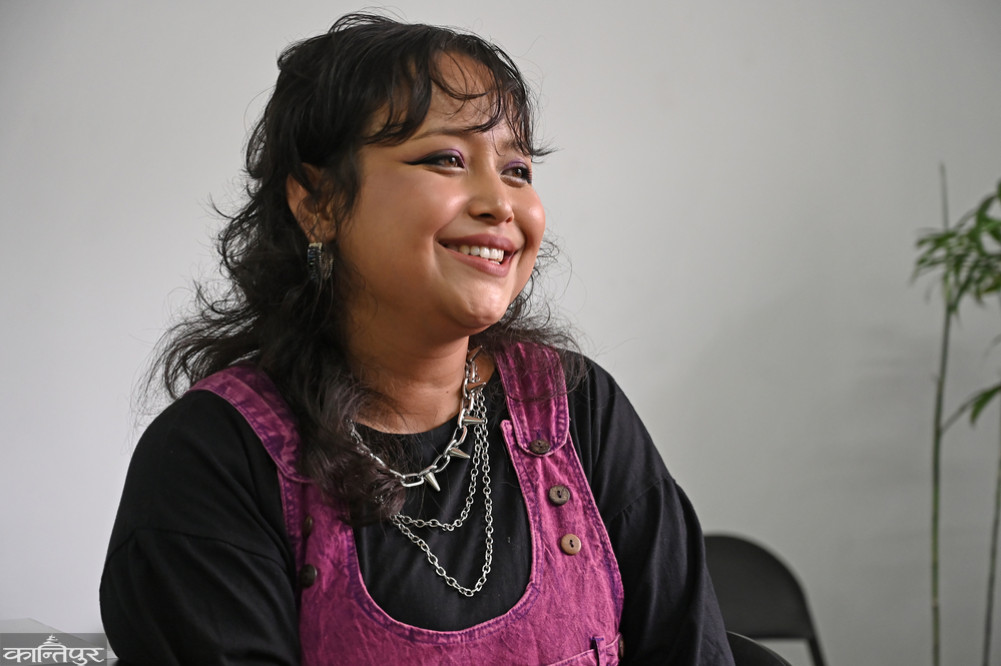
Dimriti, who raps to break patriarchy and caste discrimination, says: What have women done these days, that you would be surprised if I rap? It's as if some women haven't rapped!
We use Google Cloud Translation Services. Google requires we provide the following disclaimer relating to use of this service:
This service may contain translations powered by Google. Google disclaims all warranties related to the translations, expressed or implied, including any warranties of accuracy, reliability, and any implied warranties of merchantability, fitness for a particular purpose, and noninfringement.
Sometimes I feel like I'm no less than anyone. I'm even more amazing than others! I can't be compared to anyone. Yes, rapper Dimriti has written this feeling - Dusama Dus. Sometimes, the same beat (dhundred) comes to Dimriti. She keeps humming the same tune, mixing the words with the feeling it gives. This is how it came to be - 'Dusama Dus'. Now some clips of this rap are trending on social media. When the new rap sung for the film 'Shakti' was also released along with the music video, Dimriti is in the news!
Dusama Dus
Everyone thinks about my height
Dusama Dus
From boys to girls, everyone is excited…
Satirizing the patriarchal mindset that wants to see women as weak, modest and polite, Dimriti talks about a woman who is a ten out of ten. Who is independent, breaks the rules that women are supposed to do. Placing herself at the center of the female character, she sings, 'I said I'm the bomb, I'm the gun. Not a bitch, not a chick, independent don't (I said, I'm the explosive force, I'm the weapon. I'm not someone who is subordinate to anyone, I'm an independent and powerful don in my own right)'.
Dimriti had launched this rap in the market 3 years ago. However, the discussion about this rap started a month ago due to the show held at 'Lounge'. While performing this song in the lounge, Dimriti sang the rap acoustically, thinking of doing something new. She added flute melodies. And then she made another voice in the background a 'back vocal'. 'I wanted to do something new, so I sang it in an acoustic version, and it went to Instagram,' Dimriti says.
Sometimes Dimriti feels like a zero out of 10, and sometimes she feels like a 'ten out of ten'. At that time, she wrote this song with the feeling of 'I am something', but when she tries to say 'nothing' in life, she feels uncomfortable when she hears 'ten out of ten'. 'At that time, I wrote it that way, but now I wonder what I wrote,' Dimriti said. 'But I really like the verse of this rap.'
In the middle of ‘
Dasma Das’, Dimriti sings her own story- ‘At Eighteen When I Left the Home, I Did All’ . That is, I left home at the age of 18 and started everything on my own . In the previous line, she sings that she is ordinary and has become a ‘queen’ despite being far from special privileges . Like in rap, Dimriti left Jhapa at the age of 18 and came to Kathmandu . That too to become a rapper .
After all, she was born in Kathmandu . When her brother was born, the family moved to Prithvinagar in Jhapa . While growing up in Jhapa, she always yearned for Kathmandu . She kept feeling that ‘I wish I could go to Kathmandu’ . She thought of coming to Kathmandu when she was 16 . But at that time, her parents did not let her come . After completing grade 12, the family agreed, and Dimriti came to Kathmandu to pursue her dream. This was around 2012. Dimriti now has a distinct identity in hip-hop music. In the male-dominated rap scene, she is a voice who makes music on the suppressed and repressed issues of society in a loud voice. Her journey in
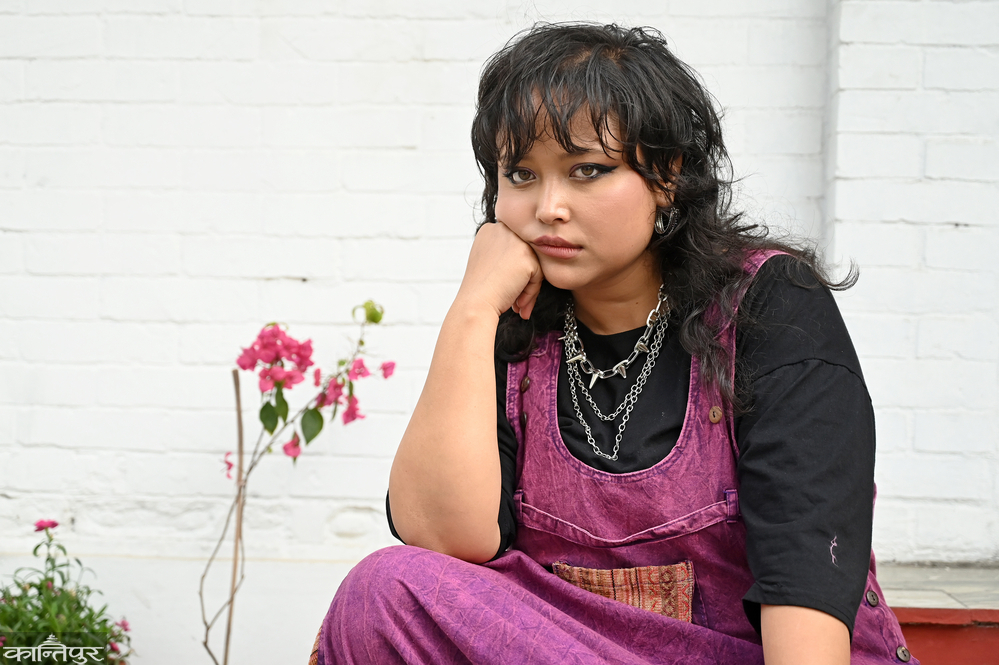
rap began with the 'Yi Yi Dynamite Break Bars Rap Battle'. Dimriti won the competition by participating in this battle in 2012. Dimriti, who grew up listening to Eminem to Rihanna, MC Flow to Yamabuddha as a child, now shares her rap with the world. The rap titled 'Naam' from the film 'Shakti' has been released on Spotify.
Dimitri, who used to listen to rap by putting hip-hop songs on a pendrive, never thought she would become a rapper. But, her interest in rap led to a break in the competition. She was the only woman in the competition. She lost to the female participant in the first battle right from the start. But, when she won that battle, she was not strong in rap. She says that she won the first battle because her competitors were weak. 'I did it so that no one would see that I was blindfolded in that battle. I had dark glasses on my eyes. When the battle started, I forgot everything. The other competitor's battle was worse than mine. And I won,' Dimitri says.
After winning the first battle, she lost sleep. She would get 2 weeks off from the battle. She would come home and prepare for the battle. She would work night after night to improve her rap. ‘It turned out that something called fear is also necessary. There, they said you can’t talk too much, which turned out to be the best practice. I didn’t like the talk in traditional battles,’ she recalled. Demriti won a powerful battle in the rap arena, beating all the male competitors. ‘I didn’t think I would win - but I did. I earned a little and it felt like I could survive,’ she says.
: Demriti had been rapping even before Breakbars. She used to produce underground rap. But she didn’t see a future in rap. She used to rap just to satisfy her interest. She would sing and put it on YouTube, and she would be amazed when she got a hundred views. ‘I used to sing in college too, but I wasn’t serious,’ she said.
Dimriti has a strong grasp of English. That’s why most of her raps are in English. Even though she raps in English, she sometimes mixes in a little Nepali. She sang the rap titled ‘Aajbholi’ in Nepali. ‘I found it easier to write in English for a while. Why? Probably because I mostly listen to English. Another thing is that my mind thinks a lot of things in English, so I found it easy,’ she said. ‘It feels like I’m not good at writing rap in Nepali. But I’m still trying.’
Whether the language is English or Nepali, Dimriti does not mix only love in her rap. Be it the identity of oppressed women or the caste system that has been ingrained in society since the patriarchy. In her rap lyrics, you can find an attack on the oppression that has been entrenched in society since the patriarchy. Even though ‘Aajbholi’ is a rap on the subject of love, the caste system has affected it;
…but where is your love, when I need it, I break it
A companion, how scared you are;
You have the courage to cross the ocean, but;
My caste has put a lock on your hand;
When your father came to cut the knot of our relationship;
Dimriti also wrote this part of ‘Aajbholi’ from her own experience. ‘The experience of the Dalit women I have met so far was also similar.’ Only after 6 months of dating do guys realize that their families don't like us. I had a similar experience in love,' she said, 'In this day and age, isn't it embarrassing to not be able to speak up against such evil practices with your family?'
However, the audience who listens to rap prefers to listen to lively music, not the issues raised by Dimriti. In a situation where music with catchy lyrics is dominating the market, what kind of music should you make? Dimriti sometimes hesitates. 'Will the audience not understand the rap I do?' She sometimes feels like this. Since art and literature are not taught from school level, she feels that it has taken time for the Nepali audience to develop an awareness of the depth of this field.
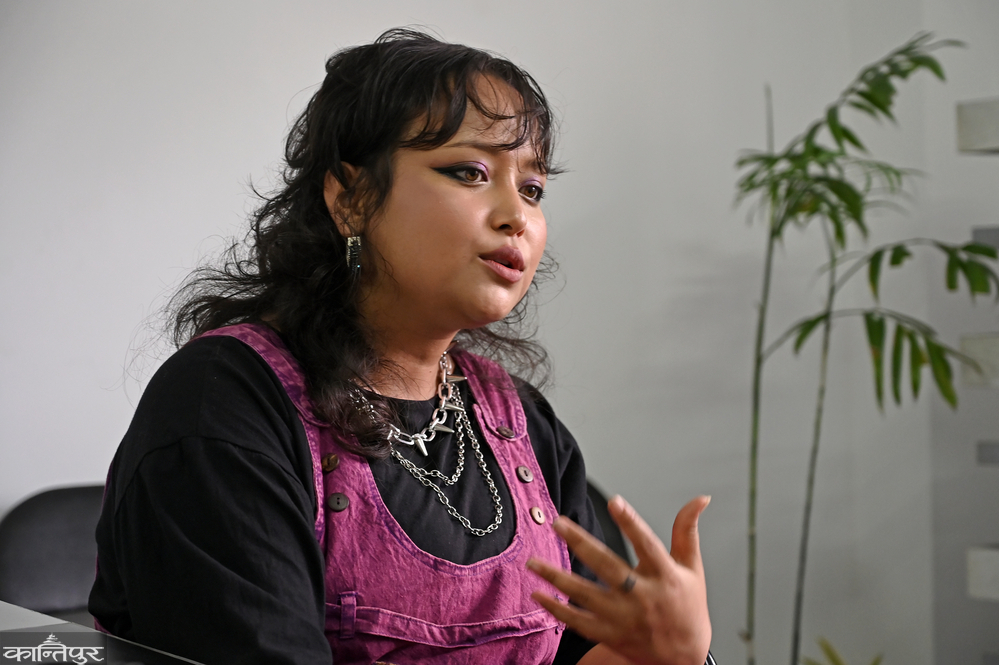
'In foreign countries, music is taught from a young age. I feel now that they will understand the song I sing or not. I feel that if I sing it in English, they will not understand it even more. That's why they are saying, 'The frequency of the artist and the audience is not the same. There are audiences who listen to serious songs, but some do not listen to Nepali songs.'
So far, Dimriti has understood the taste of the audience. And she knows that this is a problem not only in Nepal but also in music from other regions. However, she prefers to make music that she likes rather than what the audience likes. 'No matter what topic I sing, I had to be passionate about it first. If I had that experience, the audience would have the same. I don't worry about the audience,' she said. She has realized that she has matured in music over time. Her perspective on music has also changed. Now her only goal is to sing rap that sounds sweet. ‘Let what I say in rap heal me. Don’t feel ashamed when I hear it later. Rapping like this may not benefit me, but I don’t want to sing whatever I get,’ she said.
Dimriti sits down every day to write rap. However, songs don’t become songs every time. Songs come out suddenly. When they come out, they flow smoothly from beginning to end. ‘Dusama Dus’ was also written in this way. ‘The style of writing songs is dangdung. Like the waves of the sea,’ she said with a laugh.
She had to think a lot while writing the song for ‘Shakti’. She watched the film first. This powerful film on sexual abuse touched Dimriti's heart. That's why she was looking for that depth in the lyrics too. 'The production team had already said they wanted the song. But I was saying, "Wait a minute," she recalls when she was writing the song for Shakti. After watching the film, she met director Nani Sarah Walker. After talking to the director about her own experience watching the film, she sat down to write again. 'When it came out, it came out in an instant. But it took a long time to come out. The rap for that film was written that way. But sometimes the song comes out as easily as a sneeze,' she said.
Director Nani was waiting for an emotional song for 'Shakti'. At that time, Dimriti had just written the chorus of a song - 'I am a lost traveler, my house is not there . I have lost the love of life and become a living corpse . I am your beloved for the sake of survival' . She wrote these words of the song for her mother . The film had a mother-daughter relationship . So she added the remaining words to the chorus and wrote 'name' .
Sinful society
My ancestors and ancestors' great
Sinful society
My right to live as a man
Sinful society
Standing up to discrimination and raising her head…
Dimriti's 'female rapper' is just as full of satire . She made this rap public after winning the battle . However, she had written the lyrics to the rap before the battle . As stated in this rap, others saw her as a second-rate rapper. So she answered them through this rap. Where she sings, 'I didn't get respect in your speech...'.
She has given a great answer to those who underestimated her rapping ability and writing talent in this rap. 'You're good. But you're not a very good rapper. You're good because you're a female rapper,' she said, 'Do you think that you're good because there's no female rapper?' "Don't you believe that someone can rap well? It's not like you were the only student in the class because you were first."
She has no problem being a female rapper by adding a 'D' to her real name, Smriti. However, she dislikes the patriarchal thinking that limits her ability and talent based on gender.
"There is no shame in being a female rapper. But it is wrong to understand that you are a female rapper without being a woman. It's like someone is seen without being there," said Dimriti. "What have women done now that I'm surprised when I rap? It's like some women don't rap," said Dimriti, 25. The fight against this patriarchal mindset, the decision Dimriti makes to write powerful rap, and the music that makes him a 'ten out of ten' in rap.