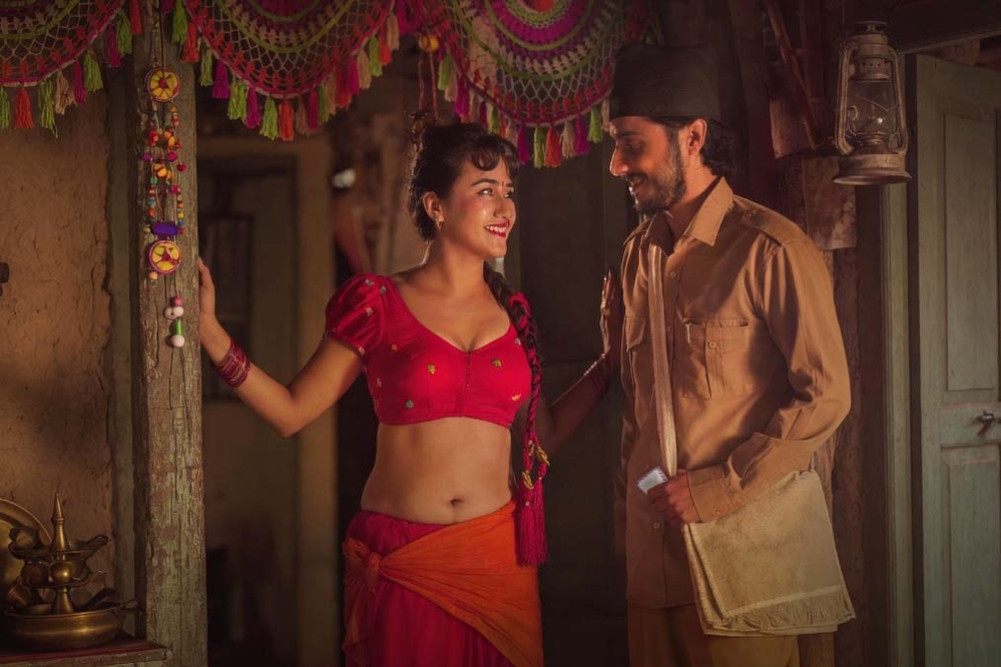
The film 'Lalibazar' was only allowed to be shown on Sunday. The board has already given it a 'universal' certificate, allowing everyone to watch it, by removing some dialogues and 'muting' them.
We use Google Cloud Translation Services. Google requires we provide the following disclaimer relating to use of this service:
This service may contain translations powered by Google. Google disclaims all warranties related to the translations, expressed or implied, including any warranties of accuracy, reliability, and any implied warranties of merchantability, fitness for a particular purpose, and noninfringement.
The premiere of the film 'Lalibazar' was scheduled for this evening. From the actors to the producers and directors, the show was being prepared. In the afternoon, the Patan High Court suddenly ordered not to perform for the time being.
Roshni Nepali had filed a writ petition on Monday on behalf of the Badi community demanding a stop to the performance. A single bench of Judge Prakash Dhungana issued a short-term interim order along with a show-cause order. The production side is in trouble after the show was banned until April 22.
Roshni has accused the film of character assassination by linking the identity of the community only with 'sex business'. Her writ claims that the film has wrongly depicted the history and identity of the Badi community.
The court has ruled that it is against the Constitution of Nepal to screen films containing words and images that incite hatred or hostility towards anyone, including the people of any caste, religion, caste, region, community, etc., that harm the dignity, honor, reputation and self-respect of the people of the Badi community.
The issue of investment and marketing has caused great mental stress after the court banned the film's screening right before its release. - Rabindra Singh Baniya , producer Roshni argues that the film has created a discriminatory narrative by showing a daughter as happy when she is born and a son as a useless character who is immersed in alcohol. 'This increases guilt and mental stress among the young generation about their identity,' she said. He says that he had to take legal action after repeatedly urging the production team to not understand the sensitivity.  However, the production team has already shown the film to the plaintiff activists and the dissatisfied parties. This film, which is based on the story and struggle of the Wadi community, is also being supported by activists from the Wadi community.
The controversy began after the film's 'trailer' was made public. Initially, Wadi community poet and activist Asmita Wadi objected to some of the dialogues and scenes used in the trailer. She had initially disagreed with 5 points after watching the trailer. However, the production team agreed to remove and mute those dialogues from the film as per her advice. ‘I was also scared after watching the trailer, so I took the initiative for the reform,’ says Asmita, ‘but later on after watching the film, my understanding changed. The film spoke about the real pain and struggle of our community. Now that the reform has been done, I felt there was no point in going to court to stop the film.’
She says that since she is also a creator, there should be no censorship in the film. ‘I am not in favor of stopping the film. Rather, the controversial parts should be removed and the film should be released with mutual understanding,’ she says.
She says that she is saddened to see the entire Badi community divided into two groups due to the controversy over the film. ‘One side is in favor of banning the film completely, while the other side is in favor of correcting it, which has created differences within the community,’ says Asmita.
Badi activist Devisara Badi has also defended it after watching the film. She said that it does not contain derogatory words like in previous creations. ‘I personally watched the film. My own mother suffered by pounding stones and sand in the river to teach me, the film has captured that exact reality,’ she said, ‘The new generation must know what our society was like before the 2064/65 movement. It is not an insult, but a story of a mother’s sacrifice and a daughter’s success.’
I had expressed my disagreement after watching the trailer, there is no point in going to court to stop the film after it has been improved. -
Asmita Vadi , activist She also expressed her disagreement after watching the trailer of the film. But she said that the director removed those words out of respect for the community’s self-respect. She believes that more stories like this should come. ‘The film is just one aspect, but the reality is still different.’ We watch the film on reels, but the real life of the Wadi community is still a struggle,' she adds, 'Just because I came to Kathmandu and studied and became capable, the suffering of my other sisters has not gone away. I want the Prime Minister and ministers to also watch this film so that they can understand up close how much hard work and effort the women of the Wadi community are putting in to raise and educate their children.' She says that this film is a means to raise the voice of the Wadi community. 
The film's producer, Rabindra Singh Baniya, says that they were serious from the beginning about raising the story of the marginalized community. 'We made this film by sitting with the Wadi mothers, on their advice, and also got a universal certificate from the censor board,' he clarifies.
'Lalibazar' has only been allowed to be released on Sunday. The board has removed some dialogues from the film and given it a 'universal' certificate that can be watched by everyone.
Another producer Thaman Bhandari says that the court troubles that 'Lalibazar' is currently facing have brought back unpleasant memories of the past. Two films he produced had to face similar court troubles. The production side had to face mental and technical difficulties after a legal question was raised that the name of 'Actor Take 1' was similar to the name of another film. This affected the release of the film.
Ahuti , Author The film 'Pandit Bajeko Lauri', based on the story of the Badi community, also had to face court troubles for years. ‘Due to the mental trauma and financial burden caused by those events, some producers like me have to face problems such as being blacklisted by banks. Who will protect the investment of crores of rupees made by a producer with his own assets and the hard work of hundreds of artists from the clutches of such blackmailers? This invisible restriction and looting on creation must stop now,’ he says, ‘I am firmly in favor of Lali Bazaar.’ Baniya complains that the issue of investment and marketing has caused great mental stress after the court banned the film’s release. He says, ‘We showed the film to community leaders, and only after they approved it did we move forward. Now teaching the people what to watch and what not to watch is ideological slavery. If an 18-year-old can choose the prime minister, can’t he decide by watching a film himself?’  The new generation of oppressed communities needs to understand their real history, which should not be hidden or suppressed. -
The writer Ahuti calls the trend of imposing judicial restrictions on art 'another journey of tyranny'. According to him, if someone in cinema or literature is not satisfied, it should be refuted by writing or creating something else, not by going to court.
'The question of liberation comes only after exposing the crimes of the past,' he says, 'The new generation of oppressed communities needs to understand their real history, which should not be hidden or suppressed.' If the court starts deciding on creations, it will put freedom of expression at risk.'
Similar precedent
Although the 'Lalibazar' controversy seems new now, the Supreme Court has already set a precedent in a case of a similar nature. In 2075 BS, the Supreme Court refused to issue a writ petition against the film 'Pandit Bajeko Lauri' and the novels 'Nathiya' and 'Ailani'.
The then bench of Justices Ishwar Prasad Khatiwada and Bam Kumar Shrestha had said in the verdict, 'It is not reasonable to view such matters as 'judicially manageable' matters to be decided by the writ jurisdiction.'
A directive order has been issued to remove the words used in the novel that hurt self-respect and indicate caste discrimination and to apologize to the plaintiff community.