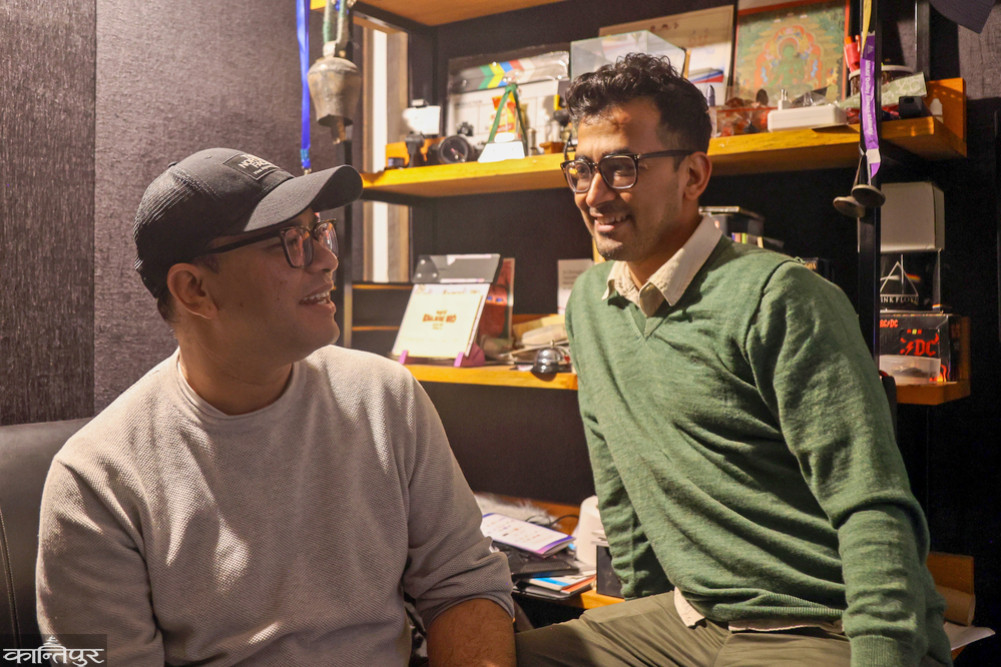
Before understanding how a Nepali feature film was selected at the world-renowned film festival Cannes, it is necessary to understand the long journey of struggle and the production story of the film's producer and director.
We use Google Cloud Translation Services. Google requires we provide the following disclaimer relating to use of this service:
This service may contain translations powered by Google. Google disclaims all warranties related to the translations, expressed or implied, including any warranties of accuracy, reliability, and any implied warranties of merchantability, fitness for a particular purpose, and noninfringement.
'Our film has been selected in UCR,' director Avinash Vikram Shah was stunned when the French producer wrote such a message. The sound work was still to be done in the film 'Elephants in the Fog'. He was busy with that. While he was discussing online with the producers from Brazil and France, including the sound designer, the French producer sent such a message to the group. UCR? Only after a while did he realize that UCR means - Un Certain Regard.
Avinash Vikram Shah is overjoyed when his debut feature film was selected in the 'Un Certain Regard' category of the world-renowned film festival Cannes. He had this dream in 2022. When the short film 'Lori' received a special mention at Cannes, Avina had made a promise to herself - 'Next time I will come with a feature film.' It is a great thing to be selected at the world's biggest festival. It is a joy to be selected for the first feature film,' Avinash said. According to Avinash, 'Elephants in the Fog' took five years to make. Every stage of this filmmaking journey was special for Avinash. 'I wrote the story of the film alone. As soon as I went into production, there was a crowd. In post-production, I was alone again. That experience of shooting was a kind of rollercoaster experience,' says Shah. Even after receiving a special mention for 'Lori' in 2022, I was afraid that the feature film would be selected/not selected by Cannes. The Cannes Critics' Week asked for the film, and sent it there too. It was a mystery whether it would be an official selection or not. The results arrived in an email within a few weeks of sending the film. Producer Anup Poudel also got the news of Cannes while he was taking an online 'pitching' class. As soon as he received the email, he stopped the online class without saying anything. And then he thought for a moment - is this real? And producer Poudel says that he quickly closed the class and 'celebrated' alone. 'Maybe I did this project thinking this. As a producer, I am happy that I have brought the film to this point,' says Poudel. story - their Avinash had read the news of a transgender woman found dead in Hetauda somewhere. That gruesome murder raised a question in him, 'Why such violence?' He thought of making a short film on that. While researching, he reached out to the community. Then he realized that this concept would not fit into a short film. It was then that Avinash thought of making a feature film.
'Elephants in the Fog' is the story of a family where the relationship between a mother and daughter is shown. According to Avinash, there is a leader in this family, whom everyone addresses as mother. That mother has four daughters. One day, one of the daughters goes missing. The story of the film is the story of a mother searching for that daughter.
'They were all outcasts from their homes and societies. Despite coming from different places and classes, they have become a separate family. That is such a beautiful thing. This film is the story of the mother of that family,' said Avinash.
Avinash had previously told the story of the mother in 'Shambala'. In the TV series 'Singh Durbar', he also wrote a story that the country's Prime Minister should be a woman. However, this time the mother's story is a little different. The family looks different, but the feelings are the same. The conflicts in the family are the same. So there is no difference between them and the families of mainstream society. Therefore, Avinash wanted to show that they are also an important part of this society.
'I thought it was beautiful that the women of mainstream society have the same feelings,' he said. Avinash has brought this story of the film to the Terai. He has shown a family living in a slum affected by the terror of elephants and their story. What a coincidence! Society calls people from sexual minorities and minority communities 'them'. That community sees the mainstream society as 'them'. And elephants are also called 'them'. From here, Avinash's team took the Nepali title of the film - 'Them'. The film was shot in the same real place where elephants cause suffering.
While telling the story of the minority community, they did not want to make a film like 'Development Project' on that subject. That is why they were aware from the beginning, and now the film has become what they wanted, says Avinash. 'From the outside, unity, harmony, and love are visible in the family. But, along with that, there are conflicts within a family. The same thing happens in the family of that community, like a mainstream family,' Avinash said, 'This is what I am trying to say through the film. They are no different from us.' What we want, what we experience, what we feel is what they want too. Even though some customs and traditions insist that the story of the film belongs to this community, the audience gets immersed in the story of the mother and daughter more than that subject when watching the film.'
Casting story
Producer Poudel says that while telling the story of the transgender community, they were sensitive to inclusion from the beginning. While trying to tell the story of the transgender community, Avinash and Anup saw the same thing everywhere. People from different classes, languages, and communities in the same family. Emotionally connected to each other, and easily understanding each other. To capture that originality, they looked for transgender women from different classes and communities.
For casting, they took help from colorist Sudam Sikey. It took a long time to find the main character 'Pirati'. 'We had already searched for Pirati in particular. As soon as I saw her, I felt like Pirati. But, she had not yet entered that role. At that time, I was wondering if she was not him or what,' Avinash recalls.
The task of finding an artist began by seeking help from the Neel Hira Society. Some of the characters in this film are from Kathmandu. Some of the main actors are from Nawalparasi, some from Birgunj. 'We have gone from where to where. We went from east to west,' said producer Poudel. Before the producer could finish talking, director Shah added, 'Once, first from Nepalgunj to Surkhet. Then via Chitwan to Hetauda. And from Hedaunta we reached Birgunj and Jhapa. It was fun, being able to travel, meeting people.'
Producer Poudel has not forgotten the moment he met another main character in Birgunj. They contacted the Neel Hira Samaj and reached Birgunj. They met the people gathered at the society's office. A character from outside the office also arrived there. They chose her as an artist. Anup is surprised that characters from a class that did not have access to the society's office were included. 'We included people from all classes as much as possible even within transwomen. On top of that, since it was a story about marginalized and minorities, we sought equal participation. This is not a development, our casting process was like this. Talents from different classes and communities have come together in the film,' said Anup.
The main characters of this film are some Tamangs, some are Vishwakarma. Yadavs and Muslims have been selected as the main characters. Avinash has made this 'non-actor' act in the film. There are two reasons for this. One - Avinash has already worked with 'non-actors'. The other is that including this woman will bring out the originality of that society. 'If I take a person from the same community, I don't have to take the responsibility of maintaining that authenticity. Oh, this is not possible,' they say, 'My main actor, Pirati's name is Pushpa. She has acted well in the film.' But, workshops alone are not enough to extract a story from a 'non-actor'. Avinash spent 2 years with Pushpa. She used to go to Nawalparasi. Slowly Pushpa started falling for Pirati. By the time of shooting, Pushpa had started looking like Pirati.
It is not only about working on the characters to bring the film closer to 'originality'. This community has been involved in the film. One of the film's editors is trans. People from this community were taken as advisors. 'We may not be able to understand the struggle of this community for years.' However, what we can do from our place is to tell their story,' said producer Poudel, 'This film may not be mainstream, but what is mainstream? A country will not be built until minority voices are heard in a film or somewhere. We have included the story of a human being in the film.'
Long time in writing, 'co-production' to get a grant
Avinash spent more than 4 years writing the story of this film. As soon as he wrote the treatment, he sent it to the 'Asian Project Market' in Busan. Due to Corona, I 'pitched' the story online. I won the award there. Then I reached the 'Writing Residency' pop-up in Slovakia. Thus began the residential training in writing. I reached Global Media Makers (GMM). The film was selected at the Oxbelly Lab in Greece. It reached the Direction Lab at Sundance.
'All of this gave me a good shape. The main lesson was how to make a local subject universal, how a universal audience accepts it,' says Avinash. While Avinash was writing the film at various labs, producer Poudel was looking for other international producers. Since it was not possible with domestic producers alone, he reached out to producers in France, Norway, Germany, and Brazil. 'We reached out for one grant. The other is for the visibility and mentorship of the project. To find out how universal the film is, we went to a different residency-lab. Our desire was for our story to be universal and our originality not to die,' Poudel said. Prachandaman Shrestha, Kumidini Gurung, and Pravesh Gurung joined from Nepal. 'We had faith in our project. But, it was a little difficult to trust others. I don't know of any project where co-production happens quickly. It takes two to three years. It took us four/five years.'
Co-production is not as easy as you think. After taking a certain amount of money from a country, some percentage of the talent of that country has to be spent. That's why award-winning cinematographers, sound mixers, and editors joined this film. Anup has endured the hardship of bringing together talents from different countries and making them work in one place. 'Their food and accommodation are different. It was a challenge to keep everyone together during the shoot,' said Anup.
On the other hand, Avinash faced another challenge. Now, after involving foreign filmmakers in the film, they had to explain the depth of the story, the society and characters there. 'It took time to explain the culture here to the crew from abroad. Before filming, they had to first learn about transwomen here,' said Avinash. He told us in 'Pitching' how he would explain to them about the society and characters shown in the film.
Our society has made certain rules. Those who do not adhere to them are ostracized from society. They are treated like students who do not study in class. Those who are not bound by the same rules and definitions of society have come together to create another society. Where they have created their own customs and traditions. Saying that they are telling the story of that society, Avinash deepened the story to the foreigner.
'They are probably showing that I am also a bit loud by being a bit loud? With the makeup, with all that clothing,' Avinash says, 'While telling their story, I have experienced that I have grown not only as a filmmaker but also as a human being.'
Avinash wants to see the audience 'humble' towards the characters of the minority community after watching 'Elephants in the Fog'. 'Let's empathize with the characters of the film a little. Let them understand that they are also like us. There doesn't have to be much change, even if I take just that small joke, I will be successful,' Avinash said.
'I found the love I didn't get in Nepal at Cannes' [Video]