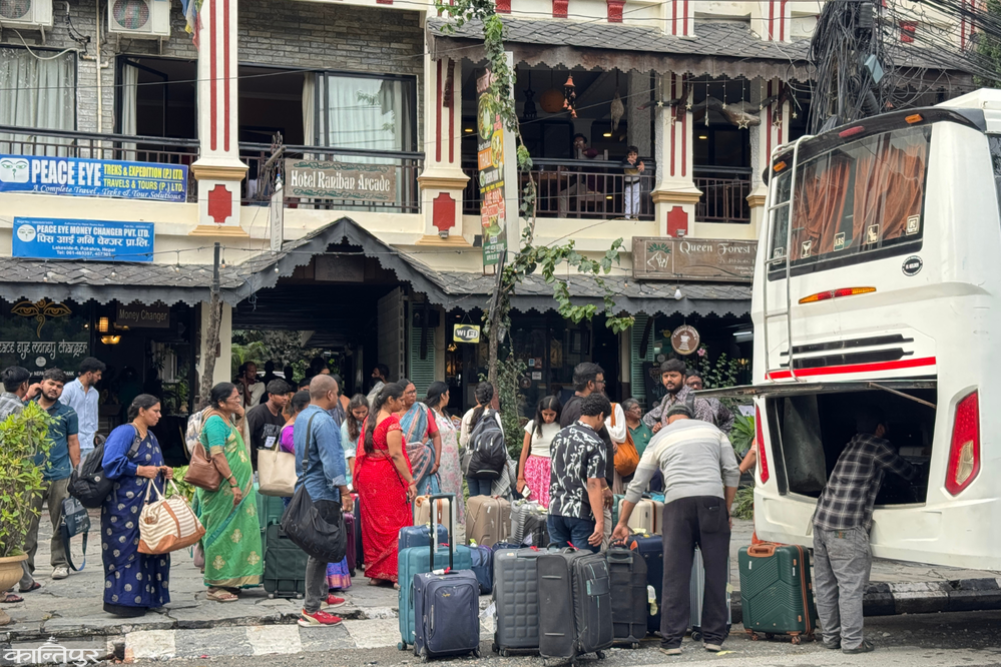
Nepal's tourism sector is enthusiastic after Indians became a bustling destination even in the 'off season'
We use Google Cloud Translation Services. Google requires we provide the following disclaimer relating to use of this service:
This service may contain translations powered by Google. Google disclaims all warranties related to the translations, expressed or implied, including any warranties of accuracy, reliability, and any implied warranties of merchantability, fitness for a particular purpose, and noninfringement.
The number of foreign tourists coming to natural, cultural, religious and adventure tourist destinations in the country has increased rapidly. For the past few months, there has been a lot of activity in major destinations from east to west due to the influx of visitors from neighboring India.
Even in the month considered the 'off season' in Nepal's tourism sector, the destination has become a buzzing place due to Indians. Even businessmen who have not received returns after investing in tourism infrastructure are starting to look enthusiastic. It has been found that more than 2,000 Indian vehicles enter the country daily through the country's main border points carrying tourists and pilgrims.
Among such vehicles, there are many four-wheelers. There are also motorcycles and buses. Usually two people ride on a motorcycle. At least 4 people travel in a vehicle. Most pilgrims come by bus. Nowadays, many vehicles with Indian number plates are found on the highways from the border points to the main destinations in the country.
Indian pilgrims and tourists are pouring in through the major border points from east to west every day. Now, along with pilgrims, many are also coming to Nepal with their families in their private and rented vehicles. Indian visitors entering through the main border checkpoint in the south are reaching Muktinath in Mustang as well as Pokhara, Kathmandu, Chitwan, Lumbini, Bardiya and other religious and tourist destinations.
Till a few years ago, the number of visitors was high for the purpose of visiting religious places including Pashupatinath and Muktinath. Recently, many are also coming with family and friends for sightseeing and entertainment. Not only do they reach the hills and Himalayan regions to beat the heat. Many come to enjoy the casinos and spas in the border cities.
Indian tourists are also notable in Lumbini, Bardiya, and Chitwan. Most of them reach Palpa, Baglung, Mustang, Manang, and Pokhara to enjoy the hilly scenery and cool weather.
An average of 600 Indian vehicles carrying tourists enter through the Belahiya border checkpoint every day, said Harihar Poudel, head of the customs office in Bhairahawa, Rupandehi. He said that during the school holidays in India, up to 1,200 vehicles carrying tourists enter in a day. The vehicles entering in this way include motorcycles, cars and buses.
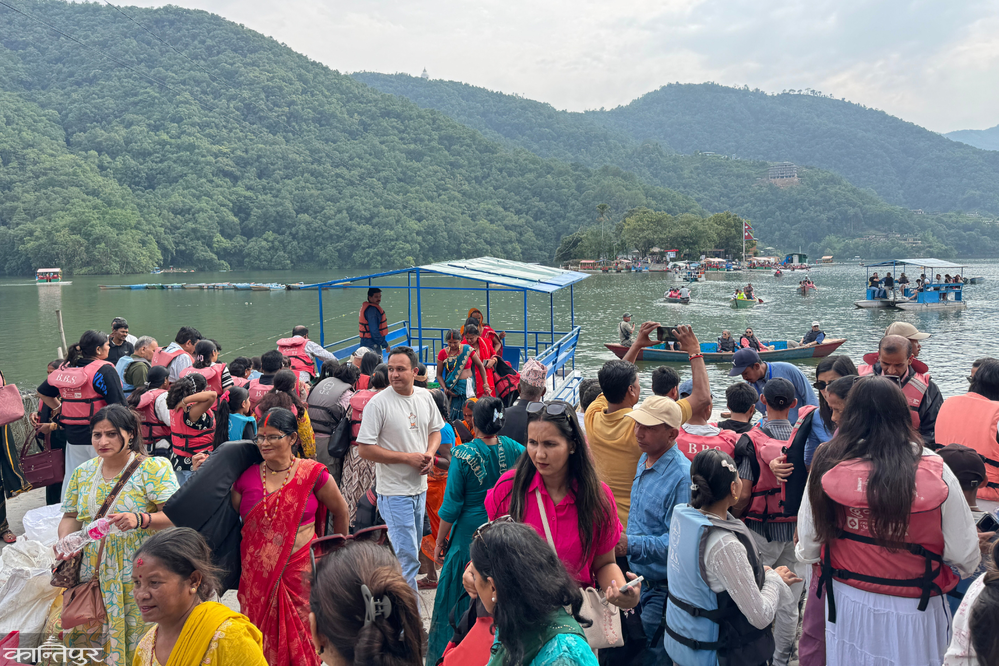 As the number of Indian tourists visiting Nepal with vehicles through the Bhairahawa border checkpoint has increased, an online system has been implemented at the customs to facilitate them, said Poudel, head of the customs office. “Many Indians come to Nepal especially for holidays,” Poudel said. “Most of the destinations of Indians who come through the Bhairahawa border checkpoint are Muktinath, Korala, Pokhara and Chitwan in Mustang.”
People come through the Bhairahawa border checkpoint from places like Kerala, Madhya Pradesh, Delhi, Uttar Pradesh, Punjab in India. Some Indians travel by train to Gorakhpur in India. From there, they come to Nepal through the Bhairahawa border checkpoint. Poudel said that the customs office data shows that Indians spend an average of three days in Nepal.
When bringing Indian small vehicles to Nepal, a daily fee of Rs 600 is charged per vehicle and Rs 200 for motorcycles. If you have to pay a fine, it is Rs 2,500 per vehicle and Rs 1,002 per motorcycle. Earlier, when returning with Indian vehicles, a general inspection was done at the customs, but now there is a provision to register online with all documents.
The increase in the number of Indian tourists entering through the Bhairahawa border is due to promotional programs that Nepali tourism entrepreneurs, including Pokhara, are holding in various cities in India, says Chandra Prakash Shrestha, a tourism entrepreneur from Bhairahawa and a central member of the Nepal Hotel Association. Shrestha says that if Indian tourists bring excess cash without knowing Nepal's rules, they are in trouble due to the rule that security agencies will seize and take action against them.
‘Many Indian tourists say that they faced a lot of trouble in Nepal while bringing cash and vehicles,’ said Shrestha. ‘It is necessary to set up a hearing desk at every customs checkpoint to facilitate tourists.’
500 Indian vehicles enter the country daily from the two main checkpoints of Kapilvastu, neighboring Rupandehi, at Maryadpur and Krishnanagar. Motorcycles and four-wheeled jeeps, cars and vans carry pilgrims and tourists. More than 250 vehicles with Indian number plates enter from Maryadpur daily after paying customs duties. Of these, 60 percent are four-wheelers and 40 percent are motorcycles, according to Kiran Bista, head of the Suthauli Customs Office.
More than 280 vehicles enter the country daily from the district’s main Krishnanagar checkpoint. Half of these are motorcycles and half are cars/vans. Mayank Karna, information officer at the Krishnanagar Customs Office, said that 60 percent of Indians entering through the district's border posts reach Supadeurali in Arghakhanchi and Swargadwari in Pyuthan.
'Of these, 40 percent are visiting Pokhara,' he said, 'They come as religious pilgrims to Supadeurali and Swargadwari. Those who go to Pokhara come to visit. The number of tourists and pilgrims coming through both border posts has increased in the past month.'
The number of Indian tourists and pilgrims entering through the western border posts is also increasing, not only from the central region of the country. Most of the tourists entering through the Gaddachauki border post in Kanchanpur in the far west are Indians. Since it is close to the tourist area of Uttarakhand in India, they also enter through this border post from third countries.
Tourism professionals say that now most of the tourists who are playing in the local market and wandering around are Indians. They say that the number of Indian tourists entering the park has also increased compared to the past. ‘Those who come to play casino games sometimes also come to Shuklaphanta for jungle safaris,’ said tourism entrepreneur Parmanand Bhandari, ‘the number of tourists coming has increased compared to the past.’
Bhandari has been conducting jungle safaris in Shuklaphanta National Park for a decade. Most of the tourists who come here are from Uttarakhand, India. Apart from this, they also come from areas including Delhi and Bareilly. Some who come for the Kailash Mansarovar pilgrimage also enter through this checkpoint.
Tourists entering through this checkpoint reach Kathmandu, Pokhara, and Lumbini. The border market of Brahmadev is crowded with Indian visitors due to the Purnagiri Fair. The fair, which starts on Phagu Purnima, attracts visitors from states including Uttarakhand, Uttar Pradesh, and Delhi.
The number of Indians visiting Kanchanpur has also increased due to the visitors to the three casinos operating in Mahendranagar. Indians from Uttarakhand to Delhi come here to play casino games. The number of vehicles coming with customs and facilities is also high, according to the Customs Office at Gaddachauki.
Customs Officer Chakradev Bhatta said that 70 to 75 Indian vehicles enter Nepal daily after paying customs. Around 300 vehicles enter only after making facilities.
At a health tourism promotion program organized in Bhairahawa last Friday evening, Minister for Culture, Tourism and Civil Aviation Khadak Raj Poudel said that Nepal's tourism cannot move forward by forgetting spirituality.
'People travel to be happy,' he said, 'that is why the government is going to form a pilgrimage department.' His statement was aimed at the increasing number of Indian pilgrims and tourists. There is now a stream of Indian tourists at major destinations in Nepal. Thus, the first destinations for Indian tourists entering the country are Muktinath and Pokhara.
Kathmandu and Muktinath through the border
A large number of Indian tourists enter Nepal every day from the country's main border crossing, Birgunj. But most of those tourists do not stop in the Parsa-Bara area and go directly to Kathmandu, Pokhara, Muktinath and other hilly destinations. Despite this, the tourism and hotel business of Madhesh has not been able to reap the expected benefits even though tourists enter through the Birgunj border crossing.
The Birgunj Customs Office says that an average of 600 to 700 Indian two-wheelers and four-wheelers have been entering Nepal every day since the beginning of Ashad. In Jestha, this number had reached 800 to 900 daily. Although Indian motorbikes usually obtain short-term permits, most of the tourists coming by car, jeep and van obtain Nepal visit permits for 4 to 10 days. The remaining pages 8
Due to the extreme heat in various states of India and the start of summer vacation in schools, the number of Indians visiting Nepal with their families has increased significantly. Among the tourists entering through the Birgunj border, most of them go to Pokhara, Ghandruk, Punhill and Muktinath.
Businessmen say that the number of religious tourists who reach Kathmandu and visit Pashupatinath is also significant. Among the Indians entering through the border, there are also religious and family tourists from Bihar, Uttar Pradesh, West Bengal, Rajasthan, Delhi, Odisha, Maharashtra and other southern Indian states.
However, there is a tendency for those tourists to move on to their destination without staying even a night in Birgunj, Parsa or neighboring Bara district. This year, tourism entrepreneurs from Pokhara and Sauraha have visited various cities in India to promote Nepal tourism, and its positive impact has been seen, says Mohan Sharma Lamichhane, President of the Madhesh Province of the Nepal Association of Tour and Travel Agencies (NATTA).
‘Currently, tourists from India are looking for cooler destinations in Nepal to beat the heat,’ said Lamichhane. ‘From Chitlang to Pokhara, Ghandruk, Punhill and Muktinath, hotels are full. But Madhesh has not been able to take advantage of that.’ If Indian tourists could stop at least one day at the religious, historical and natural destinations of Parsa-Bara, the local hotels, restaurants, transport and trade sectors could have directly benefited. But he said that sufficient initiatives have not been taken for the necessary publicity, package creation and infrastructure development.
New record in occupancy
The destination is also being promoted because of Indians coming to Pokhara. An example of this is Said Sah from Uttar Pradesh, India. Known as ‘Blogger Bhaiya’ on Facebook and Instagram, he has made more than 20 ‘reels’ about Pokhara alone. Those reels have been viewed millions of times.
Indian ‘vloggers’ like Aaradhya Singh, Mohd Umar, Ronak Rider Ji have also made many reels of places like Pokhara, Muktinath, Ghandruk. Ronak Rider also traveled from Varanasi, India, to Mustang via Pokhara with his friends on a motorcycle. Two years ago, a blog posted on YouTube by famous Indian artist Ashish Vidyarthi about Pokhara gained equal attention.
Due to the publicity on social media, the increasing heat in India, the government’s dollar-saving policy, and the liquor ban in Bihar, thousands of Indian families have been drawn to Nepali destinations including Pokhara this time.
Pramod Agrahari, a businessman from Gorakhpur in Uttar Pradesh, has come to Pokhara with a team of 9 people including his family and relatives. After visiting Butwal, Tansen in Palpa, and Rani Mahal in Pokhara, they are now planning to go to Kathmandu. ‘We visited Fewatal, Sarangkot, and Pumdikot, everyone is having fun,’ he said.
Agrahari said that he planned the trip after seeing the beauty of Pokhara on social media. He has learned a lot about Pokhara, Mustang, and Ghandruk from Facebook Reels. ‘I want to tell everyone in India, come to Pokhara once,’ he said, who came to Pokhara to make the most of his children’s school holidays.
For the Khurana family, who run a textile business from Punjab, Pokhara is an ‘adventure’. ‘We found Pokhara to be the best city when we searched on the internet. We chose Pokhara for paragliding, bungee jumping, Gupteshwor Cave, and Fewa Lake,’ says Krishna Khurana, who came by road through a travel agency.
According to his father Gaurav Khurana, his relatives had visited Pokhara before. This time, Pokhara’s hotel occupancy has broken records. Usually, the occupancy of five-star hotels during the summer months is only 40 to 45 percent. This time, another 20 to 25 percent increase was reported by Pokhara Grand Hotel General Manager Pancham Lama. Lama has experienced that the extreme heat in India and the publicity on social media have increased the overall hotel occupancy in Pokhara more than expected. He has also observed the behavior of Indian travelers. “They are ‘last minute travelers’. The booking window is not 15 days or a month in advance,” he said. “If they get a two-day vacation or the heat increases, they plan and arrive within 48 to 72 hours.” But now, the number of high-class tourists who travel in their free time is also increasing, who book three-star, four-star, and five-star hotels through online agencies like Make My Trip, Expedia, Agoda, and Booking.com. They also have good spending capacity. ‘Most travelers come by road from Uttar Pradesh, Bihar and West Bengal, which share borders with Nepal,’ he said, ‘and it is a common habit of Indian tourists to eat at least one meal a day in hotels.’
This year is also extraordinary for Laxman Subedi, president of the Pokhara Hotel Association. ‘In my opinion, this is probably the first time that such a large number of Indian tourists have come,’ he says. Until a few days ago, the occupancy of hotels was around 90 percent. Since the beginning of the new year, the number of Indian travelers has been significant not only in Pokhara but also in other destinations in Gandaki Province, including Muktinath, religious sites and trekking routes.
This surge is not due to one reason alone. The huge promotion of places like Muktinath on Facebook and Instagram last year, Indian Prime Minister Narendra Modi’s encouragement for citizens to visit countries where the rupee is used to save dollars, and geographical proximity: all these have made Pokhara the choice of Indian travelers.
Kishor Dahal, President of Nepal Association of Tour and Travel Agents (NATTA) Gandaki, says that the financial incentives provided by the government for religious visits to Indian senior citizens are also making Pashupatinath and Muktinath the first choice. Efforts to institutionalize the growing pressure have also been underway. On 29 Jestha, Nepal Association of Tour and Travel Agents (NATTA) Gandaki organized a B-to-B networking program in Kolkata, India under the ‘Pokhara-Nepal Promotion Campaign 2026’.
Indian tourism entrepreneurs who participated in the program stated that Pokhara is one of the best destinations in South Asia and pledged to send more passengers. The foundation of this boom is the May-June summer vacation of Indian schools and colleges, according to Maniraj Lamichhane, Gandaki Province Chief of Nepal Tourism Board.
Local tourism entrepreneurs have felt relief after the number of Indians visiting Chitwan National Park has increased. This time, domestic and foreign tourists have decreased in Jestha compared to Baisakh. However, the number of tourists from SAARC countries has increased sharply, according to Chitwan National Park.
Among SAARC countries, there are many tourists from India. A total of 256,800 tourists, including domestic, foreign and SAARC tourists, visited the park in the 11 months of the current fiscal year from Shrawan to Jestha, according to Chitwan National Park Information Officer Avinash Thapa Magar. Of these, domestic tourists account for the largest number, 153,874. Foreign tourists account for 83,071 and SAARC tourists account for 19,855.
The largest number of Nepalis visited the park in Kartik. Then, 18,046 people visited in Baisakh. Domestic tourists came in Jestha, 16,628. Foreign tourists came in Baisakh, 9,881. In Jestha, only 7,433. Thapa Magar said that the number of Indians visiting the park in Jestha is significant compared to other months.
The total number of tourists visiting the park has increased significantly in Jestha. Rishi Tiwari, a hotelier and jeep safari operator from Sauraha, said that residents of Uttar Pradesh and Bihar, India, are coming to Nepal. ‘It is extremely hot there too,’ he said. ‘Indians who have come to Nepal with the aim of visiting Muktinath, Pokhara and Manakamana usually stay in Chitwan.’ He said that Indians come because the climate is cool and the accommodation is cheap.
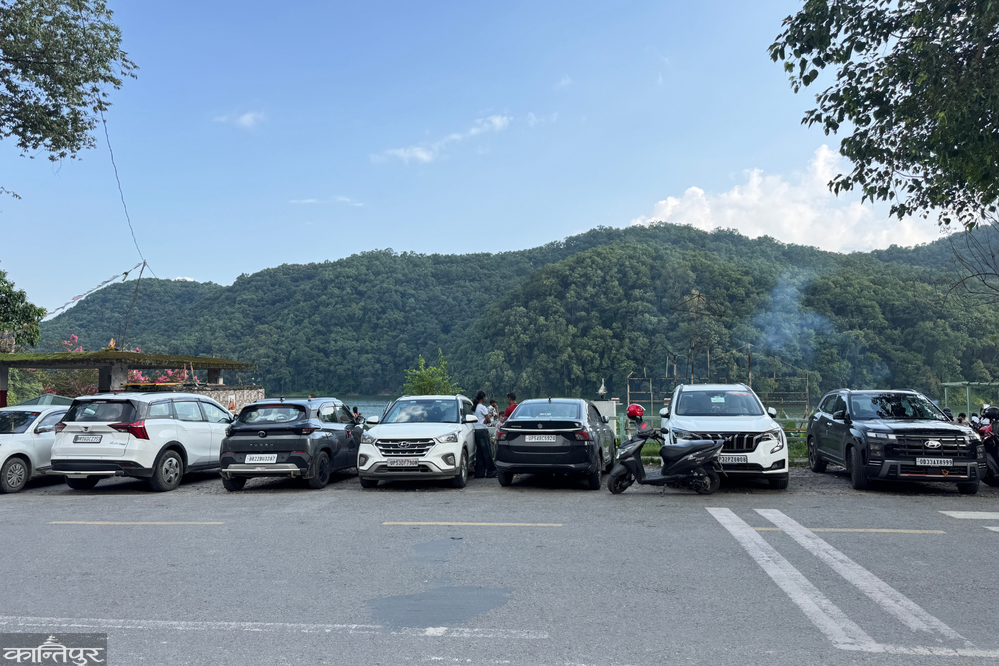 Around 16,000 passengers enter and exit Banke’s Jamunaha border post every day. However, there is no exact data on how many Indian citizens enter Nepal daily. The Nepalgunj Customs Office says that it is not clear for what purpose they come to Nepal.
Customs Chief Janardan Poudel said that 16,000 passengers cross the border post every day. Last Wednesday and Thursday alone, 275 Indian vehicles obtained route licenses from India, said Ram Bahadur Khatri, a computer operator at the Transport Management Office at the border. Of these, 50 are motorcycles. Vehicles coming to Nepal from India for tourism and business purposes obtain route licenses.
Farms and 'homestays' are preferred
There are more than a hundred hotels and restaurants in Palpa. Only 15 are affiliated with the Palpa Hotel Association of Nepal. But almost all hotels are crowded with domestic and Indian tourists. Nevertheless, hotels only receive guests who do not stay at village resorts and 'homestays'.
'Travelers also have different preferences,' said Laxman Basyal, president of the Hotel and Restaurant Business Association, Palpa. 'Some say village resorts and some say homestays. But for those who cannot go far, the ‘hill station’ Tansen is also considered very pleasant.’
He has the experience that despite being a city located on a hill, Tansen is considered like a rural area. Among the tourist places worth visiting, Tansen in Palpa and nearby villages are visited. It has been found that those who go out to visit first look for homestays and only later for hotels.
Recently, hotels in Tansen Bazaar as well as nearby resorts are full. Basyal’s resort is located 4 kilometers away from Tansen Bazaar in a rural settlement. He shared his experience of not being able to accommodate more than 50 people on holidays than on other days after the summer season began. ‘Even though it is close to the Terai, people probably like it very much,’ he said. ‘After seeing the peaceful environment and open space, one tells another and the number of visitors has also increased.’
The Sirjana Farm Resort in Khasyauli, Ribdikot Rural Municipality-3, also experiences an increase in crowds after the summer season begins. Bishnu Adhikari, manager of the farm resort, said that although there are 14 cottages with rooms, they are booked for two or three days a week. He said that 50 percent of the capacity to accommodate at least 40 people is booked by Indians.