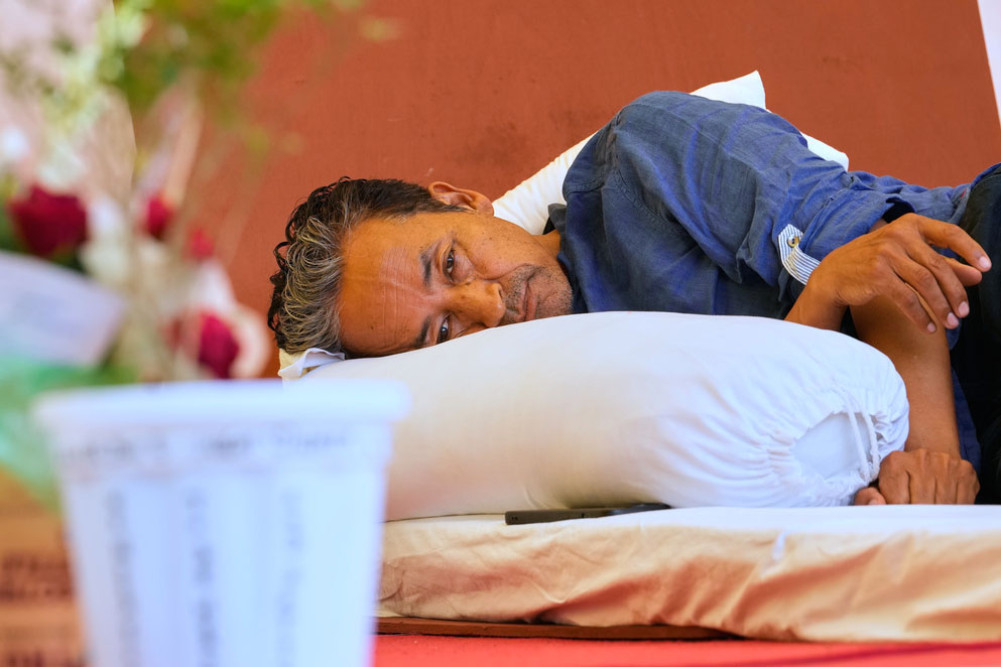
The Modi government is facing widespread criticism for the inhumane treatment of educationist and environmental activist Wangchuk, who has been on a hunger strike for 21 days demanding educational reforms, while being taken to the hospital by police on Saturday.
We use Google Cloud Translation Services. Google requires we provide the following disclaimer relating to use of this service:
This service may contain translations powered by Google. Google disclaims all warranties related to the translations, expressed or implied, including any warranties of accuracy, reliability, and any implied warranties of merchantability, fitness for a particular purpose, and noninfringement.
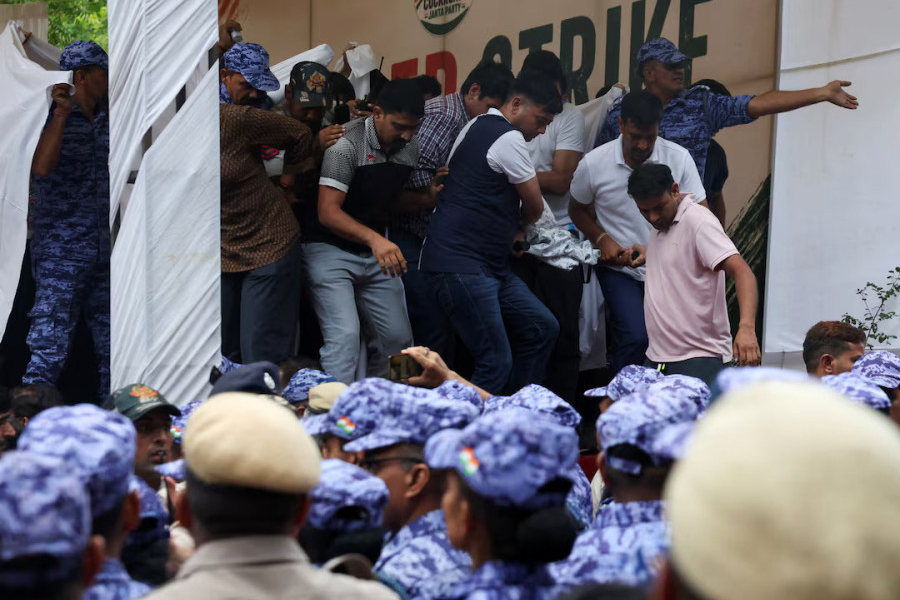
Educationist, environmental activist and innovator Sonam Wangchuk was forcibly taken to Safdarjung Hospital on Saturday, the 21st day of her indefinite hunger strike. The police had even tried to cover up the scene of her being lifted from the hunger strike by saying that it would be shown in the media. The scene of her being forcibly lifted from the hunger strike has been criticized by everyone.
After Wangchuk was taken to the hospital, Abhijit Deepke, founder of the Cockroach Janata Party (CJP), himself has been on an indefinite hunger strike.
Recently, Wangchuk has been on a hunger strike demanding reforms in India's education system and the resignation of Union Education Minister Dharmendra Pradhan. Her main demand is the resignation of Education Minister Pradhan over the irregularities in the National Entrance Test (NEET), which is conducted for admission to MBBS, BDS and other undergraduate medical and health-related courses, including the question paper leak. Wangchuk's fast is also supported by the CJP, which has dubbed it a youth-centric political movement.
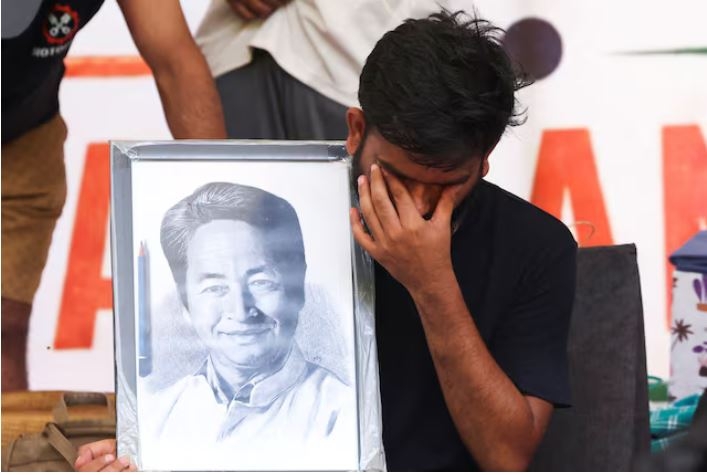
Wangchuk has been on a fast since June 28. According to reports, his weight has lost more than 8 kg and his blood sugar level has also dropped.
The Delhi High Court this week directed the government to ensure daily clinical monitoring of Wangchuk, who is on a hunger strike at Jantar Mantar. Delhi Police, however, claimed that Wangchuk was taken to the hospital due to his deteriorating health, following the doctor's advice and the Delhi High Court's order. Along with Wangchuk, three students of the All India Students' Association (AISA) - Neha, Amin and Manish - are also on an indefinite hunger strike demanding the resignation of Union Education Minister Pradhan and reforms in the examination and education system.
Wangchuk's supporters have alleged that he was illegally arrested and forcibly taken away. After Wangchuk was arrested and picked up from the hunger strike site, Deepke called Prime Minister Narendra Modi a dictator and told reporters, ‘These are not police, they are RSS goons. I have returned to my own country from abroad. Am I a criminal?’
Sonam has continued her fast despite being taken to the hospital. She has refused to take fluids. Sonam’s wife Dr. Geetanjali Angmo filed a writ petition in the Delhi High Court on Sunday, seeking permission to shift Wangchuk from the Safdarjung Government Hospital to a private hospital. She said that Wangchuk was being detained illegally in the name of treatment. But the court has ruled that it is not necessary to shift Wangchuk from the government hospital. During the hearing of the case, the doctor at Safdarjung Hospital said that Wangchuk refused to take ‘IV fluids’. The government also said that Wangchuk should trust the doctors.
Senior advocate Kapil Sibal, who argued for Wangchuk, said that they wanted to shift him to Medanta Hospital.
A bench of Justice Mini Pushkarana said that there was no need for an immediate interim order and ordered the doctors and the central government to submit a status report on Sonam Wangchuk's health condition within the next three days. 'Wangchuk is not in custody.' His wife, brother and sister-in-law have been allowed to meet him,' the court order said.
The next hearing on the writ petition is scheduled for July 24.
Chalo Sansad March Call
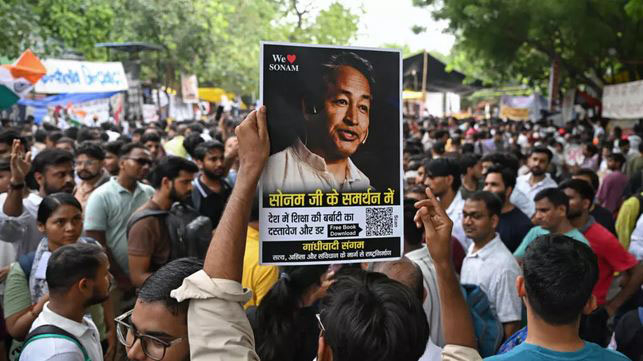
Wangchuk sent a message to his supporters and well-wishers through his wife from the hospital. His message said, 'The second movement of freedom.' Fear-free India, injustice-free India.' After Sonam's message, the CJP has called for a march from Jantar Mantar to Parliament House on Monday. The CJP has called for the march to be held on Sunday itself. The CJP claims that only positive slogans will be raised during the march, carrying only the Indian flag, Constitution, pictures of Mahatma Gandhi, BR Ambedkar or Bhagat Singh. The Delhi Police, on the other hand, has been calling the protest at Jantar Mantar illegal. The Delhi Police says that permission has been given for the protest only for one day. The Delhi Police has said that the CJP has not taken permission for the march.
There has been no official response from the government so far regarding the hunger strike and student agitation. The protesters, on the other hand, are demanding that the government seriously address the students' demands. Protests are also being held in cities including Mumbai and Kolkata in support of Wangchuk and the CJP's protest.
Modi government is being opposed everywhere
From Rahul Gandhi, the leader of the main opposition Indian Congress party, to artists and social activists, the treatment meted out to Wangchuk has been condemned. ‘The very principles of the Modi government have become untrue and violence has become. It is wrong to remove Sonam Wangchukji, who is on a non-violent fast at Jantar Mantar. Issues like question paper leaks, rising cost of education and student suicides are very serious issues related to the future of India. No use of force can stop the students of India and those of us who love and trust them from raising these issues,’ Rahul wrote on social media.
Political analyst and founder of Swaraj India, Yogendra Yadav, said, ‘No living person in this country is wrapped in a white cloth (chadar)’. But this government has shown shameful behavior.'
Indian writer and intellectual Pratap Bhanu Mehta wrote in The Indian Express, 'Sonam Wangchuk's demand for resignation is not just about a minister or an exam. It is a plea for the principle that accountability is essential in democratic politics. Before institutions can be reformed, it is necessary to clearly acknowledge who has damaged them. Just as if we want to stop a war, we must identify those who start it and make them publicly accountable, similarly in a democracy, those responsible must be held accountable.'
Similarly, Professor Apoorvananda writes in The Wire Hindi, 'This move has also lost the credibility of the government in the eyes of those who wanted to give the government some more time. After all, Sonam Wangchuk did not ask for the government's resignation. He was only demanding that a useless education minister be held accountable. But let's not think about that, the government has oppressed the very person who raised the demand.'
Artists including Prakash Raj and Vishal Dadlani have also criticized the treatment meted out to Sonam Wangchuk. Vishal said on Instagram, 'Have you ever seen such an incident? Sonam ji was forcibly taken away. These people are pushing the country towards ruin. My heart is hurting seeing this. People of my country, when will you wake up? If you don't wake up now, then when?... My mind is burning with anger.'
Artist Prakash Raj wrote on X, 'The world is seeing such a cowardly government, which does not want to communicate with the youth, but is trying to behave like a dictator. Forcibly taking away Sonam Wangchuk and disrupting the peaceful protest of students is a sign of the government's fear. This is very shameful.'
Congress publicity department chief Pawan Kheda has also reacted to Sonam's forcible admission to the hospital, saying, 'The Constitution has given us the right to express our disagreement.' But it seems that the Home Ministry is trying to suppress this right.'
Similarly, actor Sonakshi Sinha has also opposed the incident of Sonam being forcibly admitted to the hospital. 'What was done to Sonam Wangchuk was very wrong. I have been watching her and the thousands of people standing with her for the past few days. No matter how they are treated, they are raising their voices in a very peaceful and respectful manner. We all know that the future of the country lies in the youth. This is even more true after seeing you. My message to those who are going to participate in the march on the 20th is to raise your voice but follow the same method that you have been doing so far in a peaceful and respectful manner.'
Can a person on a hunger strike be forcibly lifted?
Some judgments and orders of the Supreme Court of India have stated that the government is responsible for protecting the life of any person on a hunger strike. But those judgments and orders also state that there should be no interference with the right of that person to dissent. In the Sonam Wangchuk case, the Delhi High Court has also stated that the life of every citizen is valuable.
In 2024, the Supreme Court had directed the central government and the Punjab government to provide full medical care to the hunger striker Jagjit Singh Dallewal and respect his decision to continue the movement. In November 2024, Dallewal, 70, went on an indefinite hunger strike on the border of Punjab and Haryana in response to the demands of the farmers. He had been on a hunger strike for more than 20 days. On November 26, the police forcibly removed Dallewal from the hunger strike site and admitted him to a hospital in Ludhiana. Unable to withstand the pressure from the farmers, the police released him. At the same time, the court had ordered the central and state governments to take into account Dallewal's age and health condition.
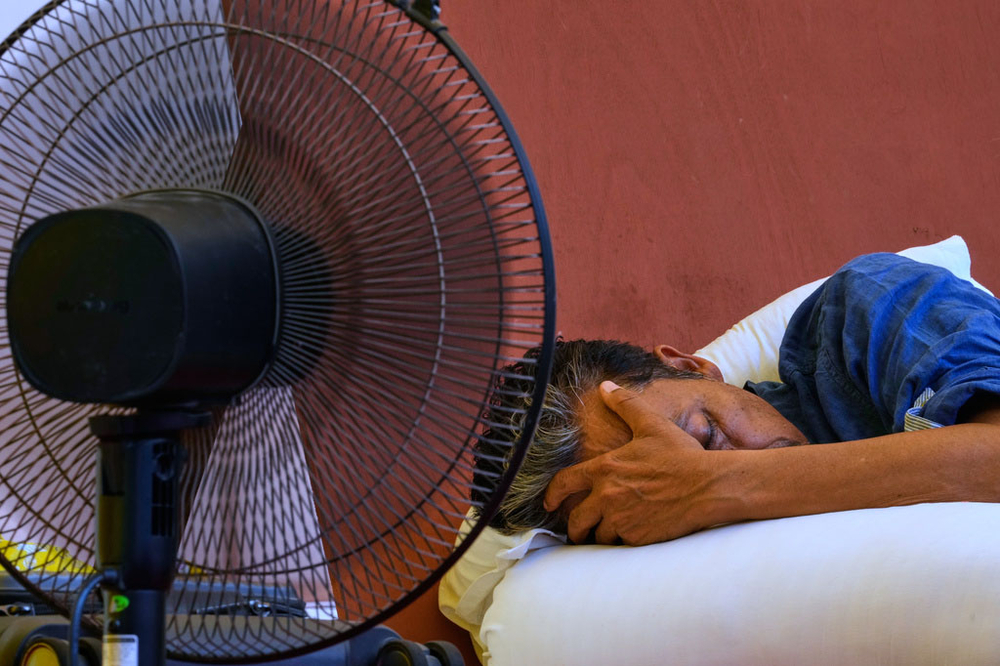
According to a report by The Hindu, several Supreme Court judgments have stated that one should not take the path of confrontation with a person who resorts to hunger strike to make his voice heard. The court said, 'Freedom of expression can be interfered with only when there is a situation of communal harmony, social disorder and public peace being disturbed. Hunger strikes are neither unconstitutional nor prohibited by any law.' The court also said that if a person goes on an indefinite hunger strike in protest against any decision of the government, it cannot be considered a threat to public order. ‘This is a form of protest, which is recognized by both history and our constitutional jurisprudence. Its inspiration comes from Mahatma Gandhi’s Satyagraha.’ This time too, the Delhi High Court has emphasized that every effort should be made to save the life of an individual.
Saurabh Das, spokesperson of the Kaakroch Janata Party, has accused the government of contempt of court by interpreting the Delhi High Court order in its own way. ‘The Delhi High Court order says that Sonam Wangchuk’s health should be monitored. If her health condition deteriorates, then we should proceed as per the doctor’s advice. But the Delhi Police is trying to mislead us that they have come to take Sonam Wangchuk on the court’s order. This is a complete lie and also contempt of court,’ he said.
Who is Sonam Wangchuk?
59-year-old Sonam Wangchuk is one of India's renowned educationists and environmental activists. He has played a significant role in transforming the education system in Ladakh through hands-on learning. He is also known not only in India but also internationally for his internationally renowned 'Ice Stupa' project, which helps in conserving water for communities living in the arid regions of Ladakh.
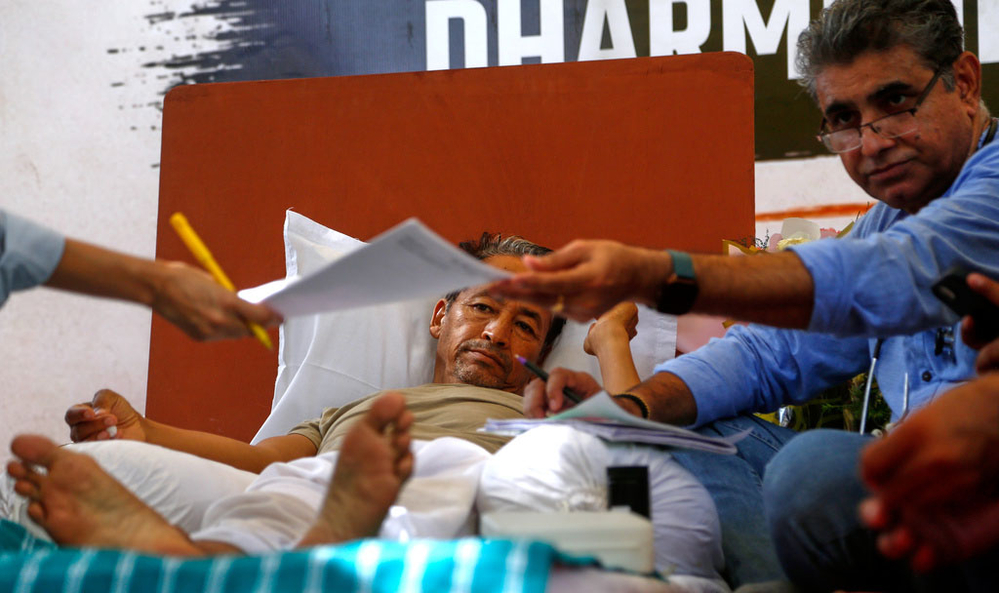
In 1998, Sonam founded a school named Students' Educational and Cultural Movement of Ladakh (SECMOL). Its aim was to strengthen the confidence of Ladakh students, develop life skills, and provide practical training ranging from leadership development to solar energy installation. Under Wangchuk's guidance, the students of SECMOL were able to generate renewable energy and develop innovative technologies to solve problems faced by the school and the villages of Ladakh.
After observing that the natural sources of water needed for agriculture were being affected due to climate change, Wangchuk came up with the concept of building ‘ice stupas’. These artificial stupas store water in winter and slowly melt in summer to provide water for the fields. In recognition of this contribution, he was also awarded the prestigious Ramon Magsaysay Award in 2018.
When Jammu and Kashmir was reorganized in August 2019 and made into two union territories, Jammu and Kashmir and Ladakh, Sonam Wangchuk initially welcomed the decision. When immediate protests began in Kashmir, Leh started its agitation about a year later. The main objective of the agitation was to ensure greater democratic representation and constitutional rights for Ladakh. In 2023, Wangchuk went on a hunger strike on Khardung-Lama, one of the world's highest peaks, demanding protection for Ladakh under the Sixth Schedule of the Constitution. But the Indian government did not grant permission for the fast, and he was placed under house arrest. After that, Wangchuk made a political statement that Ladakh was better off with Jammu and Kashmir than as a union territory.
A year later, he went on a hunger strike demanding constitutional protection for Ladakh. In September 2025, during his 21-day fast, the protest turned violent and four people were killed in police firing in Leh, according to the Indian Express. After that incident, Wangchuk was arrested under the National Security Act and kept in Jodhpur jail for six months. The central government also canceled his organization's license to receive foreign aid, accusing him of inciting youth through provocative statements. In March 2026, he was released from prison after the charges were not proven and returned to Leh.
Wangchuk describes himself as a 'Gandhian' and has been using non-violent movement and long fasts as a means of struggle. In September 2024, he marched from Leh to New Delhi demanding the protection of the Sixth Schedule to Ladakh, but was detained on the outskirts of the capital. More recently, he has been supporting the youth-led political movement, the Kakroch Janata Party.
Indira Gandhi broke Sonam's father's fast
Sonam's father, Sonam Wangyal, was also a well-known politician in Ladakh. He was also a minister in the then Jammu and Kashmir state for some time. In 1965, he even climbed Mount Everest at the age of 23. He was also the youngest climber to that time. Wangyal actively fought in the 1980s to get Scheduled Tribe status for Ladakh. The local people of Ladakh were not only economically and educationally backward, but also in terms of political representation. Wangyal went on a hunger strike for 16 days in 1982 and 5 days in 1984 to get the recognition of Scheduled Tribes. In 1984, the then Prime Minister Indira Gandhi was visiting Leh. According to the Indian Express, Gandhi met Wangyal, assured her of Scheduled Tribe status, and even broke her fast by giving her juice. Wangyal has stated in his memoir, ‘Political Evolution in Post-Independence Ladakh’, that the Indira Gandhi government was positive in accepting their demands. However, Gandhi was assassinated in the meantime. Later, in 1989, when Rajiv Gandhi became Prime Minister, several castes in Ladakh were given Scheduled Tribe status, as reported by the Indian Express.