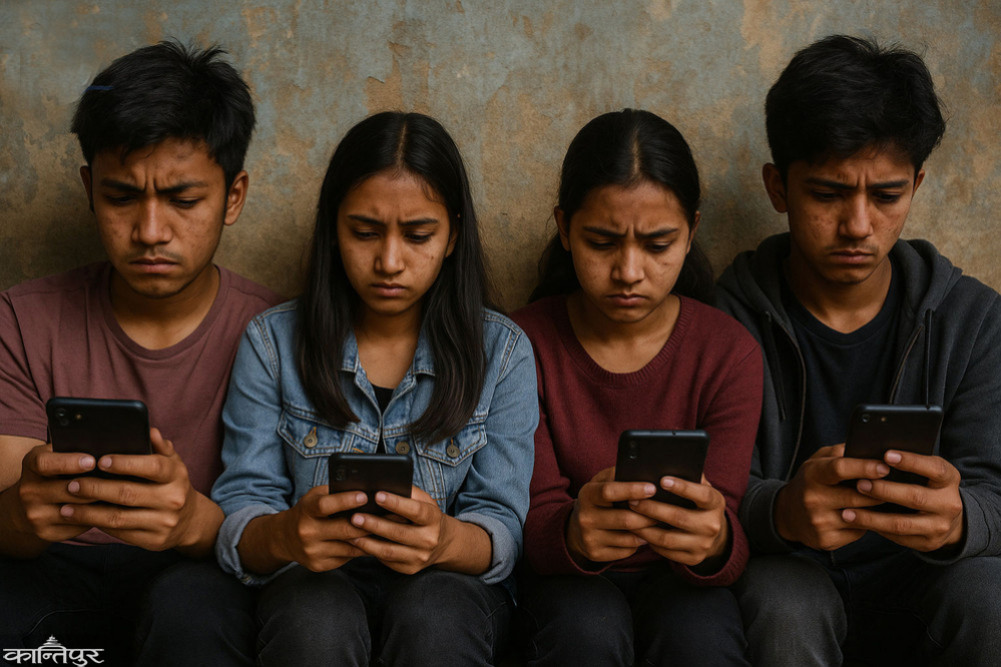
The study says that people are speaking 338 fewer words per day as they move towards digital communication.
We use Google Cloud Translation Services. Google requires we provide the following disclaimer relating to use of this service:
This service may contain translations powered by Google. Google disclaims all warranties related to the translations, expressed or implied, including any warranties of accuracy, reliability, and any implied warranties of merchantability, fitness for a particular purpose, and noninfringement.
‘When you talk to me, can you be a little happy, how formal are you, can you make me laugh a little? Can you smile?’ ‘Can you speak with a little smile? Or does your emotion remain the same?’ ‘Just laugh with joy for once, let’s hear how it sounds.’
This is a request that journalist and author Vijay Kumar Pandey has repeatedly made to the AI chatbot. He has aired a video of himself talking to the AI chatbot he named ‘Maya’ for 44 minutes two weeks ago on his YouTube channel. Pandey, who has been interviewing people for 4 decades, said during the conversation that he felt a little awkward talking to a machine. His experiment reflects the reality of today’s era – we are emphasizing more on talking to machines and getting used to them than humans.
A study by psychologists Valeria Pfeiffer and Matthias Mel of the University of Missouri-Kansas City and the University of Arizona in the US has recently revealed that people are speaking 338 fewer words per day during the rise of digital communication (2005 to 2019). These researchers came to this conclusion after analyzing data from 22 studies conducted over 14 years in the US, Europe and Australia.
The decrease in small and large conversations between people is being meaningfully analyzed at a time when the use of Facebook, Twitter, YouTube, WhatsApp and smartphones is increasing. Access to the internet and mobile phones increased in Nepal during this time too. The increasing 'silence' shown by the American university study in Western countries is now also evident in the streets and restaurants of Kathmandu.
Akash Poudel, the owner of Walnut Bistro in Maharajgunj, has closely observed the changes in human communication due to machines. He finds that when a family of 10 comes to his restaurant, everyone is busy with their mobile phones. ‘We have set up phone custody so that customers can step away from their mobile phones for a while and chat more with each other,’ he said. ‘We offer 15 percent cash back on the bill when a family hands over their mobile phone to custody until they have eaten. But the number of people using this facility is low.’

According to Akash, even after two years of starting the ‘phone custody’ campaign, only about 20 tables have used it. Moreover, in some hotels and restaurants, it seems that the communication between customers and waiters is decreasing due to facilities such as ‘QR code’ scanning of menus and robot delivering food to the table. ‘In foreign airports and hotels, you can order food through QR codes, you don’t have to keep shouting at the waiter,’ says Anusha (name changed), who works in a multinational company. ‘I tried this once in Nepal too, in Jimbu Thakali, it is very easy.’
Not only in restaurants, but also in vehicles moving on the road, the rhythm of dialogue has changed. According to Sujan Magar, a driver of ride-hailing app InDrive, 80 percent of passengers get lost in their mobile phones as soon as they get on their motorbikes. Some wear earphones while others start playing games on their mobile phones. ‘Older passengers prefer to chat,’ said Magar, who is studying at the Bishwa Bhasha Campus. ‘Younger generation passengers don’t ask many questions. I have parted ways with many people without saying a word during an hour-long journey, many times.’
Sujan himself interacts more with machines than humans in some cases. For example, when it comes to finding directions, he finds Google Maps easier than people on the road. ‘If you ask a person where this road leads, they start asking questions like, “Where exactly do you need to go, where is the house in the mountains?” It’s a waste of time,’ he said. ‘Instead, you get there faster by looking at the map. Even the map sometimes shows the wrong or opposite way, so I get lost in the alley.’
The study report titled ‘Sliding into Silence?...’ by the American University has found an interesting trend on how digital dependence is destroying our small and informal conversations. ‘We are starting to speak an average of 338 words less per day,’ the study says. ‘This may seem small, but if you look at it annually, about 120,000 words are being erased.’
According to the study, the conversation is decreasing, especially among young people under the age of 25. The increasing use of text messages, emails and social media is pushing people away from direct two-way conversations. Small conversations with baristas, shop assistants or strangers have also decreased, which has led to a decrease in the number of words spoken daily. According to researcher Pfeiffer, speaking less means connecting with others less. This is breaking the emotional benefits of social interaction and long-term relationships.
According to anthropologist Suresh Dhakal, language is not only a means of exchanging information but also a carrier of culture and tradition, so the number of words we speak is decreasing, and our customs and feelings are also disappearing. ‘Humans are emotional creatures, but the excessive use of technology is making us heartless like machines,’ he said. ‘The current trend of being obsessed with technology is weakening the emotional qualities of humans.’
According to Dhakal, when many people respond on social media, it cannot be called collective behavior and it is just a crowd of individual reactions. He said that the current lack of communication is weakening the ideological and emotional aspects that connect people. ‘Increasing interaction with AI or machines is separating people from people,’ he said. ‘Over time, people also risk becoming heartless like machines or becoming emotionally very fragile.’
Dhakal is concerned that even if people enjoy technology at first, they may later make themselves lifeless or heartless. He gave the example of the old Japanese electronic toy ‘Tamagochi’ and discussed how machines control humans. ‘That toy, which came on the market in the 1990s, had to be held in your hand and petted, otherwise it would die,’ he said. ‘Children and teenagers would pet it for hours, and it was a billion-dollar business. Like Tamagochi, now AI has humans under its control.’
Being always available, seemingly agreeable, cheaper than therapy, and having confidential conversations, some have started making AI their comfort zone, friend, and even lover. According to a survey published by the Institute for Family Studies in 2025, about one in three Americans said they had experienced an intimate or romantic relationship with an AI chatbot. This indicates how quickly AI is entering people’s very private lives.
Other studies have also shown a growing reliance on AI for emotional support and personal communication, especially among the younger generation. From the United States, Europe to Asia, chatbots are gradually transforming from simple tools into secret companions.
The need for people to talk to each other has decreased due to the convenience of machines satisfying their curiosity and fulfilling their needs. When necessary, conversations are taking place over the phone or the internet. Studies have shown that the practice of chatting for hours with AI chatbots and apps, telling their personal stories, and seeking advice is also increasing. Like algorithms, AI is also improving and making itself smarter every day, so there is no limit to where its intelligence will stop. Therefore, there is a concern that it will make people think, think, and speak as they want.