Chaudhary, who suffered the pain of conflict and was separated from the political legacy of the Nepali Congress, was ultimately brought to where he is today by his experience of working life and his frequent dissatisfaction with political parties within the country.
We use Google Cloud Translation Services. Google requires we provide the following disclaimer relating to use of this service:
This service may contain translations powered by Google. Google disclaims all warranties related to the translations, expressed or implied, including any warranties of accuracy, reliability, and any implied warranties of merchantability, fitness for a particular purpose, and noninfringement.
Surendra Chaudhary (Tharu), who has worked in international organizations for a long time, is a character who entered politics in search of 'alternative politics'. In the process, he reached parliament from the National Independent Party (NISP).
Chaudhary, who suffered from the pain of conflict and was separated from his family's political legacy, was finally brought to where he is today by the experience of working life and repeated dissatisfaction with political parties within the country.
He was born on 19 Jestha 2029 in Deukhuri, Gahwa Rural Municipality-4, Dang district headquarters. His grandfather, Bishweshwor Prasad Chaudhary, was the commander of the Congress Liberation Army in the 2007 BS movement. His grandfather led the activities from the capture of Gahwa outpost in Rapti Zone to the attack on Nepalgunj.
His family was displaced during the Maoist conflict in 2054 BS. He says that not only his house but also that of his in-laws were looted by the then Maoists because of the Congress. After that, their family left Dang and came to Kathmandu.
His father is a teacher and a person with an administrative background. After completing his master's degree in education from the US, he worked as an English teacher. Later, he became the District Education Officer and also became the General Manager of the Nepal Transport Corporation.
Growing up in a prosperous and educational environment, Chaudhary had no problems during his studies. His grandfather and father provided financial support along with land for the construction of schools, health institutions and other public infrastructure in the village. This showed that the family's social contribution to the village was profound.
Even though the Maoists looted the house, the family later returned to the village at the request of the villagers. His wife is involved in the fashion design business. Chaudhary's parents currently live in Dang.
Chaudhary completed his primary education in Deukhuri. He went to India for higher education and returned to Nepal after completing 12th grade and did his bachelor's degree in biology and master's degree in sociology. Due to his family heritage, he became active in politics through the Nepali Students' Union during his student life. He was also a central member in 2054 BS and says that he left that responsibility due to internal disputes within the organization and focused on his studies and professional journey.
Interest in alternative politics through foreign experience
Chaudhary entered international organizations along with his studies. Working in organizations such as the United Nations and the World Bank, he gained deep experience in public policy, conflict management and political affairs.
He has a master's degree in crisis management from Columbia University in the United States. He has worked in areas including political affairs, project management, emergency intervention, conflict resolution, human rights promotion, constitution-making process and grant management. Chaudhary, who has a deep understanding of the socio-political situation before and after the conflict, has also had the opportunity to represent the country at national, regional and international forums. 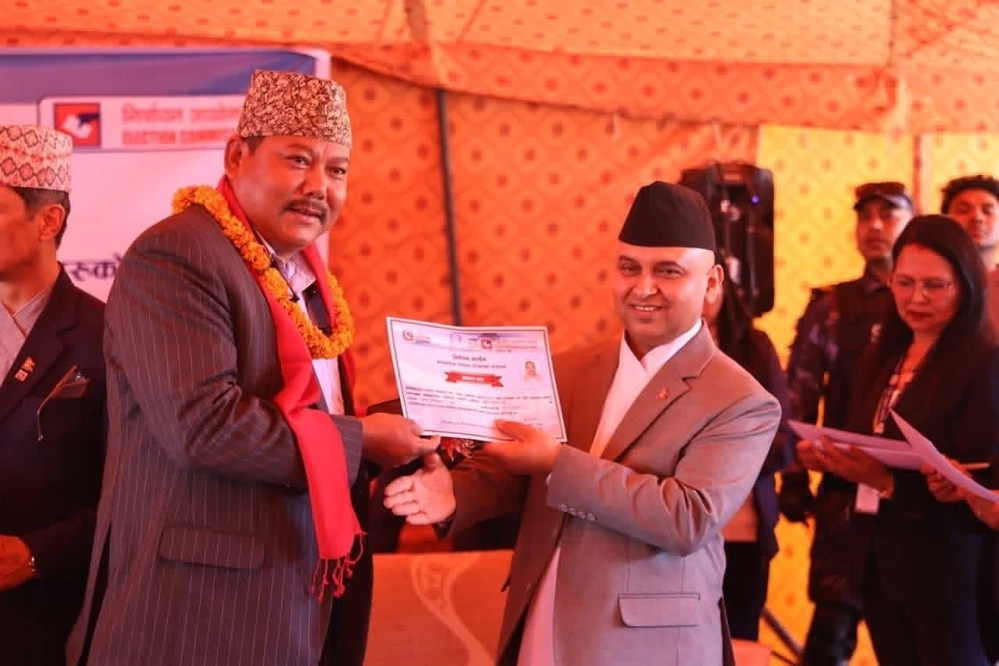
‘The main motivation for me to enter politics was to see the work of the President of Liberia, especially the work of the United Nations,’ Chaudhary said. ‘The work of Ellen Johnson Sirleaf, who is also the former Vice President of the World Bank, in a short period of time had a profound impact on the war-torn country. I saw there how the vision, knowledge and clear plans of an understanding person can build a country,’ he said. ‘At that time, it was difficult to find a leader with such vision when compared to the leaders of Nepal.’
From his experience abroad, he also came to the conclusion that nothing happens without politics. ‘Be it the price of slippers or the price of medicine. From here, everything, even the quality of water, ends up in politics. With this understanding, I felt that I should embark on a political journey,' he said, 'When I came to Nepal at a time when my passion for politics was growing, I met an honest person like former Secretary Rameshwor Khanal and former Prime Minister Dr. Baburam Bhattarai in 2013.'
This country is no longer built on old leaders and traditions. Now, I was inspired by the thought of doing something, starting some good politics. He says that Baburam's vision and plan for building a country drew me into politics.
After 20 years of working life, he entered full-time politics through the Naya Shakti Party and worked as a central member and head of the party's policy and research department with the establishment of Naya Shakti. While working, Chaudhary left the party within a year and a half, concluding that although Dr. Bhattarai's blueprint and plan for building a country were attractive, they did not reflect the practices that should be seen in alternative political parties.
However, he is still Dr. Bhattarai's vision and blueprint for nation-building are described as a unique vision found in a rare leader. He believes that the plan, knowledge, and ability to build a nation are rarely found in other leaders like him. However, he comments that Dr. Bhattarai is weak in the management aspect of party building.
Even though he could not form an organization, Chaudhary understood from that association that his vision was realistic. Chaudhary left the Naya Shakti Party, believing that it was a repetition of the old style. According to him, alternative politics is not just about starting a new party, but also the process of establishing a political culture different from other parties, starting from internal democracy.
Even after leaving Naya Shakti, his search for 'alternative politics' did not stop. The treatment of the Tharu community after the Tikapur incident shocked him. Since he worked at the United Nations, this also became a matter of interest to him. Chaudhary's perspective on crises was different due to his experience in the international arena and his higher education in crisis management at the world-renowned Columbia University.
After studying various investigation reports, he concluded that 'the state can trap even the innocent'. Then he launched the 'Tikapur Rajbandi Release Campaign'. After seeing that the Tharu community was not guilty in the report prepared at that time, he raised his voice in favor of justice together with human rights activists, civil society and the intelligentsia.
He says that he also saw in this incident how the state can trap even the innocent in a brutal way while working as a responsible citizen. Then, he also got involved in the formation of the Civil Liberation Party in collaboration with Reshamlal Chaudhary, saying that this issue should be resolved politically.
He was active in expanding the organization from Jhapa to Kanchanpur. He witnessed the initial success of the party. However, he left that party within a year, concluding that ‘personal interests prevailed over the objective.’ ‘Nothing suitable for alternative politics was seen, that character was not built. That DNA was not formed.’ And after such a situation, I came to the conclusion that I should not waste time in this place,’ said Chaudhary.
Even after leaving the party, his ‘addiction’ remained alternative politics. After that, he launched the ‘People First-Citizen First’ campaign, which sparked a debate across the country about good governance, civic awareness, and participatory democracy. ‘The citizens will decide how to build the state,’ he says. ‘We moved forward with the idea that the state is a structure inherent in the citizens.’
000
He became active in party politics again after growing dissatisfaction in the country and the street protests of the ‘Gen-G’ generation. He remembers the country taking an unexpected turn after the Gen-G movement and the dissolution of parliament. ‘The feeling that too much had happened in the country grew and the Gen-G generation took to the streets,’ he said. ‘After a few days of tension, we all brought the Gen-G group to one place for talks.’ I was also active in the talks with the Gen-G group in Baluwatar.’ That talk urged all Gen-G youth to unite.
After that gathering, he says, the need for ‘alternative politics’ became more clear as discussions were held on institutionalizing the sentiments raised by the movement. ‘Now discussions have started with the conclusion that we should form a single alternative force,’ he said. ‘For that, we have taken forward discussions with Balen’s group, Bibeksheel Party, Kulman Ghising, Naya Shakti, ‘People’s First’ campaign and Nagarik Unmukti Party.’ In the meantime, he had also reached Nakkhu Jail and held discussions with Rashtriya Swayamsevak Sangh (RSS) President Ravi Lamichhane.’
The debate that started with the belief that a single strong alternative force should be formed in the country gradually expanded, and eventually Chaudhary himself joined this trend. ‘In the course of that debate and search, I also joined and many friends gradually joined,’ he said.
Future plan: To make laws and reduce the distance between the citizen and the state After reaching the parliament, Chaudhary said that he understood his role differently from the traditional scope. ‘Parliament is a law-making body, but I am thinking a little further,’ he said, ‘The role of parliamentarians should not be limited to law-making, but should also focus on reducing the gap between the citizen and the state. We represent different districts and communities. Currently, there is a big gap between the citizen and the state, and it is my responsibility to reduce that gap.’
Chaudhary says that the use of these three elements, ‘experience, knowledge and discretion’, is necessary in the context of law-making. He understands that long-term and effective decisions are possible only when collective discretion is used. He says that the first priority is to accelerate the creation of laws necessary to complete the implementation of the constitution. ‘Our constitution is new, but the laws are old.’ That has created a problem, he said, ‘We need to play a role in making laws urgently.’
According to Chaudhary, after laws are made in Nepal, problems arise in implementation. For that, he emphasizes the principle that those who are most affected by the decision of the law should be included in the decision-making process. ‘Instead of making and passing laws by a limited group as before, the practice of making laws in a participatory manner with extensive consultation should be established,’ he said. ‘If it is a law related to agriculture, it should be made after discussing with farmers, if it is a law related to education, it should be made after discussing with teachers and students. In this way, if there is no opposition, it will be effective.’
When asked how he addresses the community he represents, Chaudhary says that the issue of social justice should be viewed in conjunction with the issue of ‘nation building.’ ‘Social justice issues are 24-carat issues, they are the basis of nation building,’ he said. ‘If the issue of rights is raised and presented only in the interests of one’s own community, it creates fear in other communities.’
Chaudhary described the recent election results as an ‘extraordinary victory’ and said that with it came an extraordinary responsibility. He says that the main reason for the formation and dissolution of parties in Nepal is the lack of internal democracy and the weakness of the collective decision-making process. According to him, the main challenge now is to develop a culture of using collective wisdom. “Citizens are watching to see whether we can use collective wisdom and make wise decisions,” he said.

