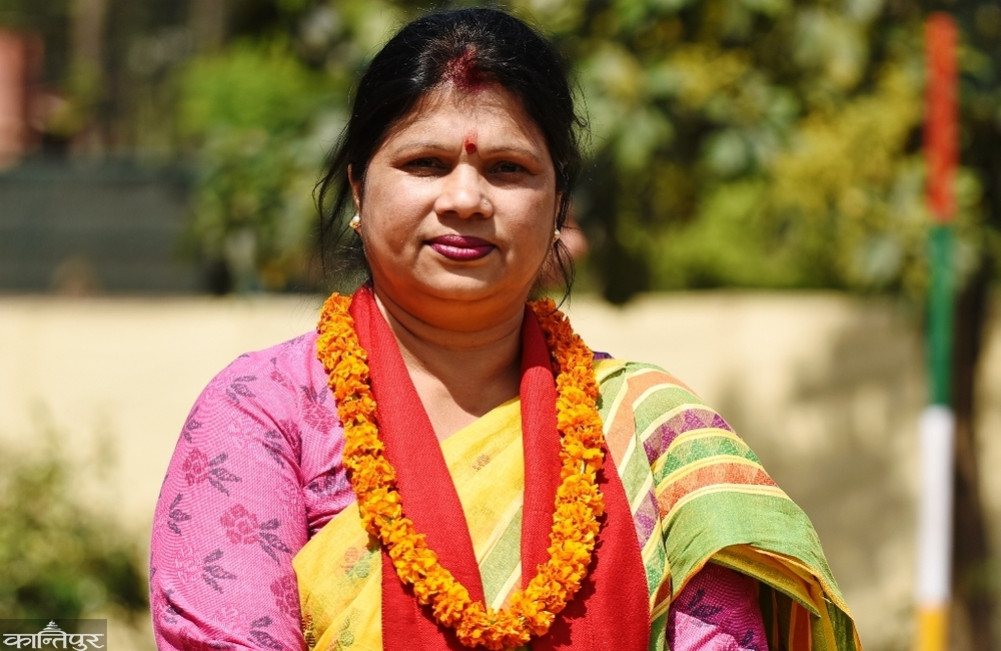
Ninukumari Karna, who has been continuously struggling since the 2046 People's Movement, has been elected as a member of the House of Representatives on the proportional representation side from the Madhesh Women's Cluster of the Nepali Congress.
We use Google Cloud Translation Services. Google requires we provide the following disclaimer relating to use of this service:
This service may contain translations powered by Google. Google disclaims all warranties related to the translations, expressed or implied, including any warranties of accuracy, reliability, and any implied warranties of merchantability, fitness for a particular purpose, and noninfringement.
It was the time of the people's movement in 2046. At that time, Ninukumari Karna was studying in class 10. The movement was very intense from Janakpur. She also joined the people's movement for democracy.
After struggling in politics, Ninu has now been elected as a member of the House of Representatives from the Madhesh Women's Cluster of the Nepali Congress on the proportional representation side. Ninu says that after becoming an MP, she will raise her voice for every region. She said, 'I will always raise my voice about the corruption in all regions of the country.'
Ninu says that she will raise her voice to stop the growing problem of drug use among the youth in Madhesh. She said, 'It pained me to see that young children who are currently studying in school in Madhesh are addicted to drugs.' In the future, those who have the responsibility of their families and the country on their shoulders,' she said, 'I feel very sad to see them using drugs from now on. I have a plan to raise my voice against addiction and to organize public awareness programs and encourage youth to do good deeds.'
She plans to raise this issue in the parliament in the coming days. She said, 'We should give priority to women from all communities in politics. I feel very sad to see the low participation of Madhesi women. I will raise my voice for equal participation in the future.'
She said that she will always work to reduce child marriage caused by the misuse of social media and the problems it causes. She said, ‘Children studying in school are misusing social media and getting married at a young age,’ she said, ‘I will raise my voice about this and work towards reducing the problem.’
Ninu says that she has many plans and agendas. She says that she will do everything she can to uproot the distortions seen in society. She said that women in these days should be physically and mentally strong and should make good use of the opportunities they receive. She has pledged to always fight both on the streets and in the parliament to control corruption, ensure good governance, and protect federalism. ‘We will always support the good work done by the government. We will never back down from raising our voice for bad work,’ she said.
Ninu grew up in a family with a political background. She is the granddaughter of Mahendra Narayan Nidhi and the niece of Bimalendra Nidhi. Growing up in a political environment from a young age, she was interested in politics. She remembers visiting her maternal uncle and grandfather in jail as a child.
Once upon a time, Bimalendra Nidhi was in jail. Ninukumari went to visit her maternal uncle with her grandmother. She wondered, 'Why and how did they keep her maternal uncle like that?' She started taking an interest in everything. When her maternal uncle went to her house, her grandmother would answer all the questions Ninu asked. At home, her father, who was a teacher by profession, would answer every question Ninu asked in a simple way. As Ninu grew older, her interest in politics grew.
It was the time of the People's Movement of 2046. She was studying in class 10 during the movement. But she joined the movement saying that she would fight for the interests of the country. She told about her past as a ‘messenger’ who carried secret letters and news for Bimalendra, who was underground at that time. She said, ‘I was suspected of giving information and was even called to the police station and warned.’ But for the sake of achieving democracy, she did not think of leaving after wavering on such matters. She said, ‘At that time, it was said that girls should not do politics. Seeing that I was involved in politics, politics was not for girls. Many people would come to tell my father that they were afraid,’ she said, ‘Once my father also told me not to do politics because he was afraid. I grew up in an environment where it was not even allowed to educate my daughter in the Terai, and the villagers would say something when I did politics.’ But Ninu went ahead by arranging bad things. Ninu's struggle and awareness of politics did not make her leave politics. It inspired her to pursue it more closely. 'I had vowed that day, the day I would enter politics.' From that day on, I have been raising my voice about women's political inclusion,' she said, 'I always felt that we should work towards increasing the meaningful participation of Madhesi Dalits, indigenous peoples and women in every structure of the state based on their population.'
Ninu considers her political career to have begun with the People's Movement of 1991. Ninu, who has been involved in politics since her student life, was a district member of Nepal Students' Union (Nevisangh) in Dhanusha, a unit member of Tri-Chandra College, and the general secretary of the Terai Students' Forum. During her student life, she was also the treasurer of the Janakpur Zonal Contact Committee. Ninu has been a central member of the Nepal Women's Union since 2078.
Born in 2030, Ninu completed her school-level studies from Saraswati Secondary School in Janakpur. She did her graduation from Trichandra Campus and her master's degree from a college in Janakpur.
Ninu also said that she was associated with social organizations. She worked as the joint secretary of Mahendra Narayan Nidhi Foundation and the general secretary of Karna Kayastha Mahila Samaj. She also said that she had been associated with Scouts since school.
Ninu got married in 2056. After that, she stayed away from politics for some time. She said, 'After marriage, her mother-in-law tried to tell her daughter-in-law not to do politics,' she said, 'Her husband and father-in-law supported her in doing politics.' But I stayed away from politics at that time.'
Even though she thought of staying away, politics could not be far from her mind. She participated in the 2062/63 movement every day. She said, 'I would go out because my mother-in-law had work outside.' And I would participate in the movement in Ratna Park. Sometimes I was even locked up at the post. The days when I went home after being dropped off in the evening are still fresh.'
Ninu's interest in politics had always been there. Thinking that she should stand on her own two feet, she joined the teaching profession for about a decade. She also gave time to her family. She taught at Budhanilkantha Secondary School for a long time. Then she gave up her teaching profession and returned to politics. Ninu is now a member of the House of Representatives. She said that she is very sad that some people are criticizing her now. She said, ‘I came into politics after struggling. I did not become a parliamentarian without politics.’ But the way society interpreted me was that I was Bimalendra Nidhi’s niece, and I was put in a similar position,’ she said, ‘I came into politics after struggling since my student days.’ But I felt bad when I was accused without understanding my political life.’
She said that even though others do not see her struggle in politics, she is moving forward by ignoring criticism. She said, ‘People in my village know about my political struggle. It is my family who teaches me about politics.’ Ninu says that she will never stop fighting for the truth in the days to come.