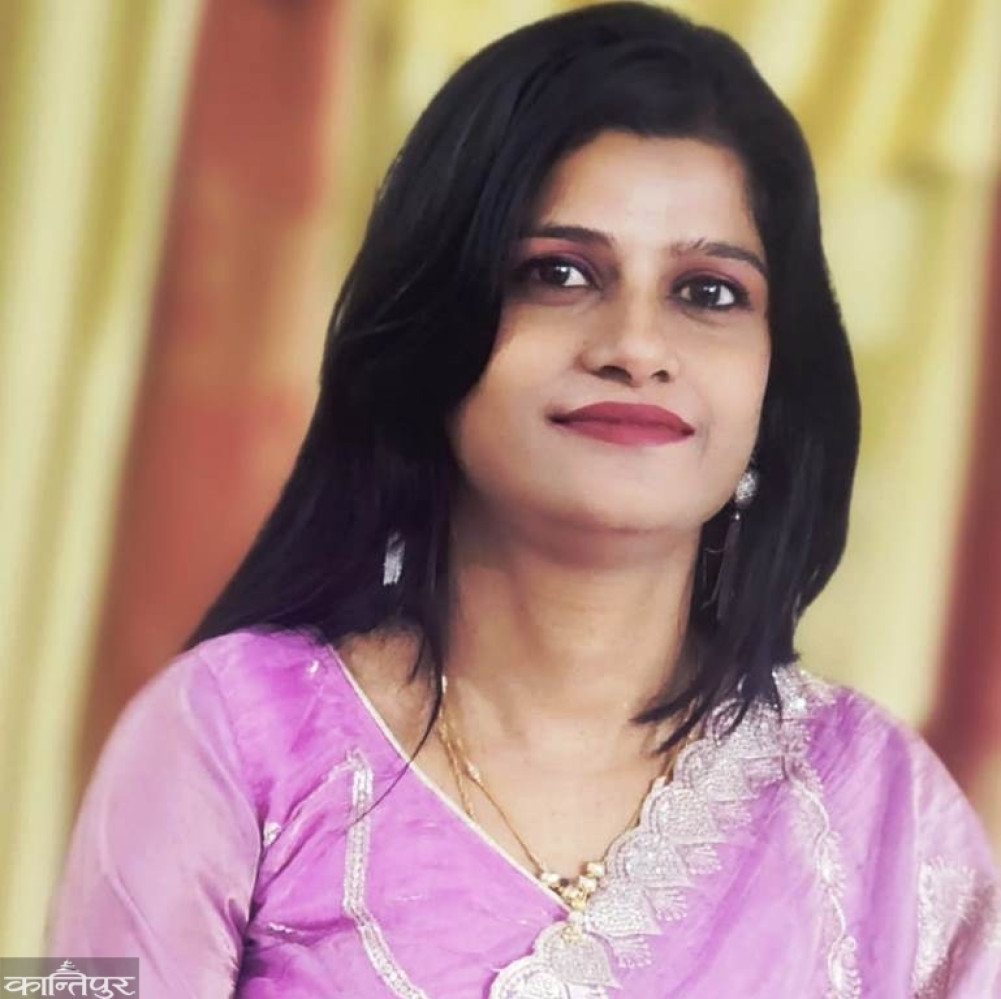
Overcoming personal struggles and social discrimination, Sarita Mahato has reached Parliament on issues of autism, women's rights, and inclusive education.
We use Google Cloud Translation Services. Google requires we provide the following disclaimer relating to use of this service:
This service may contain translations powered by Google. Google disclaims all warranties related to the translations, expressed or implied, including any warranties of accuracy, reliability, and any implied warranties of merchantability, fitness for a particular purpose, and noninfringement.
Life sometimes takes a turn where you have to take on new responsibilities without any plan or preparation. For Sarita Mahato, the responsibility of being an MP is an unexpected achievement. She had never been involved in politics before, nor did she plan to do so in the future.
She became an MP from the proportional cluster on behalf of the National Independent Party, representing Madhesi women. She said, ‘I was away from politics. I was struggling with raising and educating my child. The proposal came, if it works, and today I am in Parliament.’
Although her journey to Parliament was unplanned, the agenda is clear. She has set a goal to solve the pain she has experienced and the problems she has seen in a policy-level way. The main agenda is to establish inclusive schools in every district, ensure the rights of children with autism, protect women’s rights, and direct women limited to household work towards employment.
She said, ‘Children with autism should not be deprived of education, the state should take responsibility . Inclusive schools should be opened in every district .’ She has also put women empowerment at the center of the agenda . She is committed to fighting discrimination and violence against women in the Madhesi community legally and socially .
Sarita was born in Sarlahi . She completed her SLC from there . She came to Kathmandu for higher education and did Plus Two in Science from CCRC Capital College and Research Center . Then she went to India and completed her BHA and MBA studies . She reached Biratnagar after marriage . Her husband was a neurosurgeon, but he died suddenly .
After her husband’s death 3 years ago, she experienced many ups and downs . After working for 13 days after her husband’s death, she was kicked out of her house . At that time, her son was only four years old and could not speak or make any other gestures. Stating that she had become homeless with her 4-year-old son, she said, ‘At that time, I had no home, no support. On one hand, the pain of losing my husband, and on the other hand, the state of a small child in my arms.’
She said that she had to leave home due to the prevailing social thinking in Madhesi society. She said that she too was a victim of the tendency in Madhesi to expel women from their families after the death of their husbands. She started moving forward with the help of her family. Stating that she had the support of her family, she said, ‘After my husband was expelled from the house, there were times when my family did not look after me, but I was lucky to have the support of my family.’
Even as her son grew older, his moral development was weak. She became worried when her son did not speak or behave normally. She came to Kathmandu for treatment, after the treatment she found out that her son had autism.
Sarita Mahato's path changed after she found out that her son had autism at the age of three. After knowing her son's condition, she dedicated herself to the development and rights of children in the autism field.
Then another struggle began. The upbringing and education of children with autism had become a problem. She started looking for different schools and therapy centers to educate her son. The school refused to accept her. Describing the struggle she had to educate her son, she said, 'Many schools and therapy centers refused to run them. Therapy centers were very expensive, which I could not afford.'
Suffering personal pain, she turned to social campaigns. After realizing that this problem was not only hers but also the common pain of thousands of parents, She started raising her voice for the rights, education and inclusion of children with autism.
She got the opportunity to work as a city volunteer in Kathmandu Metropolitan City. She started working on projects related to children and the environment. While taking on administrative responsibilities at the Mentally Ill and Family Counseling Center in Sinamangal, she got the opportunity to understand the problems of children with autism and their families up close. The six-month experience made her more clear that the problem lies not only in treatment or education but also in social thinking. She said, ‘Autism is still seen as a stigma in society and many parents are forced to hide their children.’
Even after the project ended, she remained associated with the metropolis. Working as a volunteer, she started advocating for inclusive education. She emphasized that every school should be inclusive and that children with autism should be given equal opportunities, not separate. She has also seen many challenges in running a government school for students with autism. She pointed out the main challenges as the lack of necessary manpower, lack of infrastructure, lack of training among teachers, and lack of social awareness.