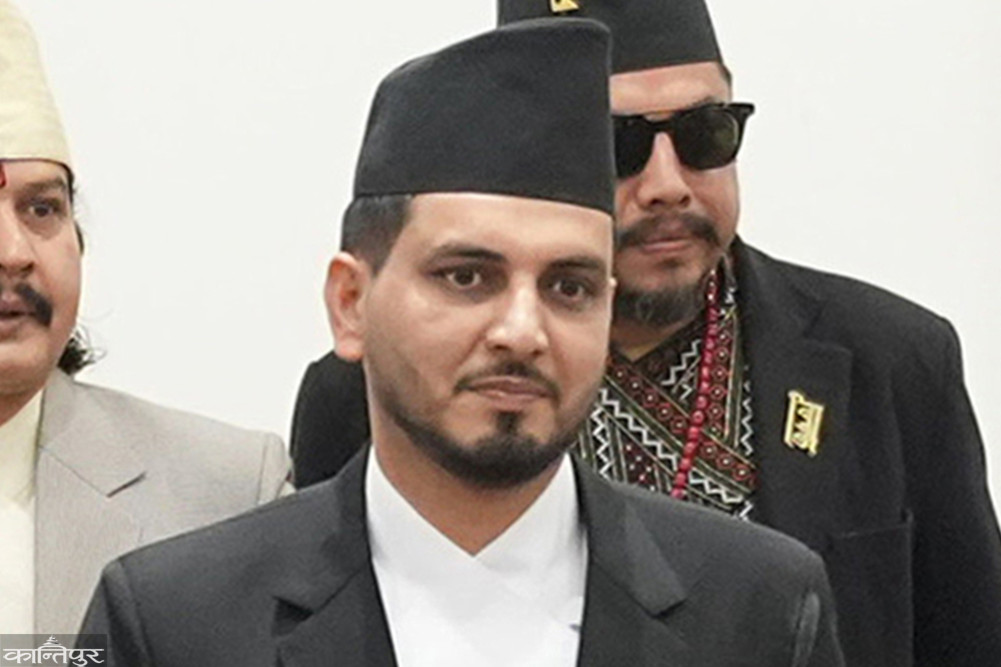
Minister for Physical Infrastructure, Transport and Urban Development Sunil Lamsal is not only handling the ministry with the highest budget allocation, but he will also have to resolve the most pressing issues within the ministry.
We use Google Cloud Translation Services. Google requires we provide the following disclaimer relating to use of this service:
This service may contain translations powered by Google. Google disclaims all warranties related to the translations, expressed or implied, including any warranties of accuracy, reliability, and any implied warranties of merchantability, fitness for a particular purpose, and noninfringement.
Sunil Lamsal, 35, of Tilottama Municipality-7 in Rupandehi, has been given the responsibility of handling the Ministry of Physical Infrastructure and Transport and Urban Development, which is responsible for the most development work.
Lamsal, who holds a bachelor's degree in civil engineering from Lumbini Engineering College and a master's degree in structural engineering from India's Niti Meenakshi Institute of Technology, is the youngest minister to handle the responsibility of these two ministries.
Lamsal Balendra Shah, elected from Rupandehi-1 from the National Independent Party (NISP), worked as an infrastructure and environment expert when he was the mayor of Kathmandu Metropolitan City.
Lamsal, who has been working in the fields of infrastructure, urban planning and good governance for a long time, will now have to show his expertise in physical and urban areas. There are gaps in both these ministries, which Young Minister Lamsal must have the ability to overcome.
Among the development ministries, physical infrastructure and transport are the ones that receive the most budget. This time, urban development, which is also a development ministry, also received a good budget.
There are also many problems in this ministry that receives the most budget. The ministry and the bodies under the ministry will not hesitate to play a role in keeping the minister in their favor. Minister Lamsal will have to avoid that.
Issues that directly concern the citizens also fall under this ministry. For example, driver's licenses can be taken. The Department of Transport Management falls under the Ministry of Physical Infrastructure and Transport. There are 42 transport management offices across the country under the provinces. The department has been coordinating the printing of licenses until the printing of licenses starts in the offices and provinces.
The 2.7 million licenses issued for new and renewal since 2022 have not yet been printed. Due to which the service recipients are forced to carry the revenue-paid amount. The demand for new licenses alone is 2,500 to 3,000 per day. The sustainable implementation of the embossed number plate operated under the department has not been achieved.
During the Gen-G demonstration, the embossed number production plant and the driver's license printing machine were destroyed by the arson attack in the department.
During the Gen-G demonstration, all the embossed number plates that were prepared to be sent to the provinces and related transport offices for installation were burned. The number plate manufacturing plant has also been destroyed by the fire. The government has a plan to install number plates on 2.5 million vehicles, but embossed number plates have been installed on only about one hundred thousand vehicles so far.
According to department sources, 819,059 embossed number plates were prepared by Shrawan 2082. Of that, only about 220,000 were sent to the respective provinces and their subordinate offices. The rest of the number plates were in the department and were destroyed in a fire while being prepared for sending.
According to the department's preliminary data, 619,000 number plates have been burned and destroyed. According to department sources, 632,141 two-wheelers, 164,191 four-wheelers, 14,582 heavy vehicles and 8,145 three-wheelers were produced till Shrawan. So far, neither the department nor the ministry has taken any decision on the preparation and installation of embossed number plates.
A joint venture contract was signed between Bangladesh and the American Decatur-Tiger IT Company on 19 Jestha 073 for the installation of embossed number plates. According to the agreement, embossed numbers should be installed on 2.5 million vehicles within 5 years. So far, embossed number plates have been installed on only about 100,000 vehicles. The deadline for Decatur-Tiger IT Company was extended until December 12, 2007 after the deadline expired in Asad 078. The deadline extended by 2 years has expired after the work was not completed during that period. No decision has been made on the extension of time. The initial contract amount was 4.16 billion 7.9 million 50 thousand rupees (excluding value added tax), but later the amount was increased by 22.50 percent with the extension of the deadline. No decision has been made on this so far.
There are also problems in road construction in the physical infrastructure sector. Projects that have progressed in construction have not been able to get adequate budget. In the current fiscal year, Rs 700 million was allocated for the expansion of the Suryabinayak-Dhulikhel road along the Araniko Highway, including the construction of a bridge.
Of which only Rs 600 million was allocated for road construction. Although Rs 3 billion was requested for the overall project in the current fiscal year, the project did not receive the budget accordingly. Due to which the road expansion work is being done by requesting a little bit of budget.
Vehicles use this road to reach the eastern hills and Terai districts via BP Highway. The construction of the roads that have been expanded and upgraded is not yet complete. Even after 7 years of the Narayangadh-Butwal road expansion, the work has not been completed. Out of the 113-kilometer road, 14 km of the Daunne section has not yet been completed.
Although the initial design mentioned blacktop, during the construction, it was found that the blacktop would not be durable due to the soil in that area, the slope work was taken forward, said Chudaraj Dhakal, Project Chief of the Project Directorate (ADB). Out of the 14 km, 3 km will be blacktopped and the remaining 11 will be sloped roads. 3 km has already been blacktopped. Of which 6.5 km of road has been sloped. 4.5 km of road is being constructed.
It has been expanded with the help of a loan from the Asian Development Bank (ADB). The contract has been taken by the China State Construction Engineering Corporation. 'During the construction period, passengers and drivers traveling through the Daunne section have faced a lot of inconvenience,' said Director Dhakal. 'We are saddened by this, now from Jestha, they will not have to face any inconvenience due to the road and bridge, passengers will be able to travel easily.'
Although the expansion and upgrading of the Nagdhunga-Muglin, Aanbukhaireni-Pokhara, Kamala-Kanchanpur, Kakadtbhitta-Laukahi roads have started, the work has not yet gained momentum. After a year of construction, the work of moving the electricity poles is finally underway. Due to lack of inter-ministerial coordination during construction, the problems of demolition, construction and demolition are recurring .
The construction progress of national pride projects in the road infrastructure sector is not satisfactory due to insufficient budget. The heads of the relevant projects have complained that they have not been able to plan and work due to insufficient budget as per demand . Although the study of two dozen tunnels has been completed, construction of only two has begun so far .
The work of selecting a service provider has reached the final stage after the completion of the Nagdhunga-Sisnekhola tunnel. Although the construction of Siddhababa tunnel in Palpa is ongoing, the progress is not satisfactory . The tunnels that have been studied are stalled . The responsibility of solving all these problems lies on the shoulders of Minister Lamsal .
Former Secretary Arjun Jung Thapa said that the first step for the minister who takes over the responsibility of the Ministry of Physical Infrastructure and Urban Development should be to pay the construction entrepreneurs who have been delayed for a long time . ‘Many payments have been stopped, payments for work completed in the past should be made,’ he said, ‘Another problem is on the Narayangadh-Butwal road section, although work has been completed elsewhere, there is still a problem in Daunne, the work should be completed so that passengers and drivers do not face problems in the coming monsoon.’
He suggested that pressure should be put on the construction entrepreneurs concerned in this regard. ‘The Naubise-Muglin road should not be allowed to face problems in the coming monsoon, work should be done in a way that does not disrupt traffic,’ he said, ‘How to do new work on contracts that were broken when Kulman Ghising was the Minister of Physical Infrastructure and Transport, another big problem is how to do new work on contracts that were broken when the contract was broken, some construction entrepreneurs have gone to court after the contract was broken, we should move towards resolving this.’
As some projects for which source agreement was sought have not yet received agreement, the work on new contracts has not been able to move forward in the current fiscal year. ‘We should prioritize the projects of pride, complete the Postal Highway quickly, if there is no work in the parks and forests, we should find an alternative or remove it and move towards completing it, we should not get stuck on one thing,’ he said, ‘The East-West Electric Railway should be put on hold for some time, we should first decide whether to build the railway or not.’
If it is to be built, he said, only land acquisition and preparatory work should be done now. ‘We should focus on the Koshi, Kaligandaki, and Karnali corridors of national pride, we should move towards completing these roads, they should be completed within the next two years, even if these roads are completed, the country is sure to see an economic leap,’ he said, ‘By this time, the Mid-Hill and Postal Highways will also be completed.’ He suggested that we should prioritize the projects of pride and manage the budget and complete them.
‘There is no need to announce many projects as glory projects, they should be prioritized, and those with higher priority should be completed,’ he said, ‘There is a big problem with licenses now, the concerned provinces should be provided with budget to buy license printing machines and arrange for them to be printed from there, this work should not be taken up by the center.’
It is seen that there will be problems during the upcoming monsoon on the BP Highway connecting the Eastern Hills and the Terai. The flood of Asoj 2081 from Bhakundebesi to Nepalthok caused more damage to the 30.5-kilometer area along the highway. Apart from the 3.2 kilometers of the damaged highway, a contract agreement has been signed for a 27.3-kilometer section and work has begun. Three packages have been signed, 3 for Kavre and 1 for Sindhuli.
Although the Japan International Cooperation Agency (JICA) has said that it will work on 3.2 kilometers, there has been no progress on it so far. In the current fiscal year, Rs 151.7483 billion has been allocated to the Ministry of Physical Infrastructure. Of which Rs 1.44283 billion is for capital.
Fragmented planning should be ended in urban areas
The Ministry of Urban Development has included 3,983 programs and plans worth Rs 1,000 to 9,900,000 in the budget for the coming fiscal year.
Which is 59 percent of the ministry's total programs and plans. Urban Development has included 6,755 plans and programs in the budget for the coming fiscal year. Although there is a standard not to include projects costing less than Rs 30 million in the federal government's budget, Urban Development has allocated only Rs 1,000 each in 20 programs.
The National Planning Commission had implemented the 'National Project Bank Standard 2081' to allocate budget only for projects costing more than Rs 30 million in the budget. However, ignoring this criterion, it has been found that Sahari has included the most fragmented plans in the budget.
When Congress leader Prakash Man Singh was the Urban Development Minister, fragmented plans that were not allocated to other ministries were taken to this ministry. He had kept the plans close to the party at his own will. According to ministry sources, plans worth more than Rs 50 billion have been kept to please party leaders and workers. Initially, Rs 100.18 billion was allocated for this ministry.
After the Gen-G movement, Rameshwor Khanal, who became the Finance Minister, decided to cut the budget allocated to the fragmented plans under the ministry. Such projects that were not needed were stopped for the time being. According to the half-yearly review of the budget, the revised budget of the ministry is Rs 91.34 billion. Of which, Rs 88.48 billion is for capital expenditure.
Even after 7 years of construction, the construction of the Parliament building on the Singha Durbar premises has not been completed. Which has prepared a multi-purpose hall on the premises overnight and administered the oath to 275 newly elected members of the parliament. The construction of the building has not been completed yet. The minister himself will have to urge for the construction to be completed quickly. The construction of the tower is still incomplete.
The initial contract period for the reconstruction of the tower, which began on 15 Asoj 2075, was 14 Asoj 2077 as per the contract agreement. Even though the deadline was extended for the fifth time until Asoj 2080, the work was not completed. The deadline was extended for the sixth time until 20 Asoj 2081, but the entire work has not been completed yet. The contract has been taken by GIETC-Raman JV. Although GIETC is a Chinese company, the work is being carried out by Nepali contractor company Raman Construction, which was awarded a contract of 3.48 billion 16 million rupees. The deadline has now been extended until April 2083.
Only 85 percent of the work has been completed so far . Even after 7 years since the construction began, its work has not been completed . The International Conference Center in New Baneshwor, which was damaged by fire during the Gen-G movement, is abandoned . Further work on its reconstruction has not been able to proceed . Where the Federal Parliament Secretariat has been conducting parliament meetings on rent since 2065 BS .
The Minister's Residence in Bhainsepati has been destroyed by fire, and further work has not been able to proceed . Similarly, the multi-purpose hall built in Godavari was also destroyed after the Gen-G movement, and its reconstruction work has not yet been able to proceed .
The riverside roads, which have become an alternative route for traffic jams in the Kathmandu Valley, are not well-maintained . The rivers in the valley are polluted . There are potholes on the roads, and some have become narrow due to the inability to demolish the houses inside the roads. The number of new city projects that started from 10 has been increased to 54. So far, there has been no visible progress in these cities.
Even though the number has increased every year due to political pressure and influence, the budget has not been managed. The project offices under the Ministry of Urban Development have been becoming centers for recruiting cadres after each change of minister. The incoming minister needs to discourage such activities.
Former urban secretary Maniram Gelal said that the immediate task of the Minister of Urban Development is waste management in the valley. ‘This is within the jurisdiction of the local level,’ he said, ‘for this, it is necessary to coordinate urban development, the polluted rivers and canals in the other valley and the sewage system are affecting the urban environment, it is necessary to work to improve it.’
It is necessary to manage those living in disorderly places along the river banks with the help of the local level.’
‘It is necessary to relocate those living in risky places from the perspective of geographical remoteness and natural disasters to safe places under the Integrated Settlement Development Program,’ he said, ‘For that, we need to create an environment for daily living and move them.’ He suggested that it is necessary to invest in minimum infrastructure in the hills to prevent the population from moving from the hills to nearby cities.’
‘We have announced new cities but not a single city has been built,’ he said, ‘Let’s complete the work of at least 3 out of 10, let’s make the old district headquarters lively.’ He said that it is necessary for the city to provide technical assistance in waste management in all metropolitan cities, sub-metropolitan cities and municipalities. He suggested that work should be done in a way that there is no ‘duplication’ in the plans of the local level, state and federal governments.