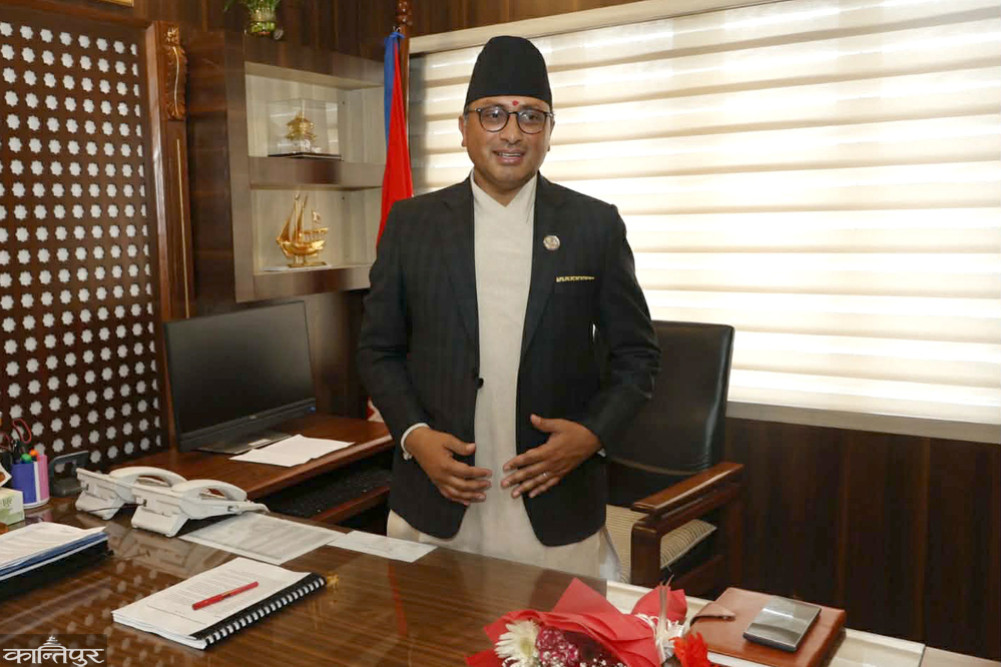
He faces the challenge of bringing the economy back on track by increasing revenue collection and capital expenditure and controlling current expenditure, while facing rampant policy corruption, financial mismanagement, revenue leakage, and procrastination.
We use Google Cloud Translation Services. Google requires we provide the following disclaimer relating to use of this service:
This service may contain translations powered by Google. Google disclaims all warranties related to the translations, expressed or implied, including any warranties of accuracy, reliability, and any implied warranties of merchantability, fitness for a particular purpose, and noninfringement.
Although some indicators such as foreign exchange reserves and balance of payments are strong, nationally and internationally renowned economist Swarnim Wagle has taken the reins of the economy at a time when revenue collection, capital expenditure, and foreign grants are in a precarious state.
At a time when policy corruption, financial mismanagement, revenue leakage, and procrastination are rampant, he faces the challenge of bringing the economy back on track by increasing revenue collection and capital expenditure and controlling current expenditure. Despite the continuous decline in interest rates, credit flow has not increased, and money available for lending has piled up in banks. The private sector's morale towards the government has declined, saying that it has not created a conducive environment for investment expansion. At such a time, the Ministry of Finance is responsible for increasing the confidence of the private sector by maintaining fiscal discipline and increasing government expenditure.
Wagle entered parliament for the first time through a by-election. This time too, Wagle defeated Congress candidate Govinda Bhattarai by a margin of 21,809 votes in the House of Representatives elections held on 21 Falgun.
Born on 16 Jestha 2031 in Sahid Lakhan Rural Municipality-8, Gorkha, Wagle completed his higher secondary education from Budhanilkantha School. He stood second in the SLC examination of 2046. Wagle has a Master's degree in Development Economics from the Australian National University, Australia. He also holds a Master's degree in International Development/Public Policy from Harvard University, USA, and a Bachelor's degree in Economics from the London School of Economics, UK. Wagle is known as one of the most highly educated economists and politicians in Nepal.
Wagle is an international development economist. Active in Nepal and abroad for 25 years, he was the Chief Economic Advisor for the Asia-Pacific Region at the United Nations Development Programme (UNDP) headquarters in New York from 2077 to 2079. Before that, he served as a member of the National Planning Commission for three years and also served as its Vice Chairman.
The new government faces the challenge of improving transparency in spending, controlling irregularities, and improving public finance management. Before returning to Nepal, Wagle, who was a senior economist at the World Bank and UNDP, is also a Senate member of Kathmandu University and the Chairman of the Center for Integrated Development Studies (IIDS).
His family has been involved in Nepal's democratic movement since 2027. Wagle, who has been politically initiated since the Satyagraha of 2042 and participated in the Jana Andolan of 2046, is a former Mahasamiti member of the Nepali Congress. He played a leading role in drafting the manifesto for the 2079 and 2074 general elections, as well as in economic policies and plans, programs, and ideological discussions. Wagle, who is currently the Vice President of the Rashtriya Swayamsevak Sangh (RSS), faces the challenge of reforming the economy at the top.
Although some indicators seem positive at the moment, the economy is weak. The economic growth rate is slow and the common people are disappointed. After the change in 2046, the country has faced difficult situations several times. Political transition and uncertainty persisted for a long time. This has added one problem after another to the economy. This has worsened the investment environment in the country, and the youth and entrepreneurs have a feeling that it is better to go abroad than to face problems in Nepal step by step. The perception that there are obstacles at every stage, from thinking about opening a new industry or business to registering, operating and closing a business, is seen everywhere among entrepreneurs.
Illegal transactions have increased in the border areas. There is excessive liquidity in the market, but liquidity in the hands of individuals is tight. The tendency to leave cultivable land fallow has increased and the number of commercial farmers is low.
Similarly, trust in public institutions has weakened. Trust in public institutions in general has weakened. Foreign investors' confidence in the country's system and institutional capacity is weakening. At such a time, the role of Finance Minister Wagle will be important to keep the economy moving. Former Finance Minister Prakash Sharan Mahat said that the new Finance Minister should work hard to reduce the gap between income and expenditure. 'The new government has said that it will create a lot of jobs. That is good. However, the challenge of fulfilling it is not normal. The international situation is also unusual. Therefore, the government needs to be practical,' he said, 'Talking about popularity will not bring results. To bring good results, it is necessary to find the root of the problem and work hard.'
Prakash Sharan Mahat , Former Finance Minister On the one hand, resources are scarce and the needs of citizens are high. The responsibility of social security is great. The expenditure of the security agencies cannot be reduced. In such a situation, a lot of work will have to be done in terms of securing the necessary resources and efficiently managing the available resources to meet the necessary expenses, and in creating large infrastructure and employment. Therefore, the gap between income and expenditure will have to be reduced and the many needs of the citizens will have to be met by managing as many resources as possible. Mahat said that this government does not have the freedom to make excuses because it is a government with a large majority. Wagle also has the responsibility of fulfilling the ambitious objectives raised by the Rashtriya Swayamsevak Sangh (RSS) in its manifesto. The RSS has set a target of achieving an average economic growth of 7 percent (at constant prices) in five years. The target is to increase the per capita income to more than 3,000 US dollars in five years and the size of the economy to close to 100 trillion. The manifesto mentions reducing all tax burdens, not imposing ghost taxes, and setting income tax limits based on family burden, while ensuring that state revenue does not decrease. The new Finance Minister should work hard to reduce the gap between income and expenditure —
The NCP plans to review the exchange rate of the Nepalese currency against the Indian rupee, which has been stable for three decades, implement a 'one-step' service to encourage investment, and complete national pride projects that have been dormant for 12 years within 2 years. It also plans to replace the uncontrolled and weak regulation of cooperatives and microfinance and bring the entire non-financial sector under the regulation of the Nepal Rastra Bank. It also plans to regulate cooperatives and microfinance with transactions exceeding Rs 500 million and form a second-tier regulatory body with high authority to regulate small institutions. It also mentions that the regulatory body Securities Board will be restructured to make the capital market systematic and given the necessary autonomy, and that NEPSE and CDSC will be restructured.
The NCP has promised to release from prison, with conditions, directors and managers who were jailed for defrauding cooperatives and are in custody pending trial. The pledge promises to replace the uncontrolled and weak regulation of the cooperatives and microfinance sector and bring the entire non-banking financial sector under the direct and powerful supervision system of the Nepal Rastra Bank. The Finance Minister also has the challenge of fulfilling these .
‘Our aim is not just to jail the directors, but to get the depositors’ money back. Therefore, in accordance with the policy of resolving the matter by listening to them, not by imprisoning them, if the directors or management of a cooperative financial institution are ready to return the depositors’ money and have reliable resources and plans with them, we will pave the way for a settlement,’ the pledge states.
The Rashtriya Swayamsevak Sangh (RSS) has promised to return the money of small depositors within 100 days of the formation of the government under its leadership. The pledge does not mention who will return the money and how much is considered a small depositor. The Finance Minister also has the challenge of raising money in this way .
Trust in public institutions has weakened in Nepal. Trust in public institutions in general has weakened . Foreign investors’ trust in the country’s system and institutional capacity is weakening .
Youth attraction to information technology-based service business has increased . The youth workforce is increasing in the production of information technology-based services and goods and expanding competitive business access to the international market. Budget management has become difficult due to the fact that multi-year projects are being agreed upon haphazardly and the system for accounting for liabilities has not matured. To correct this, it will be necessary to effectively enter projects that have reached a feasible stage into the project bank and include only those included in the project bank in the medium-term expenditure structure.
For this, the government will have to make a new arrangement whereby projects included in the medium-term expenditure structure are automatically considered to have guaranteed multi-year resources and if the completion period of a project is less than three years, the investment required for such projects throughout the project period will be mentioned in the medium-term expenditure structure.
The government is to make policies and rules, effectively regulate and play the role of a facilitator. The work of investing and doing business should be left to the private sector —
Kewal Bhandari,
Former Secretary Former Secretary to the Government of Nepal Keval Bhandari said that the role of the new Finance Minister will be important in creating more resources and responsibilities for the provinces and local levels to effectively implement fiscal federalism. ‘There is no problem in implementing our policy, legal and work systems now.’ Therefore, the government’s vision should be clear now,’ he said, ‘The government should make policies and rules, regulate effectively and be in the role of a facilitator.’ He also said that there is a problem because many people in our country react without understanding what the government, private sector and NGOs should do. ‘Creating a large number of jobs and building large infrastructure are the main problems of the day.’ The new Finance Minister will have to work a lot on that,’ he said, ‘Right now, they are saying that the economy is fine just by looking at foreign exchange reserves, balance of payments savings and increasing remittances.’ This is a superficial analysis,' he said, 'A lot of work needs to be done to improve the overall economy. The Finance Minister should pay attention to it.' 20 percent of the population is still in extreme poverty. In Nepal, the concerned individuals have a greater contribution than the government in poverty alleviation. Therefore, an environment should be created for them to work comfortably, he said. 'Many children are still out of school. Resources are needed to take them to school. It is necessary to provide skills to the manpower entering the labor market. Skills are also expensive in Nepal,' he said, 'Health insurance should be made systematic and effective. We should be able to reduce unnecessary expenses and bring programs that reach the target group.
The new government should increase the efficiency of budget allocation and there is a risk of lack of resources to complete the project on time. Public property, commercial and private property damaged during the Gen-G movement, and the reconstruction and rehabilitation action plan approved by the Council of Ministers should be carried out by the new government.
Revenue collection and resource management are the main challenges of the new government. The country's revenue collection has been sluggish for the last few years. The revenue growth rate collected in most months of this year is less than 10 percent. In this way, resource management is seen as a major challenge for the government due to the failure to collect revenue as per the target. Due to the economic slowdown, tax collection has not been able to be as per the target. The tax scope is narrow and controlling tax evasion/illegal transactions is still challenging.
Public debt control and management is another challenge. Both the country's internal and external debt are increasing. The government is under pressure to reduce the size of capital expenditure to pay off debt obligations. There are serious questions about the proper utilization of debt. Increasing the repayment capacity of debt and mobilizing debt in productive sectors is a major challenge.
In the last three decades, the country has been spending only 60 percent of its annual allocation on capital on average. This trend has been repeated this year as well. With only four months left in the current fiscal year, barely 20 percent has been spent. Our spending system and related policies and regulations will also have to be revised to increase capital spending. Despite budget allocations every year, development spending is not being spent on time and effectively, affecting the country's economic growth and infrastructure development.
Nepal's economic growth is slow. The overall economic activity has slowed down due to reduced private sector investment, weak manufacturing sector, and high dependence on imports. Economic activity will have to be increased to increase economic growth. Foreign aid and investment management is another challenge for this government. Foreign aid and grants have been decreasing in recent years. Foreign direct investment is also low. It seems that a lot of effort will have to be made to increase it.
Another challenge is financial discipline and transparency. The new government faces the challenge of improving transparency in spending, controlling irregularities, and public finance management.
The new government is under pressure to control inflation and reduce the cost of living. Especially due to the ongoing conflict in West Asia, inflation is increasing in countries including India. Its direct impact has also started to be felt in Nepal. As soon as the new government takes office, it seems that it will have to do enough to control inflation and ensure smooth supply of goods and services.
The import-export imbalance is a major challenge for the country. The trade deficit is large due to high imports and weak exports, which is sure to put pressure on foreign exchange reserves.
Policy stability and confidence: Frequent policy changes weaken the confidence of the private sector. A stable, clear and long-term policy is necessary. Experts suggest that the new Finance Minister should prioritize revenue reform, expenditure efficiency, private sector-friendly policies and institutional reforms to address these challenges.