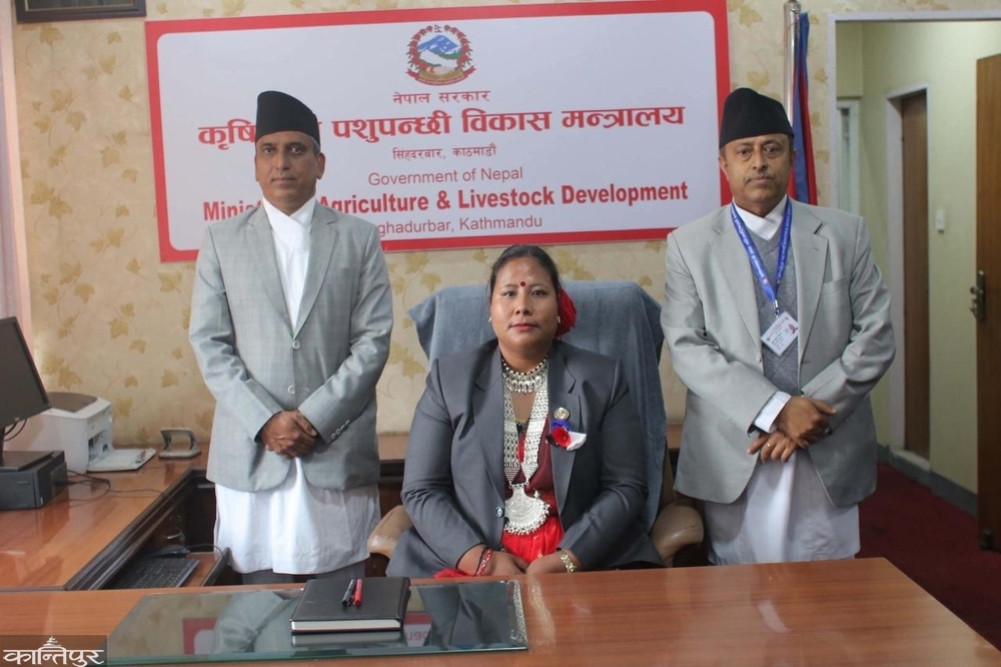
Geeta Chaudhary, who joined the Rashtriya Swayamsevak Sangh (RSS) just before the 21st Falgun elections, is a lawyer by profession. Now, her role has shifted from street advocacy to the policy-making level at Singha Durbar.
We use Google Cloud Translation Services. Google requires we provide the following disclaimer relating to use of this service:
This service may contain translations powered by Google. Google disclaims all warranties related to the translations, expressed or implied, including any warranties of accuracy, reliability, and any implied warranties of merchantability, fitness for a particular purpose, and noninfringement.
In the new government led by Balendra Shah, proportional representation MP from the National Independent Party (NISP) Geeta Chaudhary has taken over the responsibility of the Ministry of Agriculture, Livestock Development and Forest and Environment.
The 33-year-old Chaudhary from Kanchanpur, who has been advocating for human rights and social justice, now has the important responsibility of breaking through policy confusion and developing two big sectors.
Chaudhary, who joined the NISP just before the last 21 Falgun elections, is an advocate by profession. She is also the founder of 'Youth Advocacy Nepal' and has been active in the field of marginalized communities and human rights for a long time. Now, her role has reached the policy-making level of Singha Durbar from street advocacy.
The new government has merged the Ministry of Agriculture and Livestock Development and the Ministry of Forest and Environment. Although in the past there was a saying that 'agriculture spoils forests', experts now suggest that these two sectors should be brought together. Dipendra Gauchan, a scientist at the Nepal Agricultural Research Council, says that linking forests and agriculture is a positive step. 'Farmers in rural areas do not only do agriculture, they are also members of forest user groups,' says Gauchan, 'since both forests and agriculture are connected to land and water, this helps in integrated development.'
Similarly, Parbata Gautam, general secretary of the Federation of Community Forest Users (FECOFON), said that the abolition of the multi-tiered tax imposed on community forests should be a priority for the new government. Minister Chaudhary also faces the challenge of bringing the Chure region under the Forest Act, not declaring more parks, and protecting farmers' crops and people's wealth through scientific management of wildlife.
Geeta Chaudhary of Kanchanpur comes from an ordinary farming family. Her grandfather was a Kamaiya, but even in that difficult situation, the family's awareness of education made it easy for Geeta to move forward. Even when some girls in her community were going to live as Kamlari or dropping out of school, she continued her education.
Active in social work through children's clubs and youth clubs since childhood, she openly opposed child marriage and wrong practices in the village. Geeta, who was teased by society as a 'leader', decided to study law on the advice and inspiration of a teacher.
After completing her master's degree in law, she started practicing law in Kathmandu and is also the founder of 'Youth Advocacy Nepal'. 33-year-old Chaudhary, who has been advocating for human rights and marginalized communities for a long time, has now reached the position of minister through parliament in a short time.
Geeta, who has been advocating for rights on the streets, faces the challenges of policy formulation and implementation in Singha Durbar. His first task will be to organize the structural adjustment of the Ministry of Agriculture and Forestry and move both sectors forward in an integrated manner.
The current government has set an ambitious goal of making Nepal's economy $100 billion within the next five years. A revolution in agriculture and the development of forest-based industries are essential conditions for achieving this goal. Minister Chaudhary's main task will be to come up with a policy to increase production by coordinating irrigation.
Even though 46 percent of Nepal's land is covered by forests, billions of rupees of timber are being imported from abroad every year. It is challenging to become self-reliant in timber by ending the ironic situation of wood rotting in the forest but having to be imported from abroad. In addition, the demand of the Federation of Community Forest Users (FECOFON) to abolish the multi-tiered tax on community forests and bring the Chure region under the Forest Act must be addressed.
Policy-level solutions to the problems he saw firsthand in his own environment, such as the rehabilitation of those displaced by the then Shuklaphanta reserve expansion, sustainable management of floods and inundation, and distribution of red papers to freed Kamaiyas, will have to be found.
Ensuring food security for marginalized farmers by minimizing the impact of climate change on agricultural production (drought, flood) is another responsibility. In addition, it is necessary to reduce human-wildlife conflict through scientific management of the number of wild animals that has increased with the increase in forest area and the damage it is causing to human wealth.
Minister Chaudhary has committed to addressing the issues of education, health, and social justice of disadvantaged communities in a policy-level manner during her tenure. How this integrated ministry addresses the problems of marginalized communities and common farmers will be determined by her future steps.