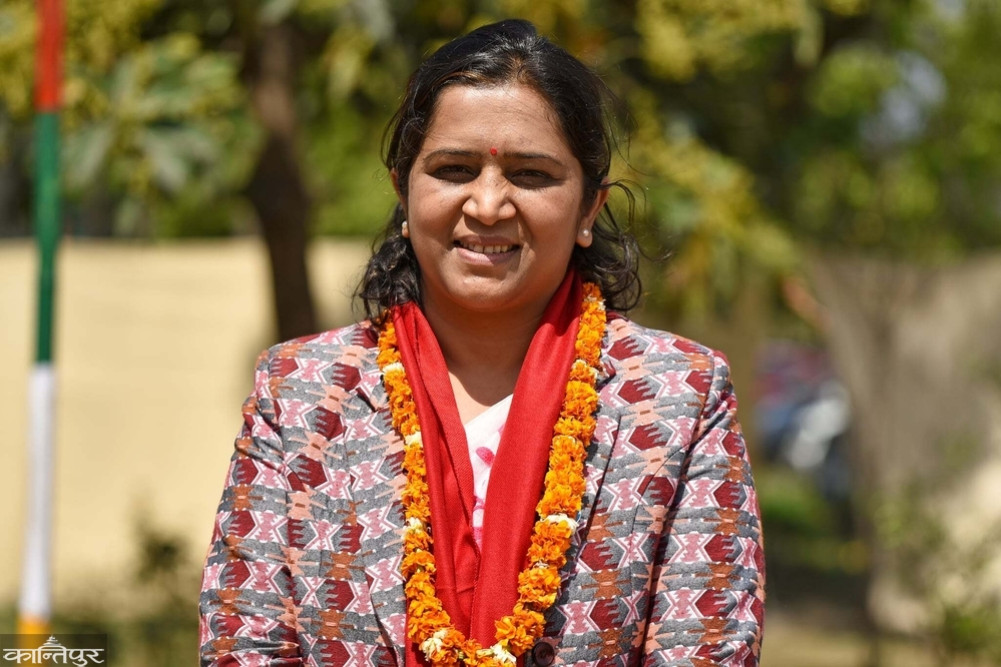
As the general election 2082 approached, the decision to merge with the Bibeksheel Sajha Party and the National Independent Party was made, and the journey of the review to parliament was set. She was elected through proportional representation and became an MP.
We use Google Cloud Translation Services. Google requires we provide the following disclaimer relating to use of this service:
This service may contain translations powered by Google. Google disclaims all warranties related to the translations, expressed or implied, including any warranties of accuracy, reliability, and any implied warranties of merchantability, fitness for a particular purpose, and noninfringement.
The Bibeksheel Nepali Party was established in 2071 as an alternative to the old political parties. Social work such as sanitation campaigns, street messages, disaster management, health camps, and public awareness campaigns against violence against women became the identity of Bibeksheel. The Bibeksheel campaign became popular through the campaign ‘Nepal is open’. Many youth started joining this campaign.
The ‘Bibeksheel Sajha Party’, which emerged as an alternative party and was chaired by Rabindra Mishra, participated in the 2074 local elections by merging with the Sajha Party, which was headed by Rabindra Mishra. But the short-lived unity of Sajha and Bibeksheel did not last long and different factions began to emerge within the party. After Rabindra Mishra left for the RPP, Samiksha Baskota took over the leadership of the party. She took over the leadership during the internal crisis of the party.
It was not easy for her to bring together the workers divided into different factions. The National Convention was held under her leadership and she was re-elected as the Chairperson from the Convention. She became the first woman to be elected as the Chairperson from the Convention of a political party in Nepal.
She openly supported Ranju Darshana when he was a candidate for the mayor of Kathmandu Metropolitan City in 2074 BS. Her presence began to be seen in various social activities since the post-earthquake reconstruction campaign. She emerged as a political figure from a social activist and legal profession.
Her political awareness was also influenced by her family background. Her father Deepak Prasad Baskota had been the Minister of State for Home. She says that Rabindra Mishra took a special initiative in her entry into politics. She said, ‘He followed me continuously for 16 days to bring me into the party. He was an expert in following. It was because of him that my path turned towards politics.’ She had planned to enter active politics only after 40 years, but circumstances and opportunities soon brought her into the political arena.
She came into the limelight when she ran for the post of mayor of Kathmandu Metropolitan City in 2079 BS. Stating that she had stood up with the aim of establishing an agenda rather than winning the election, she said, ‘You cannot say that you will not fight the election just because you will lose, politics is a fight for an agenda.’ At that time, she was also accused of ‘standing up to steal votes’, but she explained her decision by linking it to principles.
Her family background is multifaceted. Her father is affiliated with the Congress, her mother-in-law was from a Maoist background and was active in expanding the CPN-Maoist organization. Her husband is a doctor, who has constantly supported her in moving forward in politics. She said that family support and personal determination made it easy for her.
She is the fifth of eight children in the Baskota family of Panchthar. She grew up and studied in Kathmandu since childhood. She passed her SLC from Little Angels School. Her interest in social issues and justice had already begun to focus on her school life. This interest led her to law.
She graduated in law from Kathmandu School of Law. She went to the US to study law and gain international experience. She completed her Master of Laws (LLM) in the US. Despite studying in the US, she had come to Nepal with the intention of returning. She says, ‘No matter how much time I spent abroad, I felt like a second-class citizen. That also made me never want to enjoy myself abroad.’ This inspired her to return to Nepal in 2010. Within three days of returning to Nepal, she started working in a bank. She joined Civil Bank as a legal officer. At that time, it was the initial stage of establishing the bank, where she had a major responsibility of creating the legal structure. She herself took the initiative to prepare most of the bank’s legal documents.
But after eight months, she resigned, feeling that her potential was not being fully utilized while working in the banking sector. She said, ‘I got a job as soon as I returned to Nepal, it was also a job according to my studies, but I resigned because I was not satisfied.’ Then she established her own firm.
As her professional life progressed, her personal life also changed. She got married, had a child. After her responsibilities as a mother increased, she took a break from her career for a while. Giving time to her child became her priority. For two years, she gave all her time to her child. She was thinking of doing new work while raising her child. She became active in the family business by taking the family tea garden in Panchthar forward in a new way. She tried to establish it in the market by branding it through Baskota Group. She said, ‘I took the family business forward because I had to work along with my child.’
She was active in various social campaigns since college. Collaborating with NGOs and INGOs, she provided consultations in schools on legal literacy, child rights, and other issues. For this reason, in 2017, she joined the campaign of the Vibeksheel Nepali Party. She became active in socio-political campaigns, including the anti-corruption movement started by the party and the movement of Dr. Govinda KC.
As the general election 2082 approached, her party decided to merge with the National Independent Party and the journey to parliament was set. She was elected through proportional representation and became an MP. Regarding the party unification, she said, 'Unification was possible because the agenda was the same with the Rashtriya Swatantra Party. We were in different groups, but the agenda was the same. When alternative forces stood together, they succeeded in forming a national party and reaching power from parliament.'
She is confident that her legal background will be useful in parliament. She plans to place special emphasis on lawmaking, amendment, and implementation. She said, "Old laws should be changed according to the times, systemic reforms are necessary for good governance."