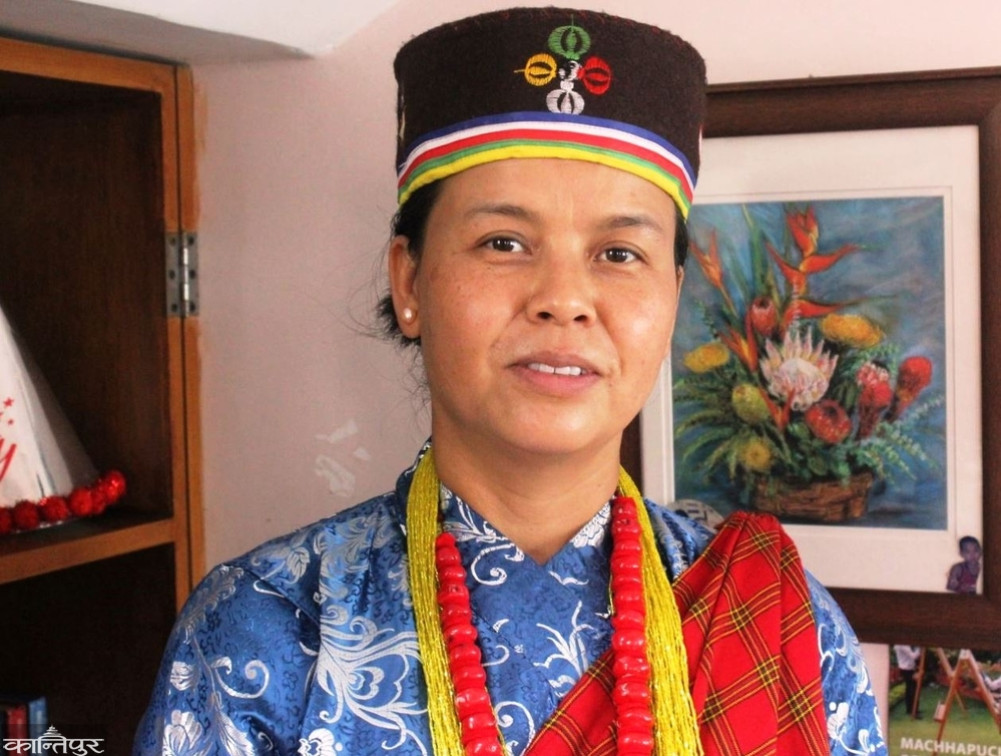
Dr. Sujata Tamang, who has worked for a long time in the field of community empowerment and sustainable agriculture, says she will now be involved in policymaking and advocacy in Parliament.
We use Google Cloud Translation Services. Google requires we provide the following disclaimer relating to use of this service:
This service may contain translations powered by Google. Google disclaims all warranties related to the translations, expressed or implied, including any warranties of accuracy, reliability, and any implied warranties of merchantability, fitness for a particular purpose, and noninfringement.
Dr. Sujata Tamang had never set her sights on the federal parliament. She felt, ‘This door is only for those with political background.’
‘From the practices we had seen, MPs came from political backgrounds,’ she said when met at her private residence in Bhainsepati-18, Lalitpur, ‘I have never been involved in party politics.’
Sujata, who has been focusing her career on policy studies and research for the sustainability of agriculture and natural resources and community empowerment, was placed on the proportional list of indigenous tribes by the National Independent Party as an agricultural research expert.
That list opened the door to parliament for her. ‘Even if I did not do party politics, I felt that politics was important when doing policy research and practice.’ However, in the current situation, I had no intention of entering politics. I had no plan to enter parliament right now,' she said. 'Based on my experience in politics and policy-related work, I accepted the proposal to represent tribal women and make thematic contributions in the environment created by the New Youth Movement.'
She was born and raised in a farming family in Tumlingar, Sankhuwasabha. She later married in Chitlang, Makwanpur. Her husband has been doing research and teaching at the University of Hong Kong. She is the sixth of seven children. Her family was completely dependent on agriculture. There was no shortage of food. However, there was a lack of cash to meet other needs. It was not easy for her father, Balram Baidya, and mother, Dambar Kumari, to educate all their children in public schools alone. ‘Since there were many people, a ‘support system’ was formed within the family. The elder brother would help the younger brothers study. There, it became a situation where the younger brother would help the younger brother study,’ she said. ‘My younger brother and sister-in-law taught me.’
She studied in Tumlingtar till the seventh grade. After that, wherever her younger brother and sister-in-law went for work, she also studied there. With her brother and sister-in-law, she reached Kathmandu via Dharan, Hetauda, and Chitwan. Her career began at the front desk at Forest Action Nepal. ‘After coming to Kathmandu to pursue a master’s degree in rural development at Tribhuvan University, she started gaining work experience at the front desk.’ She said that she then worked as a program officer, research donor, and executive coordinator.
For the past 17 years, she has been involved in participatory research and advocacy on issues involving smallholder, women, marginalized and local indigenous communities for the sustainability of Nepal's agriculture. During this time, she completed her master's and PhD from the University of New South Wales, Australia. After completing her master's and PhD, she returned to Australia. This inquiry has provided an in-depth analysis of the vicious cycle seen in food security.
She said that in the next parliament, she will focus the experience and knowledge gathered through policy research and advocacy on developing a sustainable farming system in Nepal. ‘I will focus on making and reviewing policies that establish the rights of small farmers, women farmers, and marginalized groups with natural resources,’ she said. ‘Earlier, I was in a place where I saw policy gaps. Now, I have come to a place where I can fill them.’