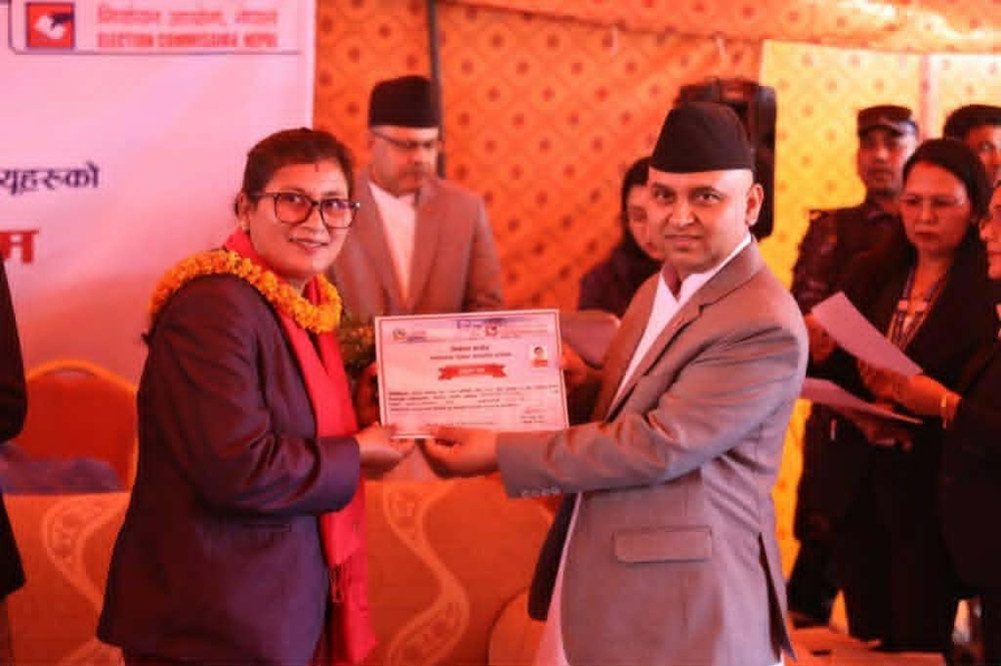
Those who previously criticized Gangadevi for her daughter's entry into politics have now started appreciating her work. Many now even tell her, 'If women don't enter politics, nothing will happen!'
We use Google Cloud Translation Services. Google requires we provide the following disclaimer relating to use of this service:
This service may contain translations powered by Google. Google disclaims all warranties related to the translations, expressed or implied, including any warranties of accuracy, reliability, and any implied warranties of merchantability, fitness for a particular purpose, and noninfringement.
Gangadevi Shrestha of Dhading Neelkanth-7 was young. One day, she got a chance to go to a function organized by the CPN-UML. Since childhood, she had been curious about what a political program was like. After many of her school friends asked her to go to the function, Gangadevi also went with permission from her home.
But she had to face a surprising question. When a man came to the place where Gangadevi and her friend were staying, he repeatedly asked, ‘Women don’t do politics. Why did you come?’ The man did not stop there, and added the question, ‘I will marry and take care of the house. After joining politics, society thinks badly of me. I will not go to any function from tomorrow.’
That question shook Gangadevi’s mind. After reaching the function with a clear mind, she returned home with more questions. ‘Why don’t girls have the right to participate in politics?’ ‘Why does society say it’s bad when women enter politics?’ She started looking for an answer. She says, ‘What a Panch leader said in the program felt like a thorn in my heart.’ Right then and there, I decided to learn everything about politics.’
There was a teacher in the school she attended who used to talk about equality, freedom, and women’s rights and interests in class. She was happy with what the teacher taught. But she had never seen equality in society. She felt that the gap between women and men should be bridged. Caste discrimination in society should be eliminated, and youth should enter politics to protect the country. ‘After seeing the social discrimination and gender inequality prevalent in society, I got inspired to enter politics and I entered politics,’ she says.
Gangadevi, who started her political journey while studying in school, has been active in UML for more than 3 decades. Now, she has been elected as a member of the House of Representatives from the Indigenous Women's Cluster. Gangadevi feels that she has added responsibility after becoming an MP.
She says, 'The election was held in such a difficult situation. So, more than being happy, I have to do more work for the country.' As an MP, she has now set a goal to raise her voice in the House, especially on the implementation of women's rights laws and issues of public concern. She is committed to supporting the good work of the government and playing the role of a strong opposition if it works against the public interest.
Gangadevi's political struggle
The family's financial condition was weak. That is why she remained responsible for the family from a young age. She could only study up to SLC, listening to the society's question about what a daughter should do after studying. ‘There were 7 brothers and sisters in our family. There was no college in the district. The financial situation was poor to come to Kathmandu to study. My father was ill, so I could not study,’ she says. She joined the Jana Andolan in 2046. At that time, it was not only difficult for women to study, but also to engage in politics. ‘It was very difficult to go to party meetings, functions, and programs. They would say that so-and-so’s daughter was spoiled,’ she says, ‘they would come and tell their family and friends. But after I walked the path of truth, I moved forward thinking that whatever others said would not matter.’
But Gangadevi was not swayed by such small things. In 2047, she became the treasurer of the initial committee of the ANRFSU. She then worked as a ward committee member in 2049, a village development committee member in 2050, and a district committee member of the All Nepal Women's Association (ANEMS) in 2051.
She also served as the district secretary, treasurer, and district president of the All Nepal Women's Association for two terms. She has been a district committee member and a provincial committee member (two terms) of the party and is currently a member of the central committee and standing committee of the All Nepal Women's Association.
Gangadevi contested for the post of deputy mayor of Nilkantha Municipality in 2074. Similarly, she also got a ticket for the mayoral post in 2079. But she was defeated in both. Gangadevi, who believes in the work she has done for the selfless society rather than political defeat and victory, has reached the position of raising her voice for the country in the House today due to her struggle and patience.
She also took care of raising and educating her siblings. She paid close attention to the care of her ailing father for 10 years. To meet the household expenses, she also ran a dairy business in Dhading for some time. She is the first person in her family to enter politics. Earlier, those who used to say that their daughter should also enter politics have now started appreciating Gangadevi's work. Now, many people tell her, 'If women don't enter politics, nothing will happen!'
Gangadevi says that she has always worked for the rights and interests of the country and will be dedicated to it in the coming days as well. She considers Madan Bhandari as her role model, saying, 'I will always fight for the rights and interests of every citizen. I will never back down from speaking for the truth.'