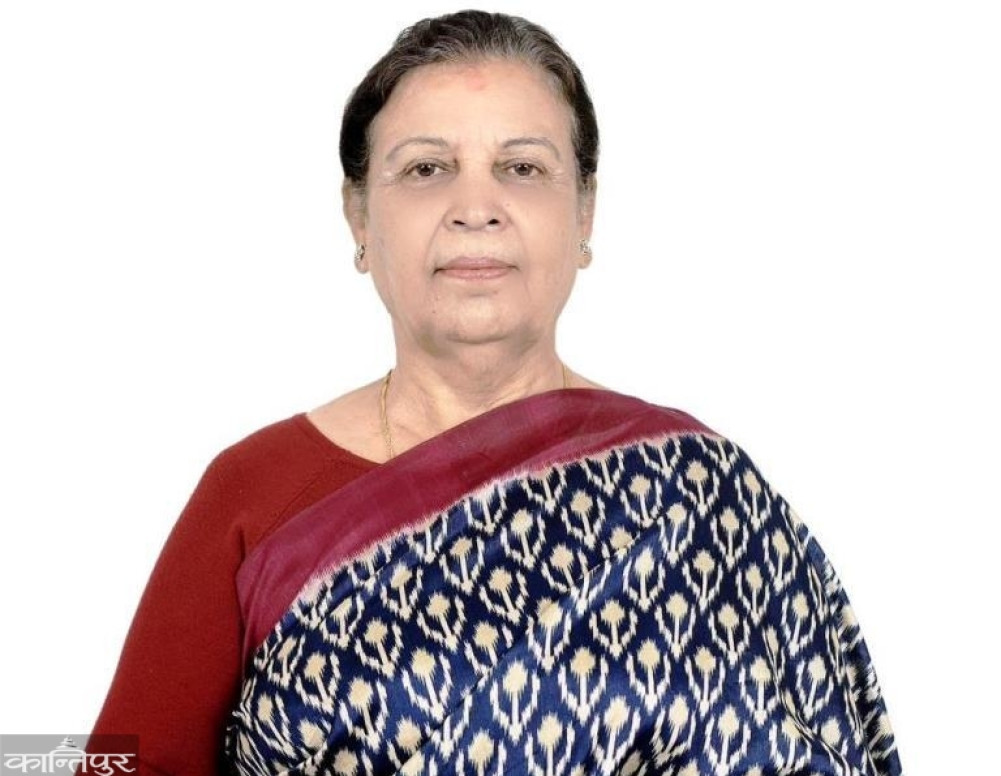
Rukmini Devi Koirala, through a half-century-long struggle and faith in democracy, has succeeded in becoming a member of the House of Representatives at the age of 70.
We use Google Cloud Translation Services. Google requires we provide the following disclaimer relating to use of this service:
This service may contain translations powered by Google. Google disclaims all warranties related to the translations, expressed or implied, including any warranties of accuracy, reliability, and any implied warranties of merchantability, fitness for a particular purpose, and noninfringement.
Despite being active in Nepali Congress politics for decades, Biratnagar's Congress leader Rukmini Devi Koirala is a character who has been overlooked for a long time.
This election has become a moment of justice for her, who has become a living example of patience, loyalty and continuous struggle. Breaking the fate of being included in the closed list of proportional representation in every election but being cut out in the final selection, the Congress has finally selected her as an MP from the Khas/Arya cluster this time. 'This achievement of mine was not achieved 'overnight'. Rather, it is the result of half a century of political penance,' she says.
Rukmini's entry into politics was not due to the desire for any position or gain. She had stood in favor of democracy since the referendum of 2036 BS. At that time, she had not formally joined the party, but she was constantly active in the movements for the restoration of the multi-party system. 'I had not yet become a member of the party, but I would provide material and moral support to every movement for democracy,' she recalls.
Ever since she started participating in anti-Panchayat activities, she had become the 'target of the then government'. Her house was repeatedly surrounded. By the time the Jana Andolan of 2046 BS arrived, she had established herself as a full-time political activist.
In that historic fight against the Panchayat system, she not only took to the streets, but also faced brutal police repression and arrests. She was active in anti-Panchayat activities, sometimes openly and sometimes underground, which made her popular among grassroots activists.
After the multi-party system came into being, she joined the Nepal Mahila Sangh. Her organizational skills were further enhanced from here. She skillfully fulfilled her responsibilities from Morang District Secretary to District President of the Mahila Sangh.
Those who knew her closely say that she fought a great struggle in the mofusal, especially for women's rights, entitlements, and empowerment. While working as the central vice-president of the Mahila Sangh, she got the opportunity to organize women activists across the country. She worked to instill political awareness in a society where women were viewed as second-class citizens.
The real test of Rukmini's political integrity came during the direct rule of the then King Gyanendra Shah. When Gyanendra took power, she stood like a rock in favor of democracy. During that time, she was harshly detained for two months.
She was also at the forefront of the second people's movement of 2062/063 BS. During the movement, she was arrested and imprisoned several times. She was constantly targeted by the then government, but she never compromised. Her unwavering faith in democracy has brought her to this place today.
Rukmini was born in Syangja in 2012 BS. However, a large part of her early life and education was spent in Meghalaya, India. She reached Meghalaya at a young age due to her father's job and completed her graduation from Shillong. This educational background of hers has helped her present herself in politics logically and intellectually.
Even though she studied in a foreign land, her heart was always in Nepal and here. 'Immediately after completing my studies, I returned to Nepal with the determination to do something in my homeland,' she says proudly.
She married Nandan Koirala (Shailesh) of Biratnagar in 2029 BS. However, she does not have much connection with the Koirala family, which is considered the center of Nepal's democratic movement. 'We are just Koirala-Koirala', she says, 'we are not close relatives.'
After spending a long time in the politics of the Women's Association, she formally joined the 'Mother Party' (Nepali Congress) from the 14th General Convention of the Nepali Congress. After the same General Convention, she was nominated as a central member.
In many previous elections, her name was kept on the closed list of proportional representation, but due to the balance of power and access of the party, she always fell on the 'second priority'. This time, the party has properly evaluated her contribution and scheduled her journey to parliament.
Having spent her energetic life for democracy, she considers herself a 'whole timer' worker of the Congress. Even at the age of 70, she is still active in party work with youthful vigor.
Her contribution to the social and political sector of Biratnagar is unforgettable.
She has also extended her hand in social service by being associated with various social organizations. 'I never did politics for office, finally the party saw my struggle', says Rukmini, 'Now I will spend the rest of my life raising the voice of the people through Parliament and taking women's rights issues to a logical conclusion.'