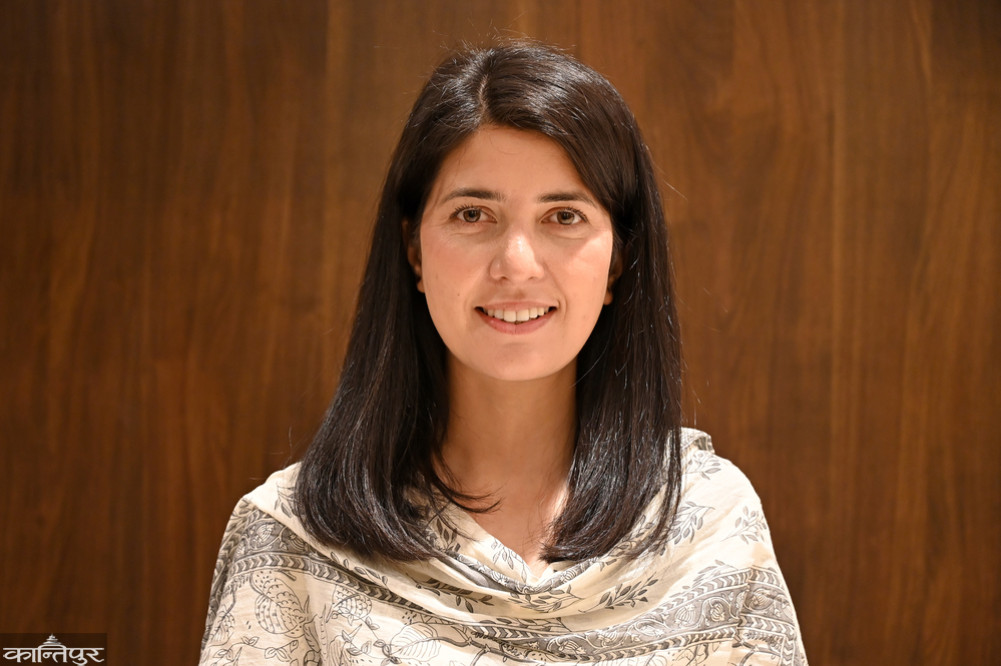
Krantishikha Dhital, who entered politics through journalism and counseling, has become a member of parliament from the proportional representation party.
We use Google Cloud Translation Services. Google requires we provide the following disclaimer relating to use of this service:
This service may contain translations powered by Google. Google disclaims all warranties related to the translations, expressed or implied, including any warranties of accuracy, reliability, and any implied warranties of merchantability, fitness for a particular purpose, and noninfringement.
Krantishikha Dhital grew up in Rolpa, the birthplace of the Maoist 'People's War'. Having spent her childhood amidst the smoke of war, the sound of guns, and fear, she has reached the highest policy-making place in the country.
She entered the parliament representing Khasarya women from Lumbini Province in the recently concluded elections. There are many identities behind her MP identity. She is a counselor by profession and a former journalist is also her identity.
There is still a lot of work to be done in the field of mental health. This will be the main agenda in parliament. The Rashtriya Swayamsevak Sangh (RSS) party is representing the parliament with about two-thirds of the votes in a short period of time since its emergence. Krantishi, a central member of the party, has also reached the parliament with a short political journey. In this election, her claim was to connect directly with the people, go among the voters to express her views, and compete. Despite her wishes, the party's decisions and equations put her in the direction of the proportional system. She said, "I had planned to contest directly, but the party felt that some of my friends should remain in the proportional representation system, and I remained in the proportional representation system on the instructions of Chairman Ravi Lamichhane."
Although the decision to contest in the proportional representation system seems to have put a stop to her aspirations to contest the elections directly, she considers it a long-term strategy. She said that since it is not possible to contest the elections directly, she will mobilize according to the needs of the party.
She has been active in the National Independent Party since its inception. She played an important role in the work of drafting the party's statute and preparing the election manifesto. She said that she is also active in party training, “I have worked hard in the preparation of the party constitution for 2079. I have played an active role in preparing the constitution, training and election manifesto in terms of how to build the party and how to move forward.”
When she was in the RSVP government, she was an advisor to the Ministry of Labor, Employment and Social Security. She worked on various aspects of policy formulation and implementation. As a central member, she is also active in organization development, training and policy debate.
She openly expresses her dissatisfaction within the party. She said, “Not all the work done by the party may be good. I have always questioned the negative aspects. I will continue to do so.”
She had political awareness since childhood. Stating that every person in Rolpa is involved in politics, she said, “Politics is in the DNA of the people of Rolpa. Since it is the birthplace of war, the political environment is in Rolpa.” ’
Her family is close to UML. Her maternal grandfather was a Pradhan Panch. During the conflict, underground leaders used to stay at their house. UML leader Shankar Pokharel stayed at their house while underground. Her family also had close ties with Maoist leader Krishna Bahadur Mahara. Her grandfather educated Mahara, and later Mahara educated his mother. Her mother was an active UML worker. Her mother was active in politics from the district, state to the center. Her mother, a government teacher, has retired.
After passing her SLC from Shanti Niketan School in Ghorahi, Dang, she came to Kathmandu for higher education. She completed her Plus Two from Golden Gate College and graduated in psychology from there. Her attraction to psychology was not limited to studies only, it was also linked to social responsibility. She was inspired to work as a counselor after seeing that mental health was not given as much priority as physical health. She is still active in the counseling field.

She said that there is a lot of work to be done in the field of mental health. 'This will be the main agenda in the parliament. Mental health centers are needed from the central level to the ward and municipality levels,' she said. 'There should be a hotline that can be called immediately when negative thoughts come.'
Before entering politics, Krantishikha was active in the field of journalism. After undergoing 10 months of training at the Nepal Press Institute, she started journalism. She says that she got the idea of taking up journalism after seeing Doctor Bhola Rijal. 'I wanted to become like him when I saw him active in the media even though I was a doctor. I thought that I would take medicine and journalism together,' she said.
People who have reached parliament and have experience should train the new generation. This will make politics and parliament mature and responsible.’ She started her journalism career from Janata Television, then worked on ‘Ko Banchha Crorepati’ aired on AP1 Television. She read news on Galaxy Foke. Her collaboration with Ravi Lamichhane started from television. That same environment of journalism led her to politics.
When Ravi Lamichhane left the media sector and founded a political party, she also joined that journey. She was clear that politics was not her profession. ‘I wanted to work with pure intentions and not make politics a profession, so I believed that the future would be good,’ she said.
She is currently practicing as a counselor, which has made her financially and professionally independent. This is why she believes that she can make decisions and work independently.
She has also seen many challenges while reaching the parliament. New faces have reached the parliament. She said that the people's expectations are high in the party. But she says that teamwork within the party will make it easier. 'People who have reached the parliament and have experience should train the new generation. This will make politics and parliament mature and responsible.'
She has also experienced increased responsibility after entering public life. She said that people have to be aware of everything, from the way they walk, speak, and eat, saying, 'Being a public figure, you have to be aware of everything. I have experienced being aware of everything, from the clothes you wear to the way you speak.'