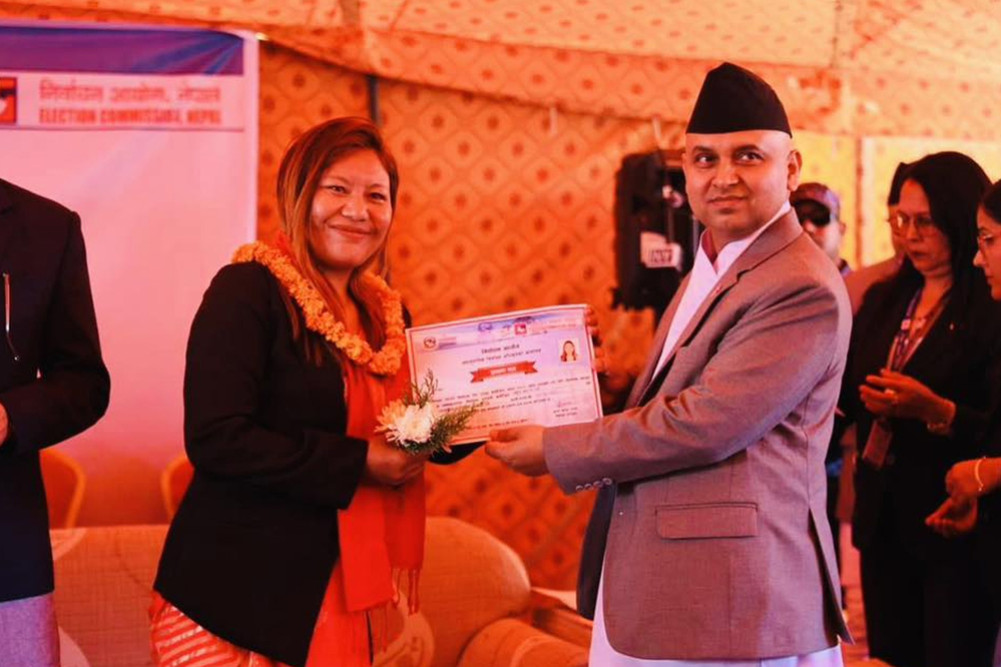
”It is necessary to change the language that says people with disabilities cannot do anything. Everyone can do it if they get the opportunity,” says Ganga. ”Our disability is not a barrier, the policy is. Now the policy needs to be changed.”
We use Google Cloud Translation Services. Google requires we provide the following disclaimer relating to use of this service:
This service may contain translations powered by Google. Google disclaims all warranties related to the translations, expressed or implied, including any warranties of accuracy, reliability, and any implied warranties of merchantability, fitness for a particular purpose, and noninfringement.
Her wheelchair-bound hands are used to sewing clothes on a machine. Her voice comes out for social campaigns. She was not interested in politics, but was active for social justice, disability, and the rights of indigenous people.
She was born 35 years ago in Narjakhani, the most remote ward of Tamankhola Rural Municipality in Baglung. At that time, the health and education conditions in this village were critical. She contracted polio soon after birth. She had trouble standing on her feet. Her father, Kul, and mother, Sunita, were very worried when their first daughter became disabled.
The Chhantyal couple could not immediately afford to treat their daughter, but they felt that their daughter should be educated, so they took Ganga to Gurja in neighboring Myagdi district and enrolled her in school. She used to go to school with the help of others. After passing grade 5, her physical condition made it difficult for her to go to a distant school.
The Chhantyal couple went to Kathmandu with the aim of treating and educating their daughter. The parents did not hesitate to work as laborers to educate their daughter. Ganga received basic treatment at the Khagendra Najjivan Center in Jorpati, but she did not recover completely. After that, the Chhantyal couple did not return to Baglung. Ganga was provided with an environment to study in a wheelchair. The parents sold tea on the roadside. They raised their children there even though they had to work as laborers. Ganga started studying at the school located in the Khagendra Najjivan Center. She passed her SLC from the center's school.
The Chhantyal couple has three daughters and a son. Ganga's sister also has a disability. She still keeps her sister with her. Ganga passed grade 12 from the newly established college in Kathmandu. After that, they needed employment instead of studying. She started working as a delivery boy with a four-wheeled scooter. She earned some money from that, but her physical condition did not support her. Since she had a problem with her legs, she started looking for a job that she could do sitting down rather than walking outside. Then she learned sewing and started working on a machine.
Her skills and business grew as she sewed and sold the clothes she brought from Ranjana Galli. Then she started working with other friends. She also wanted to work in the social sector. She became active in an organization called National Indigenous Peoples Disabled Self-Employment Women's Association Nepal (NID Seva). Through that organization, she also went abroad to do various activities for the rights of the disabled, women, and minorities. She got the opportunity to learn about rights by traveling to many countries.
Ganga is now married. She is married to Kushal Tamang from Sindhupalchowk. Currently, she not only sews on machines, but also teaches skills to employ the disabled, indigenous people and women. Her goal is to provide employment to the disabled and provide social services. Before the election, she had been working to support the disabled, those facing poverty and social exclusion. Some time ago, Ganga met Mayor Balendra Shah in Kathmandu Metropolitan City. She said that during the preparations for the election, she received an offer from Balendra's secretariat to become a candidate for the disabled on behalf of the National Independent Party. 'I am a person who has done social service, but I don't know politics,' she said. 'Now, the offer came that the voice of the disabled should be spoken, and I accepted it.' The Rashtriya Swatantra Party recommended Ganga's name to the Election Commission on behalf of women, the disabled and minorities. She has been elected as a member of the House of Representatives.
Now, Ganga says that she will be the voice of the marginalized, minorities, indigenous people, Dalit Muslims and others in the parliament. She says, ‘My priority will be to teach skills to my sisters and make them skilled and connect them to employment.’ She said that she will raise such issues in the parliament and work in the fields of women’s rights, employment and skill development, and take the initiative to formulate policies on such issues. ‘It is necessary to change the language that says people with disabilities cannot do anything. Everyone can do it if they get the opportunity,’ she said. ‘Our disability is not a hindrance, the policy is a hindrance. Now the policy needs to be changed.’ She said that she will make the voices of the disabled louder in the parliament.