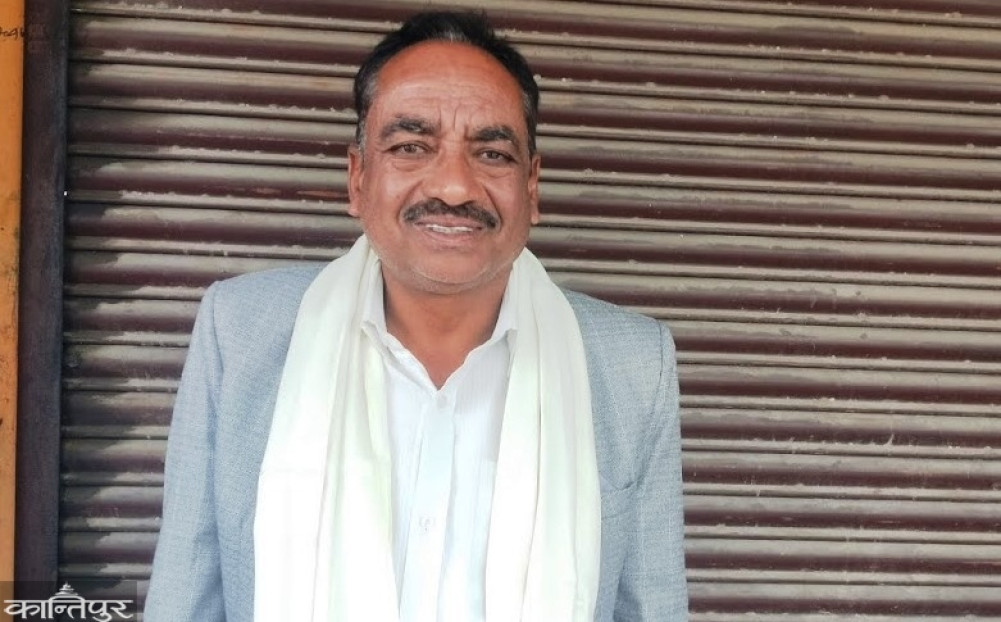
Tahir Ali, who has always been at the forefront of promoting religious harmony and social unity, will now be active in policymaking in the House of Representatives.
We use Google Cloud Translation Services. Google requires we provide the following disclaimer relating to use of this service:
This service may contain translations powered by Google. Google disclaims all warranties related to the translations, expressed or implied, including any warranties of accuracy, reliability, and any implied warranties of merchantability, fitness for a particular purpose, and noninfringement.
Tahir Ali, 61, of Rupandehi, who has always been at the forefront of maintaining religious harmony and playing a leading role, has set his sights on a parliamentary journey. Ali, of Rohini Rural Municipality-3 in Rupandehi, who has been active in social service and politics for three decades, was elected to the House of Representatives from the Rastriya Prajatantra Party (RPP) on a proportional representation basis from Thursday. He was elected from the Muslim cluster of the RPP on a proportional representation basis.
After becoming a member of the House of Representatives, he is currently struggling to greet friends, acquaintances, relatives and neighbors who wish him well. Ali, who was seen receiving congratulations from friends and well-wishers at the busy market near his home on Sunday, was suggesting that all religions and communities should move forward with a collective spirit while maintaining mutual harmony.
He said that his first priority is to strengthen the relationship of harmony and brotherhood between all religions and communities and build development on the strength of social unity. ‘If a dispute starts in the name of any religion, I will be the first to work in the forefront to maintain mutual harmony,’ Ali said. ‘Even though I was born in a Muslim family, I am affiliated with a party that believes that Hinduism should be maintained for the identity of the nation because of the feeling that there should be religious tolerance and social unity in Nepal.’
He has made his mark in society by immediately working for his neighbors and anyone in trouble in the police administration and various bodies without political discrimination. His political guru is the late leader of the RPP, Deepak Bohara. He said that he entered politics with the inspiration of Bohara.
He was born in a normal family in the then Dhakdhahi Village Panchayat-5 of Rupandehi in 2019 BS. Although there was a school near his home, he studied for some time at his grandmother's house in Pokharbhindi, 2.5 km away. After reaching grade 9, he finally studied at the nearby Shriram Naresh Adarsh Secondary School from his own home.
After the referendum of 2036 BS, a provision was made to open independent student organizations at the school level, he was unanimously elected as the president of the Independent Students' Union of Shriram Naresh Adarsh Secondary School in 2037 BS, despite not being affiliated with any political party.
After becoming the president of the Independent Students' Union, he accompanied the then principal of the school, Narayan Ghimire, to the district administration and land revenue office and obtained the title deed of about 14 bighas of land owned by the school. He began to be active in the physical and educational activities of the school.
He first met Bohara as a student leader after he came to Shriram Naresh Secondary School during the campaign of Deepak Bohara, who contested the election for a national panchayat member in 2038 BS. ‘Impressed by my conversation with Bohara, who contested the election as a public candidate at that time, I got involved in his election,’ he said. ‘After Bohara won, I became his favorite.’
After Deepak Bohara became the Minister of Tourism in 2041 BS, Ali was given a job at the Royal Nepal Airlines Corporation (RNAC). During his job, Ali became close to Bohara and started getting involved in political and social work. He said that he learned how to work in the social and political fields from his proximity to Bohara.
In his working life, he even became the head loader of RNAC. He said that he learned the habit of treating everyone equally without any political discrimination from Bohra. ‘That was an unimaginable event,’ he said, ‘I returned to my political home after three months.’ RPP Rupandehi Chairman Sagar Pratap Rana says that the injustice done to him at that time has now been remedied by including his name in the proportional representation. Rana said that the party expects Tahir’s presence in parliament to make pro-people laws and make a significant contribution to strengthening the party’s organization.
Tahir contested the 2074 and 2079 local elections as the chairman of Rohini Rural Municipality, but was defeated by a narrow margin both times. He was successful in winning other municipal posts both times and strengthening the party’s presence.
After becoming a member of the House of Representatives, he said that his role in parliament will now focus on making effective policies and regulations on issues such as agriculture, health, education, employment, infrastructure construction including roads, upliftment of the backward classes, and social empowerment.
According to him, farmers have been facing problems for years due to lack of timely seeds and fertilizers, poor prices for agricultural produce, and lack of irrigation. Due to the lack of a college in Rupandehi-1, many students have to go far away to study after grade 12. Girls often drop out of school because they think it is unsafe to go far away. Untimely deaths occur due to lack of minimum health services nearby. The problem of unemployment is also increasing. He said that he will raise his voice in the parliament to formulate policies and regulations on issues such as maintaining the minimum support price of agricultural produce and purchasing it from the government so that farmers benefit, upgrading the existing health institutions and making minimum health services free, establishing a degree college in Dhakdhahi, providing education to Muslims and all economically backward communities for income generation, etc.