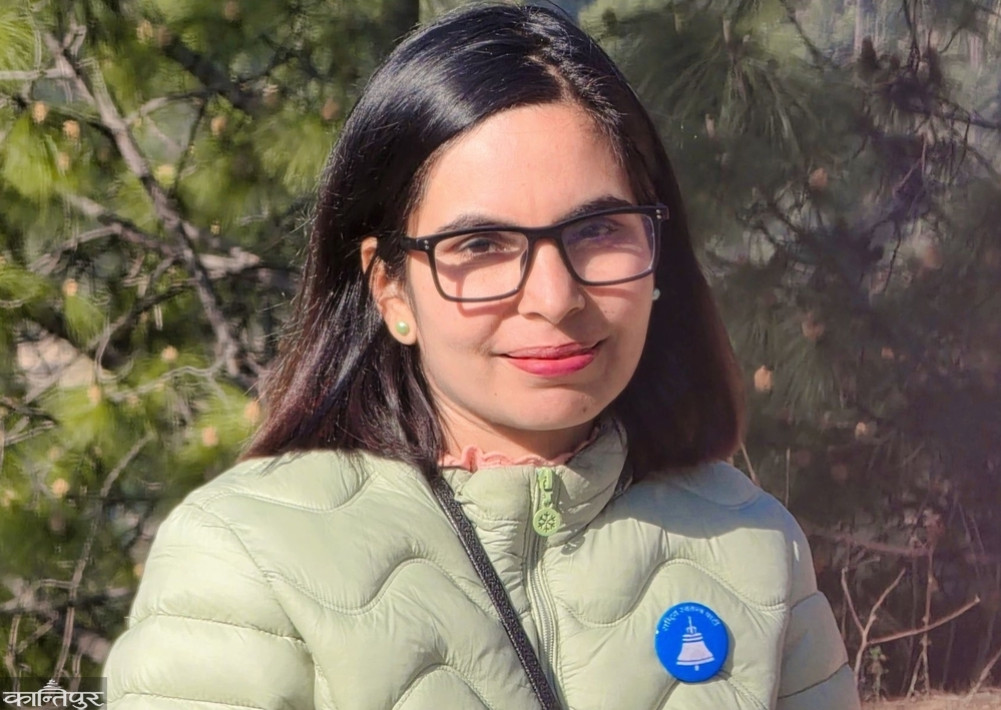
Born in the hills of eastern Panchthar and raised in the flat Jhapa, 33-year-old Jwala Sangraula will now stand in the federal parliament as a representative of the backward region of Achham in the far west.
We use Google Cloud Translation Services. Google requires we provide the following disclaimer relating to use of this service:
This service may contain translations powered by Google. Google disclaims all warranties related to the translations, expressed or implied, including any warranties of accuracy, reliability, and any implied warranties of merchantability, fitness for a particular purpose, and noninfringement.
Be it in public circles or social media, Jwala Sangraula is known as a different character on such platforms. As soon as she hears her name, the 'voice' against injustice resonates in the minds of some. Some remember her as a 'controversial activist'. Whatever the background, she cannot tolerate injustice silently.
Born in the hills of eastern Panchthar and raised in flat Jhapa, 33-year-old Jwala will now stand on the rostrum of the federal parliament as a representative of a backward region along with Achham in the far west. Jwala, who was elected as a proportional representative from the National Independent Party (NISP), has reached the high seat of Singha Durbar through the dust of the roads and police custody. Her journey is exciting and full of struggle.
Like the rural common people, her early life was spent amidst deprivation and dreams. She also spent some time in the teaching profession. At that time, she not only taught children the alphabet in the classroom, but also showed them the mirror of society. Her nature was like that of a 'born rebel'. The oppression, discrimination against women, and the slowness of the bureaucracy in government offices and courts always irritated her.
Meanwhile, she reached Japan in search of employment and a successful future. Despite her busy life there, she did not stop attacking the evils of Nepal. The digital movement that started from Japan through the social network Facebook Live brought her to the peak of discussion in a short time. The voice raised from Japan against the settings at the airport, fraud in the name of foreign employment, and violence against women in remote areas had already started to shock the ruling party in Kathmandu.
After returning to the country, she took to the streets as a full-time social activist. Before entering the field of street protests and politics, Jwala had accumulated a long experience in communication and direct social service. For some time, she worked as a journalist by joining Nari Television. She got the opportunity to observe and bring out the hidden injustices of women and society through the lens of the camera. This made it easier to connect with the people at the ground level.
Her social service is linked to the Raskot Hospital under construction in Kalikot. Jwala spent a lot of energy in humanitarian work started under the initiative of Rashtriya Swayamsevak Sangh (RSS) President Ravi Lamichhane. She started working in the field and engaged in social campaigns with the aim of ensuring that citizens do not lose their lives prematurely due to lack of health services.
She did not make social media just a medium for discussion. She raised support for the helpless through digital means. Whether it is patients lying in hospital beds without receiving treatment or children who are unable to study due to financial constraints, Jwala raised millions of rupees through Facebook by connecting Nepalis living in the country and abroad. She showed in practice how the power of social media can be used to save the lives of people in need.
Sometimes she would be found in the queue at the passport department and sometimes she would be at the hospital gate shouting for justice for the victims. Some of the movements she led brought immediate justice to the victims, but her outspoken style also drew her into the circle of controversy. She had to face detention on charges of violating legal norms. Instead of calming her down, these experiences made her even more angry. ‘When I shouted on the streets, many saw me as an anarchist,’ she had said in an interview. ‘I had no personal interest in that. As long as the state institutions do not listen to the common citizen, someone or the other has to shout loudly.’
Achham has become a new and powerful link in her life. Her marriage to Himal Upadhyay of Mangalsen-5 made her the 'daughter-in-law' of the Far West. This sign became a 'turning point' in her life not only in terms of family but also in terms of politics. Because she was a Nagakita of Achham, she decided to become a parliamentary candidate from a cluster of backward areas. Her move was not without criticism.
Some called her an opportunist, while others questioned her for representing Achham without considering its geography and people's lives. However, Jwala has been shrugging off such criticism. 'I did not take Achham's citizenship to contest the election. I am Achham's daughter-in-law and that soil is mixed in my children's blood,' she said, 'It is not only geography that is backward, Kathmandu's thinking is also backward.'
She says that after being elected as an MP, she now needs to answer the doubts that have arisen in the minds of citizens through her work style. She said that the long-term problems here have been made the main agenda. According to her, the biggest stigma of Achham is the Chhaupadi system. This evil practice of women living in cowsheds for ages should be uprooted not only by law but also by social awareness. ‘I will not only give speeches against the Chhaupadi system in the parliament, I will go to the villages of Achham and lead a campaign to demolish those cowsheds and restore the self-respect of women,’ she said.
Improving the critical condition of education and health is another of her priorities. She has emphasized on upgrading the hospital and managing skilled human resources to change the fate of women losing their lives on the road due to lack of treatment. She said that her main responsibility is to accelerate major road development projects such as Seti and Mid-Hill Highway. She has given importance to promoting the tourist areas of the district.
‘There is a plan to raise the standard of living of the locals by introducing destinations like Baidyanath Dham and Rama Roshan Kshetra, which are considered to be the jewels of the distant lands, at the national level,’ she said, ‘The doubts raised against me will fade in front of my work. The soil of Achham has made me an MP and I will repay this debt of the soil by bringing visible changes in development, education and tourism.’
After the wave of ‘Ghanti’ started spreading across the country under the leadership of President Lamichhane, Jwala decided to institutionalize her personal movement. The good governance agenda of the Rashtriya Swayamsevak Sangh (RSS) inspired her to enter politics. The party believed in her activism and recommended her as an MP from a backward area of the proportional list. Jwala, who previously faced police batons on the streets, will now participate in the formulation of laws that will shape the future of the country within the dignified confines of Parliament.
As Jwala enters Parliament, there are high mountains of challenges ahead of her. Her biggest test will be to transform herself from the image of street anger and activist to the dignified debate and argument of the House.
‘When I shouted on the street, only my voice was heard, now my words will speak the law in the House. I will represent those women from far away, who are still forced to be victims of evil practices,’ she said, ‘I will be the voice of those youth, who are forced to sweat on the hot sands of the Gulf. My presence will always remind the House of the problems of the people of the land.’