She was neither an established leader, nor a figure seen leading any major movement. Rather, her identity was limited to simple social activism and local-level labor campaigns. The extraordinary journey hidden within this mediocrity has brought her to the doorstep of the federal parliament today.
We use Google Cloud Translation Services. Google requires we provide the following disclaimer relating to use of this service:
This service may contain translations powered by Google. Google disclaims all warranties related to the translations, expressed or implied, including any warranties of accuracy, reliability, and any implied warranties of merchantability, fitness for a particular purpose, and noninfringement.
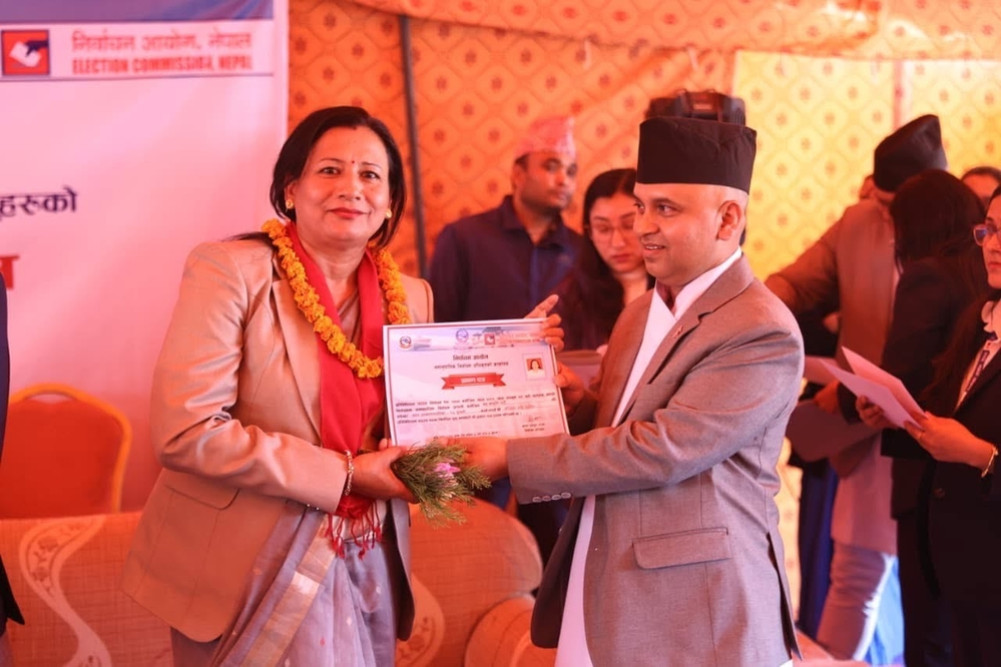
It became a matter of concern for many after the name of Ambikadevi Sangraula, who was recommended for MP under the proportional system from the Khas Arya Women's Cluster, was made public.
She was neither an established leader, nor a figure seen at the helm of any major movement. Rather, her identity was limited to ordinary social activism and local-level labor campaigns. The extraordinary journey hidden within this mediocrity has led her to the door of the federal parliament today.
Born in 2031 BS in Hedap, Tehrathum district, she grew up in Kamal Rural Municipality, Jhapa district since childhood. Her father was employed in the Indian Army, due to which the family's financial condition was somewhat easier than usual. Recalling her childhood days, she says, "We did not have much problem with food and clothing, but the idea of doing something in life was there from a young age."
She passed her SLC in 2048 BS and then completed her IA in Commerce from Damak Multiple Campus in 2051 BS. She migrated to Dharan with her family in 2050 BS. After completing her education, her life focused on family responsibilities. After marriage, she started living in Dharan Sub-metropolitan City Ward No. 13. Her husband is a government employee and has two children. She has been living in Dharan for a long time and has been running a small business for about 18 years. She has been fulfilling her family responsibilities by trading in everything from shoes to cosmetics. This business made her self-reliant, but her identity in society was still limited to that of an ‘ordinary housewife and businesswoman’.
Her political journey began very late in her life. She herself admits that politics was never a priority for her, but it was a matter of curiosity and interest. ‘I was involved in a party, I would have liked to understand politics,’ she says. However, this perception changed after the 2079 BS local elections.
After Hark Sampang was elected mayor of Dharan Sub-metropolitan City as an independent candidate, the Shramdaan campaign he started attracted many local citizens. This campaign became the turning point in Sangraula’s life. She says, ‘His work style, respect for labor, and dedication to society impressed me a lot.’
Initially, she joined Shramdaan as just a participant. She regularly contributed to works ranging from water supply improvement to park construction. Gradually, she became an active member of the campaign. This activism pushed her towards social leadership.
Before the Shramdaan, her biggest social role was as the chairperson of the Toll Reform Committee. However, after joining the campaign, her scope widened. In 2080 BS, she became the co-secretary of the ‘Swatantra Didi Bahini Group’. Then, in 2082 BS, she has been holding the responsibility of the secretary of the ‘Shramsantrik Didi Bahini Group’. In addition, she is also the chairperson of Amar Path Colony Samaj (Toll Development Organization).
She learned practical politics while organizing women at the local level, mobilizing them for Shramdaan, and solving small problems. With the establishment of the Shram Sanskriti Party, she became a central member. Based on this background, she was recommended for the Khas Arya Women's Cluster under the proportional representation system. Although this recommendation was 'unexpected' for many, it was 'natural' for people associated with the labor movement. She herself considers it a 'bonus'. 'I was just working, this opportunity is like a bonus for me,' she says.
As she prepares to enter parliament, she presents herself as a 'learning' leader. 'I am not an expert in politics, but I have a desire to learn,' she says openly. She says that she will especially raise her voice for the rights and welfare of women. 'Women are still behind in many areas, I will fight for their rights,' she says. However, her vision is not limited to just one group. She is committed to raising the overall problems and issues of the country in parliament.