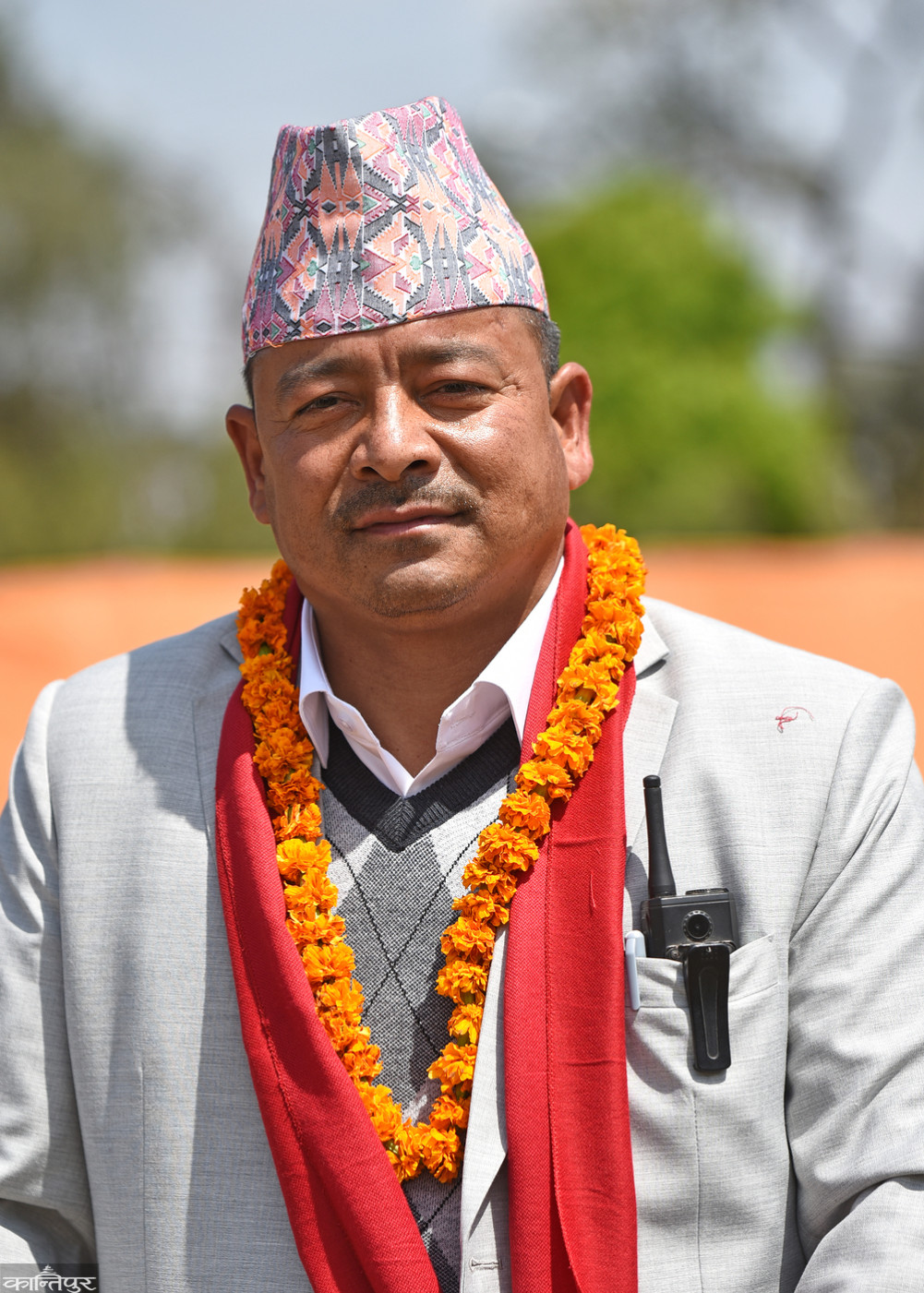
An elderly man who was disabled by a bullet to the spine during the armed conflict has been given the opportunity to represent himself in the federal parliament after a long political and social struggle.
We use Google Cloud Translation Services. Google requires we provide the following disclaimer relating to use of this service:
This service may contain translations powered by Google. Google disclaims all warranties related to the translations, expressed or implied, including any warranties of accuracy, reliability, and any implied warranties of merchantability, fitness for a particular purpose, and noninfringement.
After joining the then Maoists and going underground in the armed conflict, Prem Bahadur Bayak of Lamkichuha in Kailali joined the great military struggle.
Although he escaped death many times, he was shot in the spine during a clash in Masuria in Kailali. That is why he became permanently disabled in both legs. The same Bayak's struggling journey has now entered the federal parliament.
The 45-year-old Bayak of Lamkichuha Municipality-4 Pauwapur received his primary education at a school in Motipur, then his secondary education at Janajagruti Mavi Chauri in Lamkichuha. Until now, he studied at the Kailali Multiple Campus in Dhangadhi. While studying at the campus, he joined the Akhil Krantikari, a Maoist-affiliated group, in 2054/55. Less than two years later, he became active in Maoist party politics and went underground in 2057.
While underground, he chose the military front and was an 'urban' commander (urban guerrilla) under the 7th division of the then 'People's Liberation Army'. During that time, he was deployed in all districts of western Nepal. He participated in the battles of Mangalsen in Achham, Khalanga in Jumla, Gam in Rolpa, Lisne, Khara in Rukum, Beni, Arghakhanchi, and Gokuleshwar in Darchula. He became the witness of many small and large clashes. 'I had escaped many ambushes and moved forward,' he said, 'On 2061 Falgun 14, the double clash in Masuria Badaipur in Kailali was a memorable day for me too. I was shot and injured forever.'
Recalling the incident, Bayak says, ‘There was damage on both sides. While returning, a bullet fired by the army hit my spine from behind. My friends immediately rescued me and took me to Delhi, India for treatment. My life was saved, but I was permanently disabled in both legs.’
During treatment, he was arrested by the Indian police for 6 months in a hospital in India. He was detained in the hospital and kept under police control. But the reason for his arrest was strange. When he reached Ghaziabad, near Delhi, a theft had occurred. During the investigation, the identity of the person involved in the theft was similar to Bayak. That person, like Bayak, had also been shot in the spine from behind. That is why Bayak fell into the trap of the Indian police. ‘Later, the extradition process was initiated due to my name being on the Red Corner Notice issued by Interpol,’ he said. ‘After that, after being released on bail of 80,000 rupees by the Delhi court, I returned to Nepal. At that time, the peace process had begun in Nepal.’
He is still undergoing regular treatment. Taking medicine has become inevitable. ‘Both legs are not working. I have used artificial legs (califor) on both legs, which support the legs,’ he said. ‘Also, a walker helps me walk. I am listed as having multiple disabilities.’
After the peace process, the Maoists made him a central member. He is still a central member of the NCP. Even though the party he belongs to has repeatedly come to power, he has not had the opportunity to hold a political appointment anywhere. In 2068, he was made a three-month member of the task force to collect and classify data on Maoist fighters.
Despite being recommended for various posts from the district level several times, he was always left out in the final selection. In 2063, he was recommended for the interim House of Representatives, but he was not selected. In 2064, he was also recommended for the Constituent Assembly, but he was left out of the closed list. In 2080, his name was also in the news for the National Assembly.
Apart from politics, he has been active in social service since 2071. To contribute to the field of disability, he formed an organization called Apang Chetna Samaj in Lamkichuha and started identifying people with disabilities by going door to door and providing them with various necessary assistance. ‘I launched a campaign to provide support materials, awareness, and conduct health camps,’ he says. ‘Recently, I have been able to expand my services not only in Lamkichuha but also throughout the province.’
Apart from that, he also started raising his voice against corruption and good governance in the Lamkichuha area. He also became active for some time for educational reform. During that time, he served as the chairman of the management committee of the National Model Secondary School, Motipur, where he studied. ‘I think I have improved the school as much as possible. At that time, our school was successful in bringing good results in the far west,’ he says.
The father of a family of four, including two sons and a wife, says that he is not only happy but also feels responsible for entering his journey towards parliament. The Nepali Communist Party had included him in the list of disability clusters under the proportional electoral system. He was able to be selected from that cluster in the final selection. ‘In addition to fulfilling the role of the policy-making level for the development of the country in an excellent manner, my priority will be to focus more on health care and life protection for people with disabilities.’