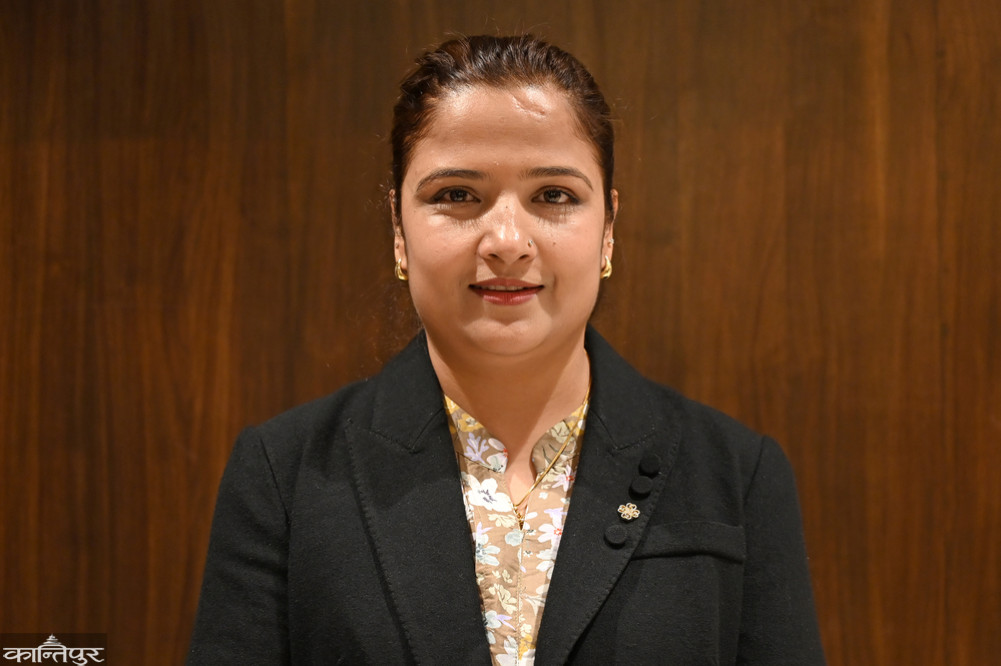
Khanal, who lives in the area affected by the inundation of the Budhigandaki Hydropower Project, a national pride, says she will raise the issue by making the project a top priority.
We use Google Cloud Translation Services. Google requires we provide the following disclaimer relating to use of this service:
This service may contain translations powered by Google. Google disclaims all warranties related to the translations, expressed or implied, including any warranties of accuracy, reliability, and any implied warranties of merchantability, fitness for a particular purpose, and noninfringement.
Shobha Khanal of Gandaki Rural Municipality-5, Darbung, was interested in politics from a young age. She would speak out against discrimination and injustice in society. Shobha's mother's activism by becoming a member of the local women's group and school management committee also inspired Shobha to become a social worker. Her grandfather and father were politically active in the village. Growing up in a political environment in the family, Khanal also got a chance to understand society and the country in depth.
After completing her LLC from Ratneshwor Secondary School in Gandaki-5 in 2060 BS, Shobha reached Kathmandu for higher education. She completed her 12th grade from Manmohan Memorial College, Sohrakhutte and did her Masters in Political Science from Padmakanya Campus. After completing her studies, Khanal stayed in Kathmandu for 4 years and joined the trekking profession. In 2070, Khanal took the step of becoming a female entrepreneur by opening a trekking company on her own initiative. Khanal is also the founding director of Himalayan Summit Tax and Expedition Pvt. Ltd., Assured Travel and Tours Pvt. Ltd., Himalaya Digital Solutions Pvt. Ltd. and Exclusive Learning and Research Center.
Khanal, who has been associated with the tourism sector for 15 years, was not affiliated with any party before the Genji Movement. She was fond of the National Independent Party. She got the opportunity to observe the Genji Movement firsthand. ‘When my siblings and I protested against corruption on the issue of good governance, we were shot dead in our own country,’ she said. ‘The Prime Minister and the Minister are like the parents of the family. If you disagree with your parents on a legitimate matter, I feel that my children are not safe. Another thing is that we cannot just sit with our hands tied to maintain good governance in the country, so I started my political journey.’
Shobha became active in the Rashtriya Swayamsevak Sangh (RSS) after the Genji movement. The RSS made her a candidate on the proportional representation side from the Khas Arya cluster. Khanal also went from village to village along with Sudhan Gurung, who was the RSSS candidate from Gorkha-1, seeking votes. When she reached various villages in Gorkha-1, she got the opportunity to observe closely the backwardness in basic infrastructure development. ‘The roads are not good in most places, women in northern Gorkha are forced to be taken to Kathmandu by helicopter to give birth,’ she said, ‘Something needs to be done in the areas of education, health, and infrastructure.’
Khanal is a resident of the area affected by the inundation of the Budhigandaki Hydropower Project, a national pride with a capacity of 1200 megawatts. She said that she would raise the issue in the House with the Budhigandaki Project as her first priority. ‘The first priority is Budhigandaki,’ she said, ‘I spent my childhood here, when it was said that it would be inundated, there were no students in the school, most of the houses in the inundated areas are empty, development work in this area has come to a standstill, now it should not be confused, we will raise our voice on the priority of moving the project forward.’
Khanal, who has spent a decade in the tourism sector, has reached the role of raising her voice in the Parliament for the development of the tourism sector. "There are many things that need to be improved in the tourism sector. We need to coordinate and study with experts related to this and do something about the tourism sector, which is a pillar of the country's economy," she said. "How can tourism be made more systematic and what needs to be modified? I will play a role in this on behalf of the parliamentarian."