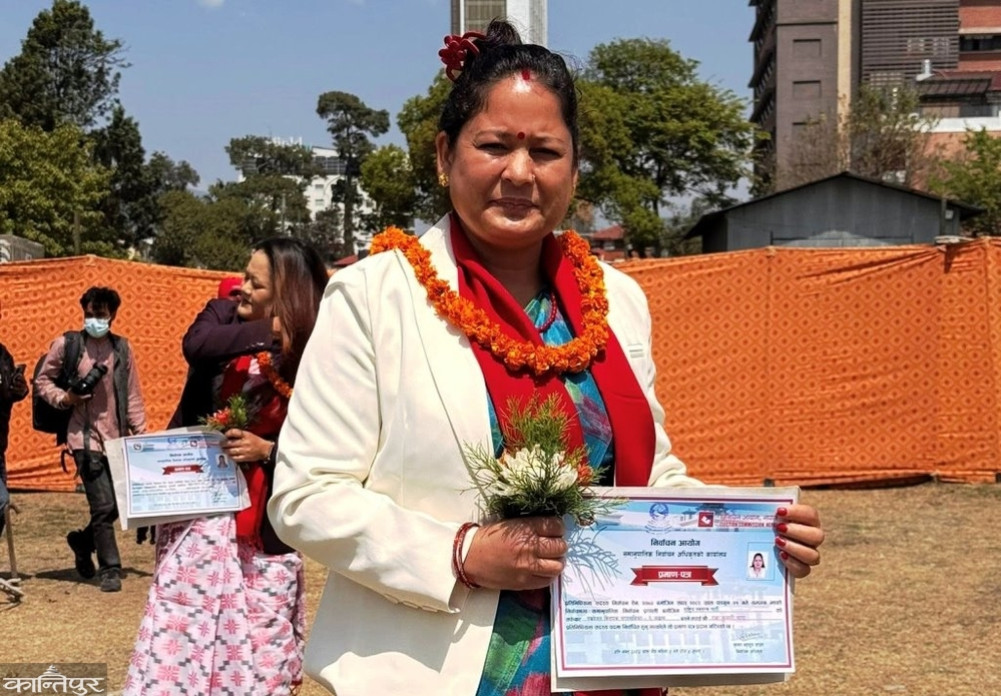
Amidst the responsibilities of home, education, and her husband's medical treatment, Ratna Thapa has not given up on her dream and has secured a seat in the federal parliament from the National Independent Party.
We use Google Cloud Translation Services. Google requires we provide the following disclaimer relating to use of this service:
This service may contain translations powered by Google. Google disclaims all warranties related to the translations, expressed or implied, including any warranties of accuracy, reliability, and any implied warranties of merchantability, fitness for a particular purpose, and noninfringement.
She rarely speaks and rarely goes out of the house except for work. Ratna Thapa Dhami, 41, of Achham, who has been shouldering family responsibilities for years, has now changed her identity. Ratna, who was confined to her home and kitchen, has now reached the highest policy-making level of the country, the Federal Parliament.
Ratna had just passed her SLC when she got married to Janak Bahadur Dhami of Panchadeval Binayak Municipality-2 at the age of 20. Playing the role of a daughter in her family, she tried to strengthen herself mentally when the responsibility of a daughter-in-law was added, but the remote environment and family situation repeatedly became obstacles for her.
Soon after marriage, she gave birth to her first child, a daughter. Between childbirth and caring for a newborn, she took the primary level teacher's license examination. After passing the examination, she started teaching at Saraswati Secondary School near her home. However, the next chapter of the struggle began when, while she was pregnant with her 6-month-old daughter, she had a second child (a son).
This time was very difficult for her. As her husband was forced to stay away from home for work and studies, the entire burden of housework, school responsibilities, and taking care of the young children fell on her shoulders alone. The life of Durgam, on top of that, a lonely struggle. But she never gave up. She raised both her children with care and continued her studies.
She passed grade 12 from Vidyamandir Secondary School in Vinayak. Her hunger for study did not stop there. While she was pregnant with her third child, she enrolled in the undergraduate level at Panchadeval Multiple Campus. Carrying the 4-month-old baby in her arms, she reached Mangalsen to take the first-year undergraduate exams.
For about 10 years, Ratna's life revolved around the familiar geography of Achham, school students, and the courtyard of her home. As an ordinary housewife and village school teacher, she was enjoying her world. A decade-long educational journey had connected her to society, while the struggle for higher education had taught her to dream big for tomorrow. At the same time, when she was climbing the heights of her personal development, another big 'storm' struck her life.
Her husband, who was doing business in Kathmandu, suddenly fell seriously ill with kidney disease. This news was no less than a 'thunderbolt' for Ratna. On one hand, the teaching profession she had been sweating for 10 years, on the other hand, the dream of higher education that she had just started. But on the other hand, the situation of her spouse and the future of her children. Finally, she made the difficult decision to sacrifice her dream. ‘I had written my dreams in the ups and downs of Achham for years. When my husband’s health fell into danger, all my certificates and jobs became secondary,’ she said, ‘For me, nothing was greater than my vermilion and the smiles on my children’s lips.’
Leaving the school, familiar faces and her own land in Achham, she headed to Kathmandu for her husband’s treatment and to take care of her children. Her journey from the remote village of Achham to the hospital rooms in Kathmandu became a living reflection of patience and sacrifice. ‘When I left everything and came to Kathmandu, I educated my daughter even though the whole society was against me. I remembered the face of my father who stood by me and said that I would take her to a good place,’ she said, ‘Despite all my efforts, I always felt regret that I could not do anything.’
Ratna’s days passed between the closed rooms of Kathmandu and the hospital. For Ratna, who had played with chalk dusters in school since a young age and lived in the ups and downs of Achham, the life of confinement within four walls became unbearable. Sitting in that room in Kathmandu, she not only gave time to her husband and children, but also realized how many compromises a woman had to make to survive in this society. The chaos of that closed room was preparing her for a big rebellion inside.
While her husband was sitting in that quiet room in Kathmandu, Ratna's mind was entangled in the problems of the people of Achham and the ups and downs of the country. Ravi Lamichhane's 'Sidha Kura Janata Sanga' program on television became her regular support. When she saw Lamichhane raising the problems she had faced in Achham, the suffering of the health service, and the administrative hassles, on screen, she felt, ‘Someone is speaking our voice.’
The news of the formation of the National Independent Party (RIP) under the leadership of Lamichhane lit a new lamp of hope in her heart. Ratna, who had been confined to her home for decades, had a strong desire to join that new campaign, but she could not find access and means. For a long time, she remained a silent supporter of the RIP. Finally, she expressed her feelings to her neighbor and the president of the RIP Achham Constituency No. 2, Jeevan Timilsaina.
Timilsaina was the bridge that connected her to the mainstream of the party. Her desire and ability, which had been confined to a closed room and family circle for decades, only then found open air. ‘I confined myself to a room for years, but my consciousness was never confined. When I got the opportunity to connect with the thoughts of the Rashtriya Swayamsevak Sangh (RSS) and Ravi Lamichhane,' she said about her political journey, 'I felt that now it is time to stand on the rostrum of the parliament and tell my unfinished autobiography. I have not only joined the party, but also reconnected with my own suppressed dreams.'
After becoming active in the party, her name was recommended for proportional representation from Achham from the backward areas and women's quota. Finally, after overcoming a long series of struggles, she succeeded in being elected as a federal MP from the National Independent Party. 'The soil in which I was born and where I struggled in the ups and downs, now I will speak the suppressed voices of that soil in the parliament,' she says, 'What kind of laws are needed for women in remote areas like Achham, I will try for that. I am going to the parliament not only to increase the number, but to be a carrier of change.'