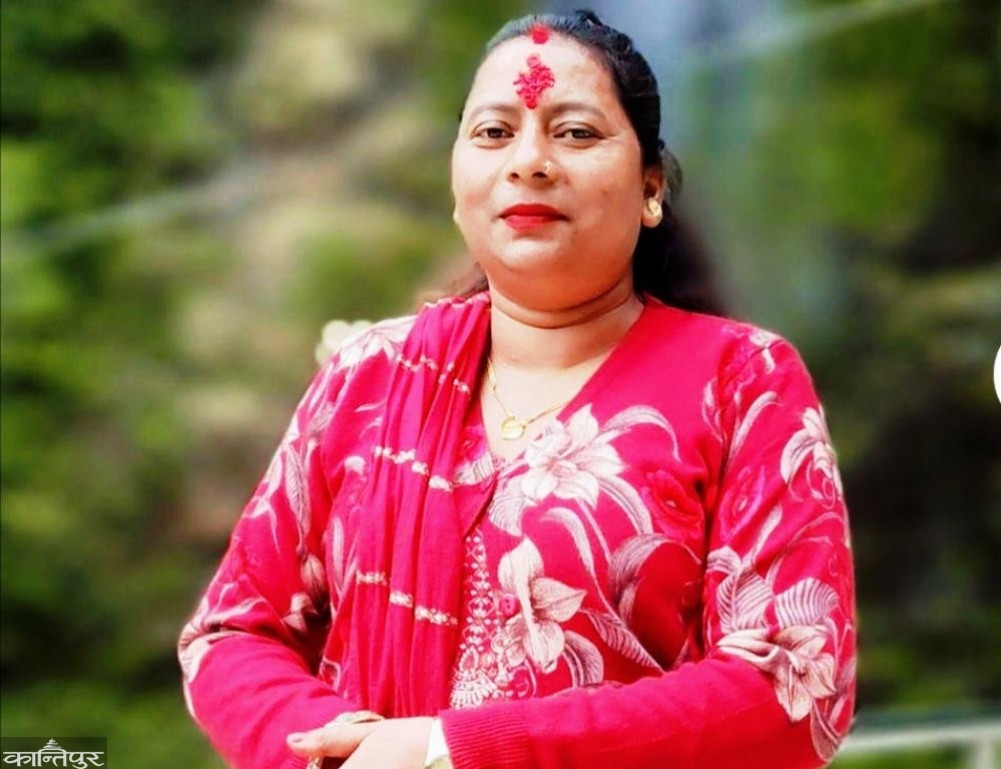
Harina Kami, 37, who grew up amidst poverty, social isolation, and discrimination in Ganyapadhura Rural Municipality of Dadeldhura, has reached the House of Representatives from the Nepali Congress by engaging in the campaign for social change through grass cutting, fairs, and farming.
We use Google Cloud Translation Services. Google requires we provide the following disclaimer relating to use of this service:
This service may contain translations powered by Google. Google disclaims all warranties related to the translations, expressed or implied, including any warranties of accuracy, reliability, and any implied warranties of merchantability, fitness for a particular purpose, and noninfringement.
Harina Kami of Dadeldhura, who was recommended by the Nepali Congress as the first candidate in the proportional list from the Dalit cluster, has become a member of the House of Representatives. Coming from an ordinary family, ordinary surroundings and a struggling life, 37-year-old Kami's journey to parliament is an example of social transformation.
Kami, who built a workshop in Tulabhadi, Parshuram Municipality-12, Madhesh area of Dadeldhura, was born in Ganyapadhura Rural Municipality. Her childhood was spent in an ordinary rural environment. Growing up amidst limited resources, social bonds, discrimination and lack of opportunities, she was a representative figure of the society of that time, where it was not considered necessary to educate daughters much and the practice of marrying them off at an early age was widespread.
Amidst such a social structure, she completed her studies up to class 10. The journey of formal education stopped there, but the desire to learn and do something did not stop. After marriage, she came to Tulabhari and from there her life took a new turn. Her life after marriage was spent in haymaking, fairs and farming like a normal rural woman. From 2064 to 2068, she remained in the village and remained busy with household chores and agricultural work. But in the meantime, she saw the inequalities within the society, especially the condition of Dalits, women and farmers, up close. She says that the thought of 'doing something' for the society arose at that time.
Her social activism began with a women's group. By bringing together women, mothers' groups and farmers in the village, she started practicing collective work. She especially embarked on a campaign to make women self-reliant by forming agricultural groups. In the Tulabhari area, she advanced the concept of dairy business along with raising cows, buffaloes and goats. The work of collecting milk production and taking it to the market through the group began. Local women who were not able to be self-sufficient reached a point where they could support their families from their own earnings. As local produce started reaching Dhangadhi, the farmers' confidence increased. As they became financially strong, their social status gradually began to change.
The experience that social work alone is not enough to change society, they need to reach the policy-making level led Kami to think bigger. But she did not initially think of entering politics. She says that as she worked in the community, politics began to seem inevitable.
The first achievement of her political journey was the 2074 local level elections. She was elected as a ward member from Parshuram Municipality-12. Along with that, she also became a member of the executive committee. She prioritized the upliftment of Dalits, women, and farmers. She took the initiative to focus the resources and means available from the local government on these groups. During her tenure, agriculture, animal husbandry, and women's empowerment programs were also held in the village.
She says that initially she did not get the expected support from her family to do politics. In society, it was not easy for women to go out of the house and do politics. After seeing her activism in social work and public service, the support of her family and relatives increased. Now they have become her biggest strength. She feels that society is also changing. ‘Earlier, there was a thought that women should not study much and should stay at home,’ she says, ‘but now that thought is gradually changing.’ Her own life is also an example of that change.
In the 2079 BS local level elections, she again became a candidate for ward member. That time, she was defeated by four votes. She took that defeat as an experience and continued her social and political activism.
Meanwhile, she became a representative of the Congress general convention and was recommended as the first candidate in the Dalit cluster from Dadeldhura for the 2082 House of Representatives election held in the reorganized political context after the Genji movement. Ultimately, she succeeded in becoming a member of the House of Representatives. She has described this success as not only a personal achievement but also the result of the people's trust. 'Now my responsibility has become even greater,' she says, 'I will raise the voices of Dalits, indigenous peoples, women, youth and all backward classes in Parliament.'
Even though she is in the opposition, she is determined not to back down from her responsibility to raise the voices of the people. She said that she will present herself as the voice of the voiceless. Kami's journey from a simple rural background to reaching the Parliament was not easy. She has come this far after overcoming all these challenges such as limited education, financial deprivation and social discrimination. But she never gave up in life. Now she has said that she will raise her voice in Parliament to ensure the rights of Dalits, women and farmers, to empower them economically and to establish social justice.