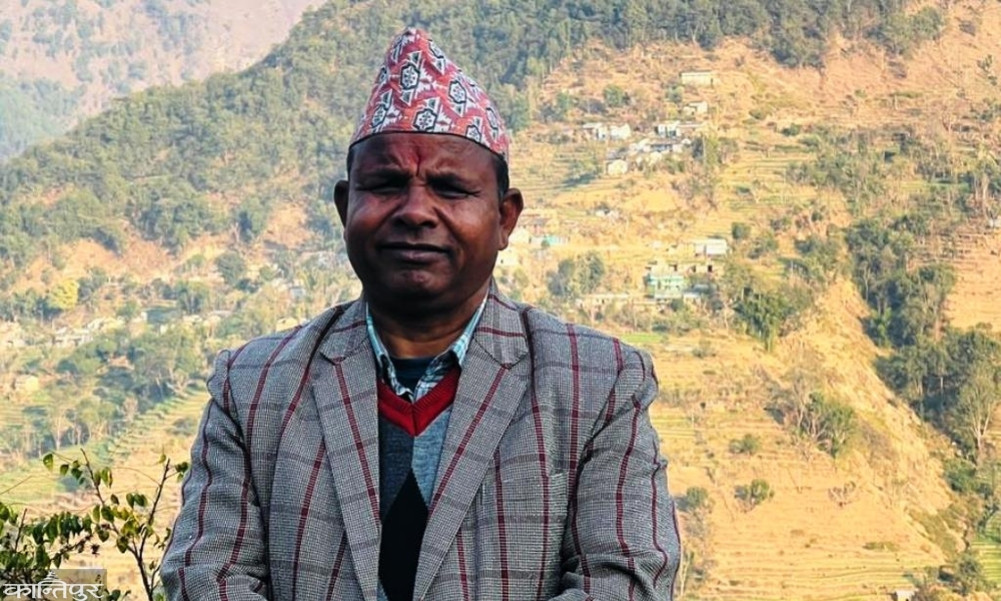
Ganesh Bishwakarma, 55, who has been leading political movements, human rights, and Dalit awareness campaigns, was assured of a seat in the federal parliament on his fifth attempt after the Nepali Communist Party recommended him as a proportional representation member of parliament in the Dalit cluster.
We use Google Cloud Translation Services. Google requires we provide the following disclaimer relating to use of this service:
This service may contain translations powered by Google. Google disclaims all warranties related to the translations, expressed or implied, including any warranties of accuracy, reliability, and any implied warranties of merchantability, fitness for a particular purpose, and noninfringement.
Ganesh Bahadur Bishwakarma, born in a poor Dalit family in Jayaprithi Municipality-9 Deval, Bajhang, a remote hilly district of the Far West, failed four times to enter the central parliament. His fifth attempt has been fruitful.
Bishwakarma, 55, who has been leading political movements, human rights and Dalit awareness campaigns, was assured of a trip to the federal parliament after the Nepali Communist Party recommended him as a proportional member of parliament in the Dalit cluster.
Bishwakarma had been on the closed list under the proportional electoral system in the elections since 2064. His name was included in the closed list of UML in the elections of 2064, 2070 and 2074. In the 2079 elections, the Unified Socialist Party had included his name on the closed list. Bishwakarma, who was the secretary of the then Unified Socialist Party, recently included his name on the closed list by the newly formed NCP.
He is a founding member of the communist movement in Bajhang. He joined the student organization in 2045 and became involved in the politics of the Communist Party in 2046. He became a founding member of the Bajhang District Committee of the then CPN-UML. After the formation of the CPN-UML, he joined the UML until its split in 2078 and was active in various social campaigns.
Before Bajhang, he made Doti his workplace during his studies and teaching. Bishwakarma says that he worked as a member of the Doti District Committee of the UML for about 6 years. Elected as a member of the Central Disciplinary Commission from the eighth general convention of the UML, he became a member of the Politburo and School Department of the Unified Socialist Party formed after the split of the UML in 2078. He was elected as the Central Secretary from the tenth general convention of the Unified Socialist Party. He is currently a central member of the Pushpa Kamal Dahal-led CPN.
Bishwakarma, who completed his formal education up to postgraduate level, remained at the forefront of social campaigns in the Far West along with politics. He was especially active in the areas of caste discrimination, Dalit community rights and human rights. He led the Nepal Dalit Liberation Organization and continuously advocated for respect and equality. ‘I played a role in raising my voice against caste discrimination, organizing the Dalit community, and taking their issues to the policy-making level,’ says Bishwakarma. ‘I feel like I played a role in institutionalizing the Dalit movement, not just limiting it to street protests.’
His list of being active in various ways on issues of caste discrimination and the rights of the Dalit community is long. Bishwakarma, who started being active in various campaigns against caste discrimination since 2043 BS, remained active at various levels in the subsequent stages. During that period, he worked at the then Oppressed Ethnic Upliftment Forum, Bajhang from 043 to 045. By 048, he had risen from secretary to president of the then Dalit Mukti Samaj District Committee, Doti.
He was also associated with various human rights organizations. He held the central leadership in some organizations including the Human Rights Alliance. Even while in those organizations, he gave priority to overall human rights issues as well as the context of Dalit rights. In 064, he was elected as the central vice-president at the second general convention of the Human Rights Alliance.
Two years ago, the Unified Socialist-led Sudurpaschim Provincial Government had appointed Bishwakarma as the UPA chairman of the Provincial Policy and Planning Commission. During that period, he got the opportunity to implement the concept of development planning, policy making and inclusive development. Under his leadership, the Sudurpaschim Provincial Government had decided to declare 082-092 as the 'Dalit Decade'. But the implementation was done .
In the meantime, he had served as a member of various commissions and committees formed by the government . He has served as a member of the High-Level Land Reforms Commission, a task force formed to resolve problems related to Dalit students, a task force to study the re-establishment of freed Haliyas, Kamaiyas, Kamlaris and Harwacharwa.
After starting his journey in parliament, he has reached a place where he can play the role of state policy-making. Stating that he will effectively play the role of an MP in parliament, he says, ‘Until yesterday, I used to raise issues of rights on the streets, now I will raise them in parliament .’