The party also elected him as an MP through the proportional representation system, which has made him even more excited.
We use Google Cloud Translation Services. Google requires we provide the following disclaimer relating to use of this service:
This service may contain translations powered by Google. Google disclaims all warranties related to the translations, expressed or implied, including any warranties of accuracy, reliability, and any implied warranties of merchantability, fitness for a particular purpose, and noninfringement.
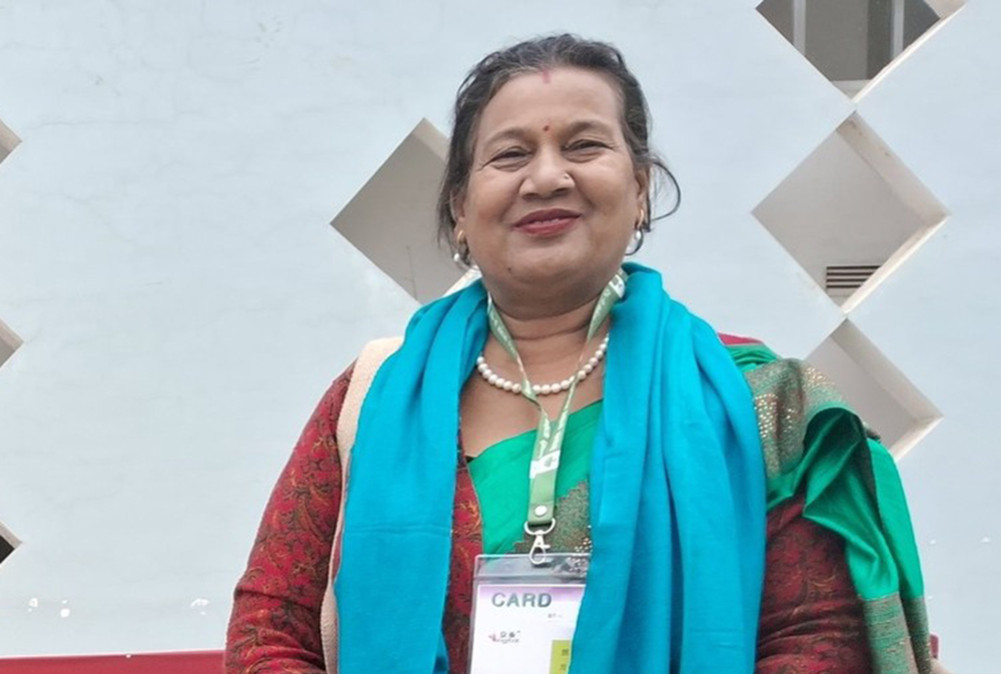
A new responsibility has come to the shoulders of Congress leader Sushila Dhakal Acharya of Birtamod-9, Jhapa, who has been active in party politics for a long time. The party also elected her as an MP through the proportional representation system. Which has made her even more excited.
Sushila never coveted the position. If she had wanted to, she could have been an MP earlier. However, she did not prioritize the position. Instead, she continued to practice politics as a form of service. ‘I never considered politics as a benefit,’ said Dhakal, ‘Politics has always been a form of service for me.’
After Dhakal became an MP after a long time, Congressmen considered it a great achievement. However, she considered it as the result of decades of dedication, sacrifice and unwavering commitment.
Born in the hilly district of Bhojpur in 2018, her childhood was spent in a simple rural environment. At that time, many women were not allowed to go to school. However, she was able to study in school. Her thinking and interests were different from an early age. She started showing interest in politics during her school life. At that time, the country had a Panchayat system, which limited civil liberties and democratic rights. Growing up in that environment, Sushila learned to raise her voice against injustice and oppression.
She especially learned to raise strong slogans against Panchayat in Bhojpur. When she was a teenager. After completing her primary education from Vishwapremi High School, she passed her SLC from Vidyodaya Secondary School in Bhojpur. During her student life, she became active against Panchayat and in favor of multi-party politics. During the 2036 referendum, the police arrested her because she was involved in the movement. That time was challenging for her, but building on that struggle, she set a clearer direction for her political journey.
After her SLC, her family moved to Jhapa, a new turn came in her life. After enrolling in Mechi Campus in Bhadrapur to study IA, she became more active in student politics. From that time on, her political identity began to expand. She understood at that time, 'politics is not only for power, but also for social change.'
Various organizations played an important role in her political journey. After reaching the Nepal Students' Union, Tarun Dal, and Mahila Sangh, she established herself as a capable, active, and trusted leader within the party. She did remarkable work, especially in the field of women's rights and empowerment. She spent two decades as the president of Mahila Sangh Jhapa.
Under her leadership, the Women's Association conducted various campaigns on women's rights, equality and participation in the district. She not only made it a priority to involve women in the organization, but also to develop their leadership skills.
Success in politics is not always easy. In the 12th General Convention, she ran for the position of central member but lost. However, she considered the defeat not as an end but as a new beginning. Due to her continuous activism and contribution, she won the position of central member in the 14th General Convention. 'That success was a symbol of my patience and determination,' she says.
People's movements also occupy a special place in Sushila's political life. She became an active participant in the people's movement of 2046 BS, which restored multi-party democracy in Nepal. Similarly, she played a role in the second people's movement of 2062/063 by being at the forefront. During this, she had to remain in police custody for some time.
She also had to bear personal losses during the conflict. Her house was looted by a masked group. The truth of that incident has not come out to this day. However, such an incident could not weaken her morale. Instead, she gathered the courage to work for the society and the nation more firmly.
Her political philosophy has always been clear. She feels, 'Politics is a service, not a means of profit.' This idea has always inspired her. She claims that she has never done politics for position or personal gain. Instead, she has remained active with the aim of contributing to society.
She did not get disappointed even after not getting opportunities for a long time. ‘Even when deprived of opportunities, I was never dissatisfied,’ she says, ‘because I did politics not for profit, but for service.’ Because of this thinking, she was able to create a different identity from others as a Congress leader.’
Even until recently, she remained active in party politics and continued to raise her voice on issues of women’s rights, social justice, and inclusion. Finally, in appreciation of her long struggle and contribution, the door opened for her to become an MP through the proportional list. ‘I will make full use of this opportunity given in special circumstances,’ she says, ‘I will raise issues in the House in the area of women’s rights and entitlements.’