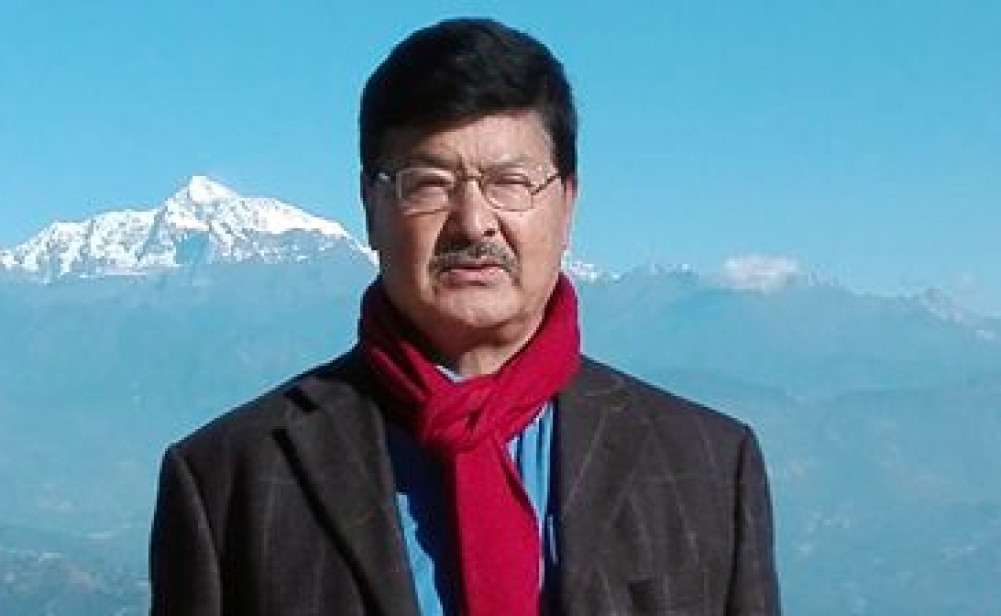
He joined the CPN (Chaum) in 2033 BS and has been campaigning for the rights of indigenous and national minorities in left-wing politics ever since.
We use Google Cloud Translation Services. Google requires we provide the following disclaimer relating to use of this service:
This service may contain translations powered by Google. Google disclaims all warranties related to the translations, expressed or implied, including any warranties of accuracy, reliability, and any implied warranties of merchantability, fitness for a particular purpose, and noninfringement.
Is liberation possible without including the rights of indigenous/tribal people in politics? Parashuram Tamang joined politics about 50 years ago in search of an answer to this question. Although the communist parties of Nepal came to talk about class liberation in the 1930s, the issue of caste liberation remained unclear. Since then, Parashuram has theorized the issue of caste liberation in politics along with class liberation.
Parashuram, who played a leading role in including the issue of indigenous/tribal rights in Nepal in mainstream politics, has been elected as a proportional representation MP in the House of Representatives from the Nepali Communist Party (NCP).
He has been campaigning for rights for a long time, saying that they are deprived of their due rights due to the lack of distribution of state power based on representation of the tribes.
This is Parashuram's first visit to parliament, who has been a member of the Standing Committee of the CPN Organizing Committee and the East Maoist Center.
He joined the NCP (Chaum) in 2033 BS and has been campaigning for the rights of indigenous and tribal communities in leftist politics since then. When class discrimination was becoming a major issue in Nepal, he raised the voice that the ethnic community was facing great discrimination.
‘The Fourth General Convention of the NCP mentioned 4 major problems. Among them, the problem of indigenous and tribal communities was one, but there was no mention of how to solve it,’ he recalled, ‘In Nepal, there are not only exploited classes, but also ethnic communities. We raised the issue that the approach to class and caste is also exploitation. The Communist Party later made this debate a formal concept. This is how the issue of rights entered the communist movement.’
He believes that progressive reforms are necessary through constitutional amendments since different castes are still facing discrimination in the state after the establishment of the Federal Democratic Republic.
‘A federal republic has been established in the country. This is a form of bourgeois democracy. The theoretical aspect of it is that everyone should have freedom and respect,' he said, 'To make the constitution progressive, all communities should be made equal. Then there will be equality in economic conditions. The development of indigenous/tribal and Dalit people means development with identity.'
Parashuram explained why he has been campaigning for justice for the community for a long time. He said, 'Federalism should do justice to all communities. No community has a majority in Nepal.'
Born in Falgun 2008, Tamang has published more than two dozen books on economics and politics, indigenous peoples, federalism, human rights, biodiversity, environment, state restructuring, and the Tamang caste.
He has been Vice-Chairman of the United Nations Permanent Forum on Indigenous Peoples (2002-2007), Executive Director of the International Alliance of Indigenous Peoples and Species of Tropical Forests (1995-2008), Director of Call of the Earth (World Intellectual Property Organization, 2000-2002), and the Indigenous World Focal Point of the Convention on Biological Diversity and the United Nations Framework Convention on Climate Change (1998-2008).
He has also been the founder and head of the Federation of Indigenous Peoples of Nepal (1991-2000). Similarly, he is the Central President of Nepal Tamang Ghedung (1988-2000), the Founding President of the International Tamang Council (2002-2005), and a leader of the indigenous movement.