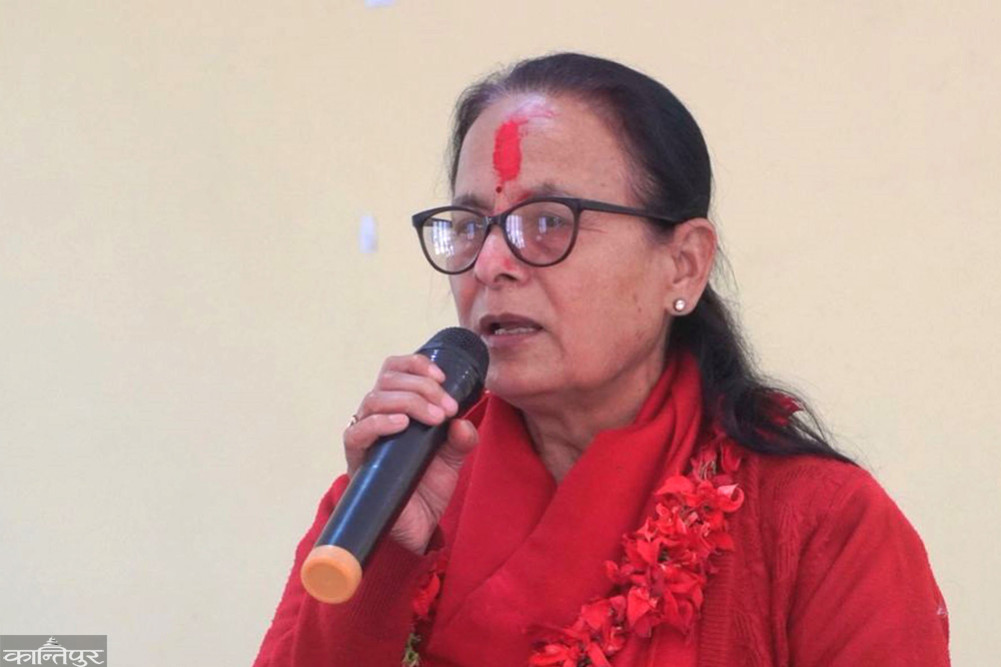
Tukabhadra Hamal, who became a member of the House of Representatives under the Khas-Arya Women's Cluster from the UML, has journeyed through student movements, underground struggles against Panchayat rule, organization building, and women leadership to reach central politics.
We use Google Cloud Translation Services. Google requires we provide the following disclaimer relating to use of this service:
This service may contain translations powered by Google. Google disclaims all warranties related to the translations, expressed or implied, including any warranties of accuracy, reliability, and any implied warranties of merchantability, fitness for a particular purpose, and noninfringement.
The name that rose from the rural areas of Lamjung to national politics is ‘Tukabhadra Hamal.’ She is the president of the All Nepal Women’s Association (ANEMSangh), the women’s organization of UML.
Hamal, who became a proportional representative in the House of Representatives under the Khas-Arya Women’s Cluster from UML, has reached the central politics for the second time through student movements, underground struggles against the Panchayat regime, organization building and women’s leadership.
Born on 22 Bhadra 2019 in Shreemanjyang, Dordi Rural Municipality-3, Lamjung, Hamal grew up in an ordinary farming family. She is the youngest daughter of 5 children of father Bir Bahadur Hamal and mother Bishnukumari Hamal. She has experienced the hardships of rural life, labor and especially the problems faced by women from close quarters.
The social structure of the village, community relations and gender inequality had instilled in her the idea of change since childhood.
After studying up to 7th grade at Lakshmi Secondary School in the village, she went to Arunodaya Secondary School in Gitanagar, Chitwan for higher studies. From there, she passed her SLC in 2037 BS.
Hamal, who began her formal political journey by becoming the treasurer of the ANRFSU Chitwan District Committee in 2036 BS, was elected as the secretary at the district conference in 2037 BS. It was not easy to expand the organization amid the oppression of the Panchayat regime, but she took the risk and jumped into politics from that moment on.
After SLC, she went underground. After the Panchayat repression increased in Chitwan, she came to Lamjung as per the party's decision. In Lamjung, she secretly started expanding the organization, mobilizing cadres, and spreading political awareness.
After receiving party membership on 9 Shrawan 2038, her political life took an institutionalized form. From Mangsir in the same year, she became the Deputy Secretary of the then CPN-ML Lamjung District Committee. Also, in Poush, she became the President of the ANEM Sangh District Committee Lamjung. After that, her activism focused on expanding women's organizations.
From Magh 2038, she assumed the responsibility of the Secretary of the Western-Northern Regional Committee of ANEM Sangh, covering the Gandaki-Dhaulagiri region. She continued to build organizations until 2044 BS. At that time, her main responsibility was to organize women by reaching villages when women's participation was low.
While studying at Birendra Multiple Campus in Chitwan from 2045-2051, she actively engaged in politics. Along with her studies, she took forward the work of organization expansion, training and public relations. In 2054 BS, she became a member of the CPN (UML) District Committee. In the 2054 BS election, she was elected as a member of the District Development Committee.
Hamal, who worked as a member of the party's Gandaki Zonal Committee from 2062 to 2066 BS, was elected as a member of the party's Central Committee from the 8th General Convention in 2066 BS. After that, she served as the Gandaki Zonal Co-in-charge and Lamjung District In-charge.
Her continued membership as a member of the Central Committee from the 10th and 11th General Conventions of the party is considered to be her organizational influence and confidence. With that influence and confidence, she became a member of the second Constituent Assembly on behalf of the party in 2070 BS. In the Constituent Assembly, she expressed her views on women's rights, inclusive representation and social justice.
Her contribution to the women's movement is more evident from the Anem Sangh. Starting from the district level, she reached the national leadership and became the vice-president from the sixth conference. She was elected as the central president of the ANEM Sangh from the seventh national conference held on 25-27 Chaitra 2078.
She considers the responsibility she received as a member of the House of Representatives through proportional representation more as a responsibility to bring the voice of rural women to the fore. ‘For me, parliament is not just a place to get a position, but a place to shoulder responsibilities.’ I understand that reaching here means representing many women,’ she said. ‘The voice of rural women has not yet reached the policy level sufficiently.’ I will try to bring the voice of women to the parliament and transform it into policy and implement it in practice.’
She sees the representation that has come through the proportional system as an opportunity. ‘Proportional representation is not just a means of showing inclusion, but a system to ensure real participation.’ Even if I reach the parliament as a representative of a cluster, I express my commitment to raise the common voice of all women,' she says.
What do you call a political companion?
Meena Singh Rakhal, central secretary of the Anem Sangh, says that Hamal is not just a leader but an institution. 'I met Tuka Hamal at an Anem Sangh program in 2055 BS. After that, we got the opportunity to work together at various levels,' she said. 'When you understand her closely, she seems like not just a leader, but an institution. Someone who thinks of taking others along, not just moving forward.'
According to Rakhal, many people in politics look for opportunities, but Tuka always looked for responsibility. 'Her greatest characteristic is loyalty. It is not easy for her to remain untarnished, not get into controversies, and continue working continuously in her long political journey. She has made it possible.'
Rakhal claims that Tuka's presence in parliament will not be just formal .
According to Jamindraman Ghale, the then chairman of the District Development Committee and UML central member and Lamjung district in-charge, Hamal's politics are not the result of any accidental opportunity . He considers it a continuation of the political identity built through the student movement, the struggle against Panchayat oppression, and underground life .
The journey that started from a village in Lamjung has once again reached the federal parliament . Tukabhadra Hamal's journey is not only a personal success but also a powerful example of the Nepali women's movement, organizational politics, and continuous struggle . Now, with the question of how effective her role in parliament will be, expectations have also increased.