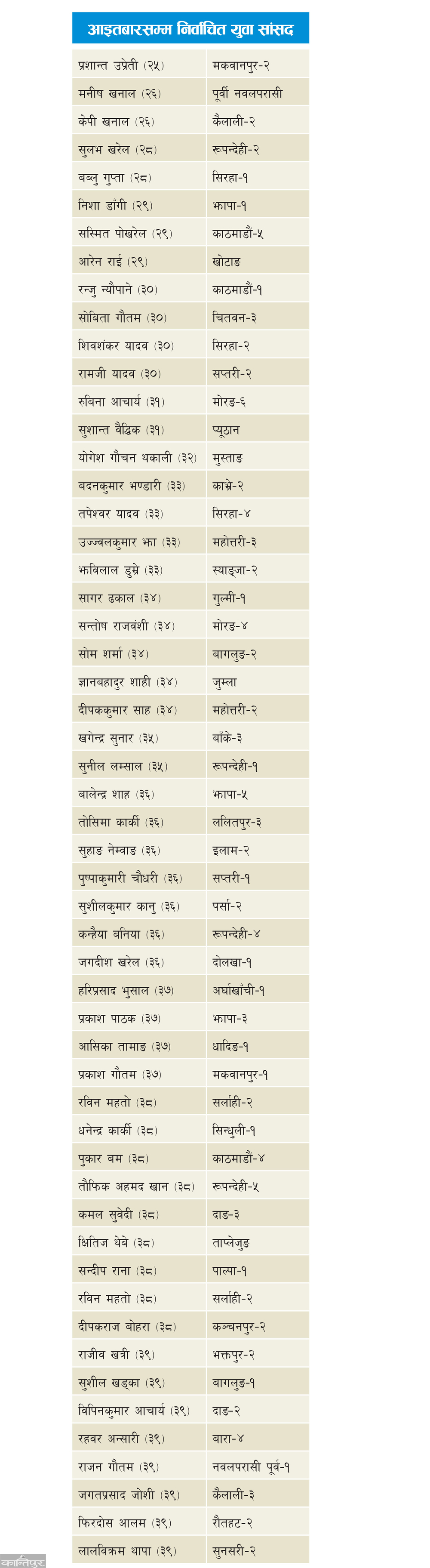
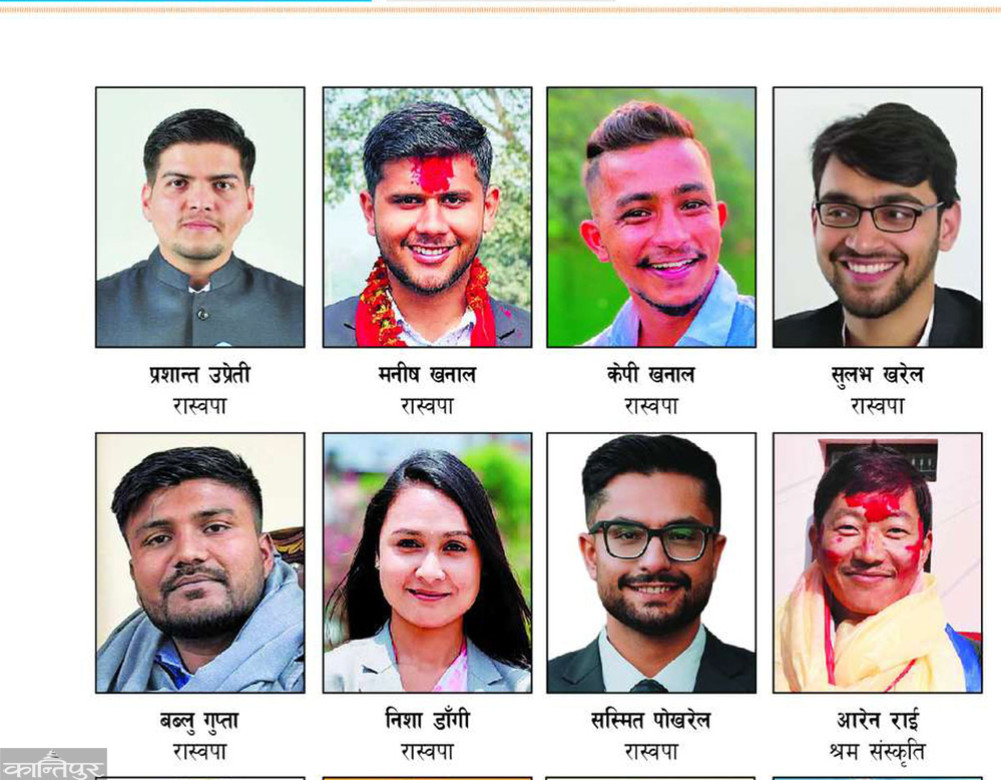
According to the results of the vote as of midnight on Sunday, 59 young candidates under the age of 40 have been directly elected to the House of Representatives, with the Rashtriya Swayamsevak Sangh (RSS) clearly dominating the race, including 51 from the party.
We use Google Cloud Translation Services. Google requires we provide the following disclaimer relating to use of this service:
This service may contain translations powered by Google. Google disclaims all warranties related to the translations, expressed or implied, including any warranties of accuracy, reliability, and any implied warranties of merchantability, fitness for a particular purpose, and noninfringement.
The results of the 159 constituencies declared public till Sunday evening under the House of Representatives elections 2082 have shown a significant change in the age structure of the federal parliament. According to the public results, the presence of the young generation in the House of Representatives has increased significantly.
Youthful enthusiasm alone is not enough, a clear vision, sense of responsibility and honesty are also essential: Naveen Tiwari, political analyst. According to the National Youth Council Act, 2072 and the National Youth Policy, 2072, the age group of 16 to 40 years is considered 'youth'. The share of the 16 to 40 years age group in the total population of Nepal is about 40.35 percent. In the 2079 House of Representatives elections, only 10 people under the age of 40 were elected out of 165 constituencies. At that time, 14 MPs above the age of 70 were elected, while the number of MPs in the age group of 40 to 70 years was the highest (138).
This time's election results seem to have brought a significant change in the age structure of the parliament. So far, according to the public vote results, 59 candidates under the age of 40 have been elected to the House of Representatives. The Rastriya Swatantra Party (RSWP) has a clear dominance in this group. Out of the 59, 51 were elected from the RSWP, while 4 were elected from the Congress, 2 from the UML, and one each from the Rastriya Prajatantra Party (RPP) and the Shram Sanskriti Party.
Youngest MP
According to the results of the vote till midnight on Sunday, 59 young candidates under the age of 40 have been directly elected to the House of Representatives, with 51 of them from the Rashtriya Swayamsevak Sangh (RSS) showing a clear dominance. Prashant Upreti, 25, from Makawanpur-2, has become the youngest member of the House of Representatives this time. The RSWP candidate Upreti defeated Mahesh Kumar Bartaula of the UML by securing 30,050 votes. Upreti, from Manahari Rural Municipality-7, is a tourism entrepreneur. Having studied up to the bachelor's level, he reached the House of Representatives in his first attempt. Similarly, young leaders including 26-year-old Manish Khanal from East Nawalparasi-2, 26-year-old KP Khanal from Kailali-2, 28-year-old Sulabh Kharel from Rupandehi-2, 28-year-old Bablu Gupta from Siraha-1, and 29-year-old Nisha Dangi from Jhapa-1 have also entered the House of Representatives.
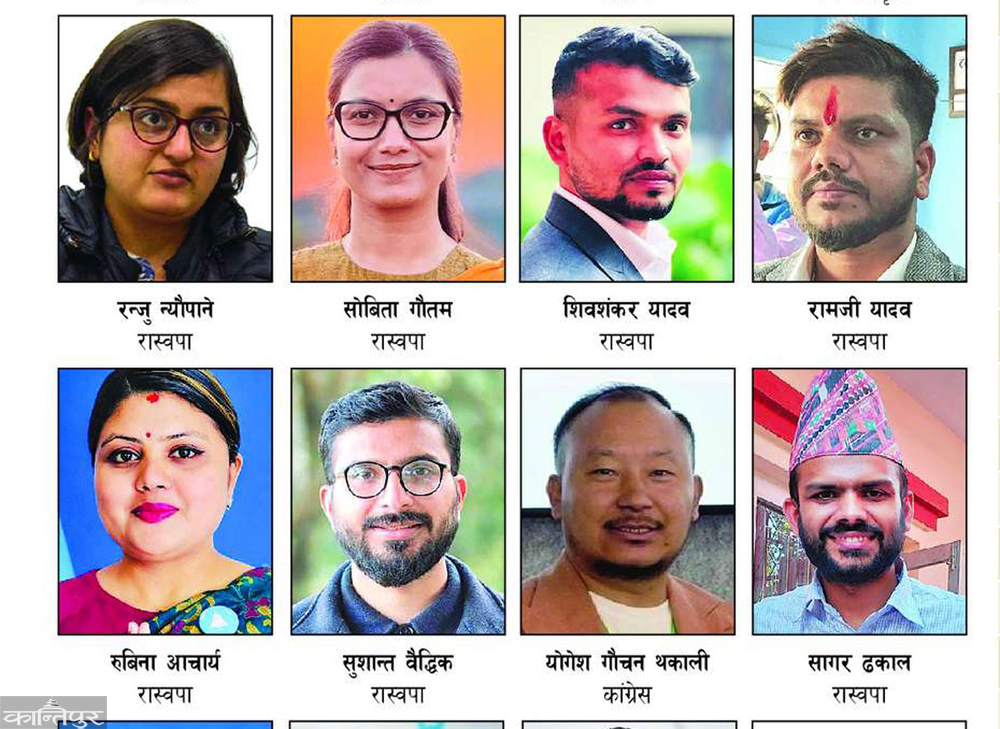
Similarly, 29-year-old Sasmit Pokharel from Kathmandu-5, 30-year-old Ranju Neupane from Kathmandu-1, 30-year-old Shivshankar Yadav from Siraha-2, 30-year-old Sobita Gautam from Chitwan-3, 31-year-old Rubina Acharya from Morang-6, and 31-year-old Sushant Vaidik from Pyuthan-1 are representatives of this age group. Balendra Shah (Balen) of the Rashtriya Swayamsevak Sangh (RSS) who was said to be the prime ministerial candidate before the election also belongs to the youth group. The 36-year-old Shah was elected as an MP from Jhapa-5, defeating UML Chairman KP Sharma Oli.
55 candidates in the age group of 41 to 50 have been elected to the House of Representatives. The RSS has dominated this group too. Out of the 53 candidates, 41 are from the RSS and 5 are from the Nepali Congress. 4 candidates from the NCP, 3 from the UML and 2 from the Shram Sangskriti have won. In this group, 42-year-old Hari Dhakal from Chitwan-1, 45-year-old Manish Jha from Dhanusha-3, 46-year-old Khadkaraj Poudel from Kaski-1, 47-year-old Buddharatna Maharjan from Lalitpur-1 and 48-year-old Dr. Lekhjung Thapa from Rupandehi-3 have been elected. Similarly, 43-year-old Harkaraj Rai (Shram Sanskriti Party) from Sunsari-1, 45-year-old Basna Thapa (Congress) from Dailekh-1 and 46-year-old Mohammad Istiyak Rai (UML) from Banke-2 are also representatives of this group.
36 candidates in the age group of 51 to 60 have been elected to the House of Representatives. In this group, 28 are from the Rashtriya Swayamsevak Sangh (RSS) and 4 are from the Congress. Two candidates each from the CPN (UML) are also from this age group.
Positive change in Nepal's governance system is possible if a balance is struck between experience and new thinking: Sucheta Pyakurel, political analyst. Under this group, 51-year-old Swarnim Wagle from Tanahun-1, 51-year-old Dol Prasad Aryal from Kathmandu-9, 53-year-old Narendra Sah Kalwar from Sarlahi-3 and 53-year-old Bina Gurung from Kaski-3, and 55-year-old Indira Rana Magar from Jhapa-2 have been elected. Similarly, leaders including 58-year-old Bishnu Bahadur Khadka (Congress) from Surkhet-1, 54-year-old Barshaman Pun (NCP) from Rolpa-1 also fall into this age group.
Only 9 people above 60 years of age
Relatively few candidates above 60 years of age have been elected. So far, according to the public results, only 9 people above 60 years of age have reached the House of Representatives. From this group, 62-year-old Prakash Singh Karki (Congress) from Solukhumbu-1, 63-year-old Laxmi Prasad Pokharel (UML) from Dailekh-2, and 68-year-old Bharat Bahadur Khadka (Congress) from Doti-1 have been elected.
Similarly, 63-year-old Bikram Thapa from Kapilvastu-2, 65-year-old Sitaram Sah from Saptari-4, 70-year-old Pushpa Kamal Dahal from Rukum East-1 and 71-year-old Mahabir Pun from Myagdi-1 have also been elected. Overall, the participation of young candidates in the House of Representatives this time seems encouraging. But political analysts say that it cannot be effective if there is no balance of power.
According to political analyst Sucheta Pyakurel, youth participation in Nepal's parliamentary politics is gradually increasing. According to her, youth representation, which was less than 5 percent in 1991, reached 8-10 percent during the Constituent Assembly period and has recently reached about 12 percent.
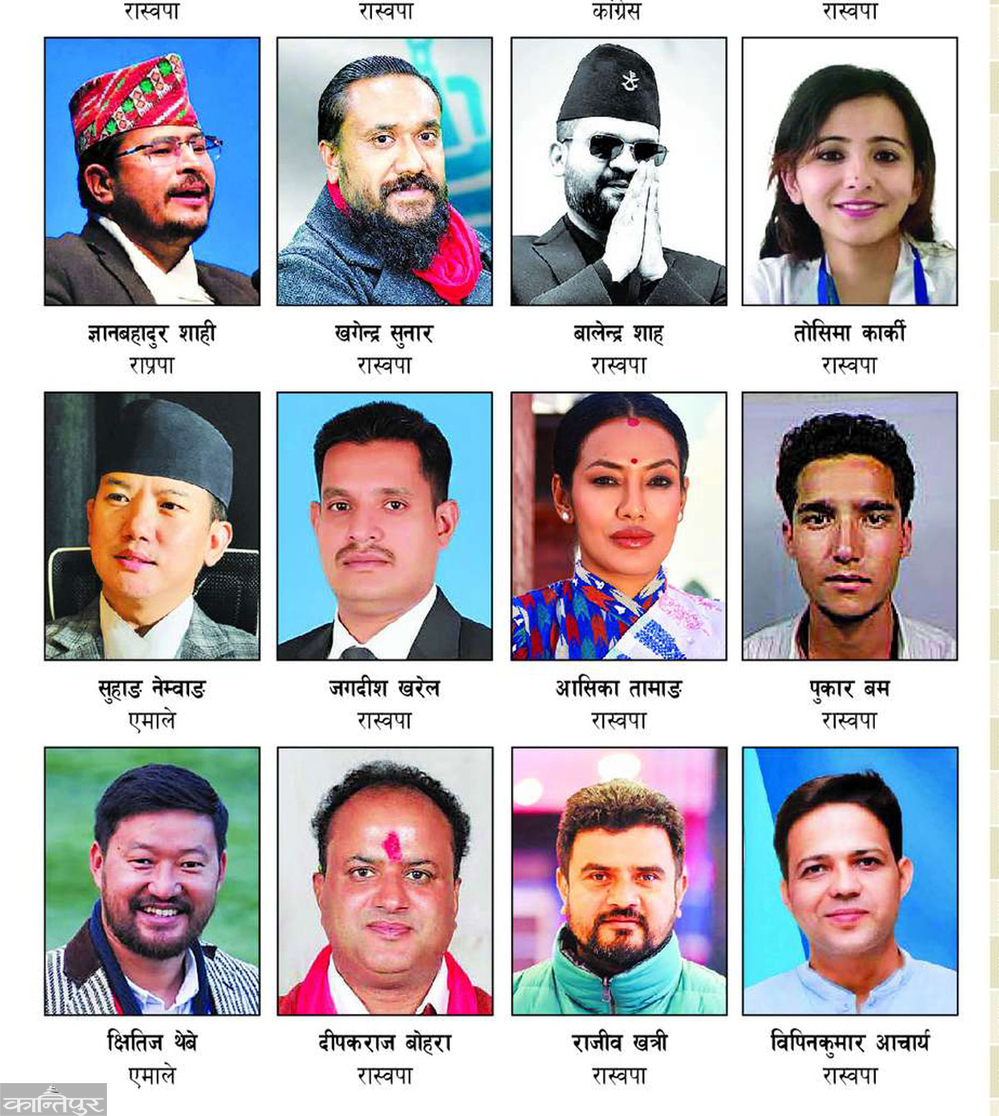
While 4 have been elected from the Congress, 2 from the UML and one each from the RPP and Shram Sanskriti, the youngest member of the House of Representatives so far is Prashant Upreti, 25, of the RPP, elected from Makawanpur-2. She said that with the increase in youth leadership, there are signs of a change in policy priorities in areas such as education, digital governance, climate policy and employment creation. However, she also pointed out the risk of a lack of coordination between youth leadership and the bureaucracy as the administrative structure is still in its old form.
‘Government does not work just by giving popular slogans.’ ‘Populist’ policies without sufficient study can also cause long-term problems,’ said Pyakurel. According to her, there is 70 percent hope and 30 percent skepticism towards the youth leadership. ‘Positive change is possible in Nepal’s governance system if a balance is struck between experience and new thinking,’ she said.
Young political analyst Navin Tiwari, on the other hand, considers the increasing presence of youth in parliament a positive sign, but says that change should not be expected based on age alone. According to her, what is more important than age in politics is the leadership’s intention, honesty and clear vision. ‘The fact that young leaders are elected is a positive aspect in itself, but age is not the only determining factor in politics,’ said Tiwari. ‘What is important is their intention, integrity and vision and what impact it has on society.’
According to Tiwari, just because old leaders misruled in the past cannot be attributed to age alone. ‘The problem was mainly in intention. Change is possible only if there is a clear intention and the will to work,’ he said. Tiwari noted that the trend of gaining popularity on social media has also been seen in politics recently, warning that it could have long-term effects. ‘The trend of showing off on Facebook and influencing people for cheap popularity is also seen among the youth. What will be the long-term impact of that is a matter that needs to be seriously considered,’ he said.
Tiwari also gave an example of how vision and foresight are more important than age for leadership. "Even when Nelson Mandela took over as leader at the age of 76, he worked to unite the country and give it the right direction," he said. "Therefore, youthful enthusiasm alone is not enough for political success; a clear vision, a sense of responsibility, and honesty are essential."